
1 Now before the Feast of the Passover, when Jesus knew that his hour had come to depart out of this world to the Father, having loved his own who were in the world, he loved them to the end.
2 During supper, when the devil had already put it into the heart of Judas Iscariot, Simon’s son, to betray him,
3 Jesus, knowing that the Father had given all things into his hands, and that he had come from God and was going back to God,
4 rose from supper. He laid aside his outer garments, and taking a towel, tied it around his waist.
5 Then he poured water into a basin and began to wash the disciples’ feet and to wipe them with the towel that was wrapped around him.
6 He came to Simon Peter, who said to him, “Lord, do you wash my feet?”
7 Jesus answered him, “What I am doing you do not understand now, but afterward you will understand.”
8 Peter said to him, “You shall never wash my feet.” Jesus answered him, “If I do not wash you, you have no share with me.”
9 Simon Peter said to him, “Lord, not my feet only but also my hands and my head!”
10 Jesus said to him, “The one who has bathed does not need to wash, except for his feet, but is completely clean. And you are clean, but not every one of you.”
11 For he knew who was to betray him; that was why he said, “Not all of you are clean.”
12 When he had washed their feet and put on his outer garments and resumed his place, he said to them, “Do you understand what I have done to you?
13 You call me Teacher and Lord, and you are right, for so I am.
14 If I then, your Lord and Teacher, have washed your feet, you also ought to wash one another’s feet.
15 For I have given you an example, that you also should do just as I have done to you.
16 Truly, truly, I say to you, a servant is not greater than his master, nor is a messenger greater than the one who sent him.
17 If you know these things, blessed are you if you do them.
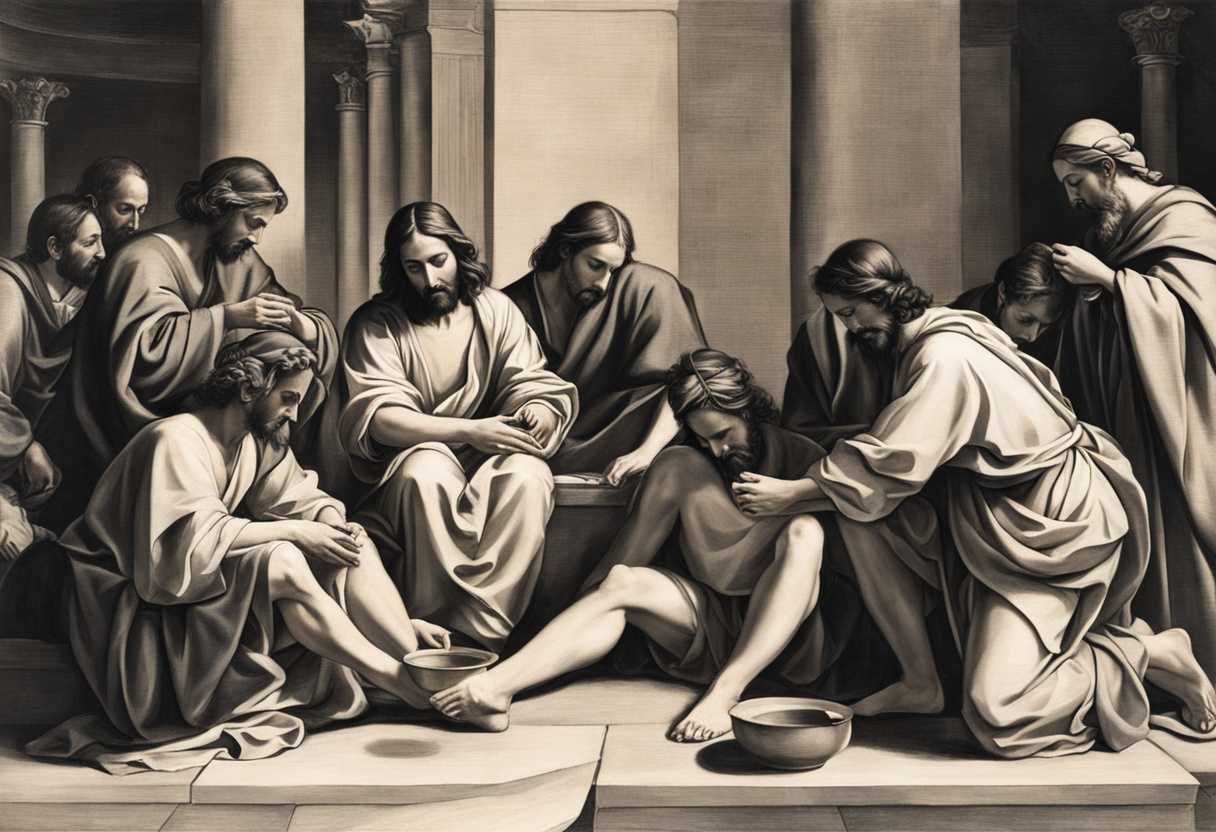
Setting the Scene for John 13:1-17
In John chapter 13, the scene is set in an upper room in Jerusalem during the time of the Passover feast. Jesus and his twelve disciples, including Peter, John, James, and Judas Iscariot, are gathered together for a meal. The room is dimly lit by oil lamps, casting a warm glow over the group as they recline at a low table, cushions supporting their bodies as they eat.
The disciples are curious and expectant, knowing that something significant is about to happen. Jesus, aware of his impending betrayal and crucifixion, rises from the table, removes his outer garment, and wraps a towel around his waist. The disciples watch in confusion as Jesus begins to wash their feet, a task typically reserved for servants. Peter, in his usual impulsive manner, protests at first, but Jesus gently explains the importance of this act of humility and service.
As Jesus moves from one disciple to the next, washing their feet and drying them with the towel, a sense of awe and reverence fills the room. This intimate moment of vulnerability and love sets the stage for Jesus to impart a powerful lesson on servant leadership and the importance of humility in following him.
What is John 13:1-17 about?
Imagine the scene: here is Jesus, the Son of God, kneeling before his disciples and washing their feet. Such a simple act, yet so profound in its message. Jesus is showing us what true leadership looks like in this moment. He is teaching us that greatness is found in humility and service to others. Jesus is demonstrating the importance of putting others before ourselves by washing his disciples’ feet and serving with a humble heart. He is showing us that true power is not in positions of authority or in being served, but in the act of service itself. This act challenges us to reflect on our own lives and consider how we can follow in Jesus’ footsteps by serving others with love and humility.
So, the next time you find yourself in a position of leadership or influence, remember Jesus’ example of washing his disciples’ feet. Ask yourself: How can I humbly serve those around me? How can I set aside my own ego and agenda to uplift and support others? Embrace the call to serve with humility and love, just as Jesus did, and watch how it transforms not only those around you but also yourself.
Understanding what John 13:1-17 really means
Delving into the context first is crucial to understand the profound message of John 13:1-17. This passage recounts a pivotal moment during the Last Supper when Jesus, knowing His time on earth was nearing its end, performed an act of profound humility by washing His disciples’ feet. This act was not just a simple gesture of service but a powerful teaching moment. Let’s break down this passage as we explore it to uncover its deeper meanings and implications.
1. An Act of Humility
The first striking element is Jesus’ decision to wash His disciples’ feet. Foot washing was a task typically reserved for the lowest servants. Jesus demonstrated the essence of true leadership—servant leadership—by performing this act. Jesus said, “If I then, your Lord and Teacher, have washed your feet, you also ought to wash one another’s feet.” Here, Jesus challenges societal norms and flips the conventional hierarchy. He models that greatness in His kingdom is measured by service and humility, not by status or power.
2. A Lesson on Love and Service
Jesus’ actions were also an expression of His love for His disciples. The passage begins with, “Having loved His own who were in the world, He loved them to the end.” This phrase sets the tone for the sacrificial love that Jesus exemplified. It’s a reminder that genuine love manifests itself through service. Just as Jesus served His disciples, we are called to serve one another selflessly. This is echoed in other parts of the Bible, such as in Philippians 2:3-4, where Paul urges us to “do nothing out of selfish ambition or vain conceit. Rather, in humility value others above yourselves.”
3. The Call to Follow His Example
Jesus explicitly tells His disciples to follow His example. “For I have given you an example, that you should do as I have done to you.” This is not just a suggestion but a directive. It calls us to reflect on how we can embody Jesus’ example in our daily lives. Are we willing to serve others without expecting anything in return? Are we prepared to humble ourselves for the sake of others? These are challenging questions that push us to evaluate our actions and attitudes.
4. The Importance of Inner Purity
Peter’s initial refusal to have his feet washed brings about an important dialogue about spiritual cleanliness. Jesus tells Peter, “Unless I wash you, you have no part with me.” This points to the necessity of inner purity and being cleansed by Jesus. It’s a metaphor for the spiritual cleansing that comes through accepting Jesus’ sacrifice. This theme is consistent with 1 John 1:9, which assures us that if we confess our sins, God is faithful and just to forgive us and cleanse us from all unrighteousness.
Relevance to Today
This passage is incredibly relevant today. Jesus’ act of washing His disciples’ feet stands as a counter-cultural statement in a world obsessed with power, status, and self-promotion. It reminds us that true greatness comes from humility and service. A CEO who takes time to understand and assist his employees, or a community leader who prioritizes the needs of the marginalized, should be considered. These actions reflect Jesus’ teachings and have the power to transform communities.
A Personal Anecdote
I recall a time when a member of our congregation, a successful businesswoman, volunteered to clean the church restrooms. When asked why she, of all people, was doing such a task, she replied, “Because Jesus washed feet.” Her humble service spoke volumes more than any sermon could. It was a living example of the principles Jesus taught in this passage.
Conclusion
John 13:1-17 is not just a historical account but a blueprint for Christian living. It calls us to embrace humility, prioritize service, and seek spiritual purity. Let’s strive to integrate these teachings into our lives as we ponder them, remembering that in serving others, we are following the footsteps of Jesus Himself.
How can we humbly serve others like Jesus?
To humbly serve others like Jesus, we can start by being willing to take on tasks that may seem beneath us or outside of our comfort zones. Jesus washed His disciples’ feet as a gesture of humility and servanthood, setting an example for us to follow. We can show true humility and selflessness by looking for opportunities to serve others in ways that may not be glamorous or prestigious.
Another way to serve like Jesus is to have a genuine concern for others’ well-being. Jesus not only washed His disciples’ feet, but He also knew their hearts and their needs. He demonstrated compassion, understanding, and love in His service. We can show that we are serving with a humble and compassionate heart by taking the time to truly listen to others, understand their struggles, and offer support and care.
Finally, we can serve like Jesus by being willing to sacrifice our own comfort, time, and resources for the sake of others. Jesus gave up His own life for the salvation of humanity, the ultimate act of selfless service. While we may not be called to make such a monumental sacrifice, we can still be willing to put the needs of others above our own, to give generously of ourselves, and to serve with a sacrificial attitude.
Application
Imagine the most influential CEO washing the feet of his staff—now, that’s humility. Jesus did exactly that. He showed us that true greatness lies in serving others, not seeking status. Will you step up and serve your family, coworkers, and community, just as He did? Don’t just read the words—live them. How will you make a difference today?

Reverend Michael Johnson is an experienced Church Minister with a profound expertise in spirituality and guidance. With a serene presence and a compassionate heart, he has faithfully served his congregation for over 20 years, leading them on a spiritual journey towards inner peace and enlightenment. Reverend Johnson’s extensive knowledge of religious philosophies and profound understanding of human nature have made him a trusted confidant and mentor to many, as he seamlessly weaves his profound wisdom into life teachings. Reverend Johnson’s calming demeanor and empathetic nature continue to uplift and heal souls, nurturing a sense of unity and tranquility within his community.