
John 13:1-38 is about the demonstration of Jesus washing the disciples’ feet as an act of profound humility and servanthood, emphasizing the importance of serving others selflessly and loving one another as Jesus loved them.
1 Now before the Feast of the Passover, when Jesus knew that his hour had come to depart out of this world to the Father, having loved his own who were in the world, he loved them to the end.
2 During supper, when the devil had already put it into the heart of Judas Iscariot, Simon’s son, to betray him,
3 Jesus, knowing that the Father had given all things into his hands, and that he had come from God and was going back to God,
4 rose from supper. He laid aside his outer garments, and taking a towel, tied it around his waist.
5 Then he poured water into a basin and began to wash the disciples’ feet and to wipe them with the towel that was wrapped around him.
6 He came to Simon Peter, who said to him, “Lord, do you wash my feet?”
7 Jesus answered him, “What I am doing you do not understand now, but afterward you will understand.”
8 Peter said to him, “You shall never wash my feet.” Jesus answered him, “If I do not wash you, you have no share with me.”
9 Simon Peter said to him, “Lord, not my feet only but also my hands and my head!”
10 Jesus said to him, “The one who has bathed does not need to wash, except for his feet, but is completely clean. And you are clean, but not every one of you.”
11 For he knew who was to betray him; that was why he said, “Not all of you are clean.”
12 When he had washed their feet and put on his outer garments and resumed his place, he said to them, “Do you understand what I have done to you?
13 You call me Teacher and Lord, and you are right, for so I am.
14 If I then, your Lord and Teacher, have washed your feet, you also ought to wash one another’s feet.
15 For I have given you an example, that you also should do just as I have done to you.
16 Truly, truly, I say to you, a servant is not greater than his master, nor is a messenger greater than the one who sent him.
17 If you know these things, blessed are you if you do them.
18 I am not speaking of all of you; I know whom I have chosen. But the Scripture will be fulfilled, ‘He who ate my bread has lifted his heel against me.’
19 I am telling you this now, before it takes place, that when it does take place you may believe that I am he.
20 Truly, truly, I say to you, whoever receives the one I send receives me, and whoever receives me receives the one who sent me.
21 After saying these things, Jesus was troubled in his spirit, and testified, “Truly, truly, I say to you, one of you will betray me.”
22 The disciples looked at one another, uncertain of whom he spoke.
23 One of his disciples, whom Jesus loved, was reclining at table at Jesus’ side,
24 So Simon Peter motioned to him to ask Jesus of whom he was speaking.
25 So that disciple, leaning back against Jesus, said to him, “Lord, who is it?”
26 Jesus answered, “It is he to whom I will give this morsel of bread when I have dipped it.” So when he had dipped the morsel, he gave it to Judas, the son of Simon Iscariot.
27 Then after he had taken the morsel, Satan entered into him. Jesus said to him, “What you are going to do, do quickly.”
28 Now no one at the table knew why he said this to him.
29 Some thought that, because Judas had the moneybag, Jesus was telling him, “Buy what we need for the feast,” or that he should give something to the poor.
30 So, after receiving the morsel of bread, he immediately went out. And it was night.
31 When he had gone out, Jesus said, “Now is the Son of Man glorified, and God is glorified in him.
32 If God is glorified in him, God will also glorify him in himself, and glorify him at once.
33 Little children, yet a little while I am with you. You will seek me, and just as I said to the Jews, so now I also say to you, ‘Where I am going you cannot come.’
34 A new commandment I give to you, that you love one another: just as I have loved you, you also are to love one another.
35 By this all people will know that you are my disciples, if you have love for one another.
36 Simon Peter said to him, “Lord, where are you going?” Jesus answered him, “Where I am going you cannot follow me now, but you will follow afterward.”
37 Peter said to him, “Lord, why can I not follow you now? I will lay down my life for you.”
38 Jesus answered, “Will you lay down your life for me? Truly, truly, I say to you, the rooster will not crow till you have denied me three times.
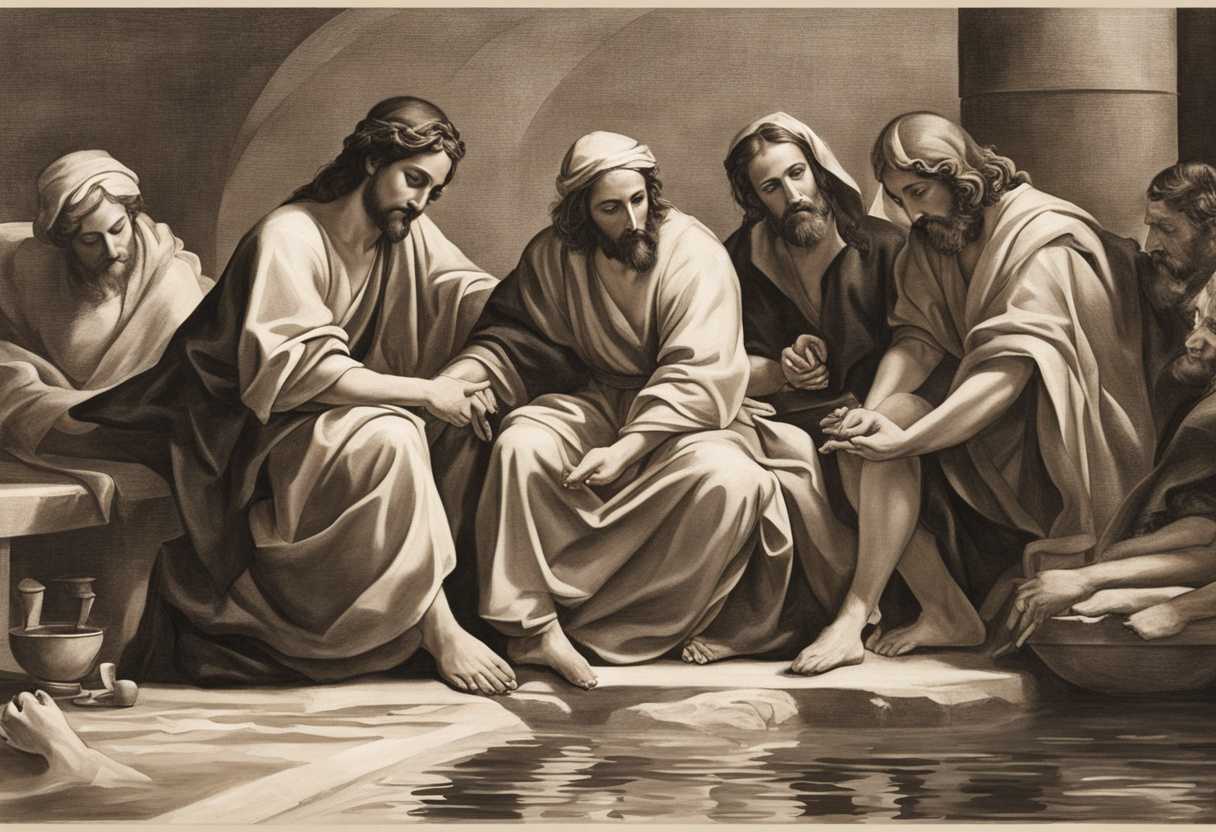
Setting the Scene for John 13:1-38
In John chapter 13, the scene is set in a room in Jerusalem where Jesus and his twelve disciples are gathered for the Passover meal. The room is dimly lit by oil lamps, casting a warm glow on the faces of those present. The air is filled with the scent of freshly baked bread and roasted lamb, typical of a Passover feast.
The disciples, including Peter, James, John, and Judas Iscariot, are reclining at the table, their sandals kicked off and their feet washed from the dusty streets of Jerusalem. Jesus, the central figure in the room, rises from the table, wraps a towel around his waist, and begins to wash the feet of his disciples, a task usually reserved for servants. The disciples watch in astonishment as their teacher and leader humbly performs this act of service.
As Jesus washes their feet, he explains to them the importance of humility and servanthood, teaching them a powerful lesson in love and selflessness. He also foretells his betrayal by Judas and Peter’s denial of him. The atmosphere in the room is heavy with emotion as Jesus shares these profound truths with his closest followers, preparing them for the events that are about to unfold.
What is John 13:1-38 about?
Jesus demonstrates the ultimate act of humility and servanthood by washing His disciples’ feet in this powerful verse. Can you imagine the Son of God, the Messiah, stooping down to perform a task typically reserved for the lowest servant? With this simple yet profound act, Jesus not only sets an example of humbleness but also teaches us the importance of serving others with love and humility. He shows that true leadership is not about power or authority but about selflessly caring for others. Judas betrays Jesus, reminding us of the painful reality of betrayal and how even those closest to us can act against us. Despite knowing that He would be betrayed, Jesus still chooses to love unconditionally. He gives His disciples a new commandment – to love one another as He has loved them. This commandment challenges us to love and serve one another with the same selflessness and compassion that Jesus exemplified. It serves as a reminder that love is not just a feeling but a deliberate choice and action towards others, even in the face of betrayal or difficulties.
Understanding what John 13:1-38 really means
The setting of John 13:1-38 is the Last Supper, where Jesus shares a final meal with His disciples before His crucifixion. This chapter includes Jesus washing the disciples’ feet, predicting His betrayal, and giving a new commandment of love. “Having loved his own who were in the world, he loved them to the end.” This phrase highlights Jesus’ unwavering love for His disciples, even in the face of His impending suffering. It reminds us of the inseparable love of Christ mentioned in Romans 8:38-39.
“He poured water into a basin and began to wash the disciples’ feet.” This act symbolizes profound humility and service, demonstrating servant leadership. It echoes the description in Philippians 2:5-7 of Jesus taking the form of a servant. “A new command I give you: Love one another. As I have loved you, so you must love one another.” This command challenges us to love others selflessly and sacrificially, mirroring Jesus’ love. It aligns with 1 John 4:7-8, emphasizing loving one another as a reflection of God’s love.
In today’s world driven by power and status, Jesus’ act of washing feet teaches the importance of humility and serving others. The timeless command to love one another urges us to practice selfless love in our relationships and communities. Jesus’ prediction of His betrayal and His response to it can offer comfort and guidance to those dealing with betrayal or hurt. Imagine a modern-day scenario where a CEO personally serves and cares for their employees, inspiring loyalty, respect, and a stronger sense of community. Similarly, Jesus’ act of washing His disciples’ feet exemplifies leadership through service and love.
John 13:1-38 calls us to reflect on the depth of Jesus’ love, the importance of humility, and the command to love others. By embodying these principles in our daily lives, we can create a more compassionate and connected world.
How can we humbly serve and love others?
Jesus displays a powerful example of humble service and love towards others through His act of washing His disciples’ feet in John 13:1-38. This act symbolizes putting the needs of others before our own and serving them selflessly. To humbly serve and love others like Jesus did doesn’t just involve grand gestures but also simple acts of kindness, compassion, and selflessness in everyday interactions.
We can follow Jesus’ example by setting aside our pride and ego, being willing to serve others with a humble heart. It may mean stepping out of our comfort zone, sacrificing our time and resources, or simply showing empathy and understanding to those in need. When we approach others from a place of humility and love, we reflect Christ’s teachings and embody the essence of His message. Ultimately, we go beyond our own desires and agendas by humbly serving and loving others. It’s about recognizing the inherent value and dignity of every individual, regardless of their circumstances or background. We emulate the sacrificial love that Jesus demonstrated by extending grace, kindness, and compassion to those around us, making a profound impact on the lives of others and fulfilling the greatest commandment to love our neighbors as ourselves.
Application
Imagine you’ve just clocked out from a grueling workday, yet you still take time to help a colleague get through their toughest project. Picture balancing a busy home life but still finding moments to teach your kids kindness by example. Jesus, like that unseen hero behind the scenes, washed His disciples’ feet to show us real, humble leadership. Can you be that person who lifts others even when it’s least convenient for you? Will you follow His example and let love be your action step today?

Reverend Michael Johnson is an experienced Church Minister with a profound expertise in spirituality and guidance. With a serene presence and a compassionate heart, he has faithfully served his congregation for over 20 years, leading them on a spiritual journey towards inner peace and enlightenment. Reverend Johnson’s extensive knowledge of religious philosophies and profound understanding of human nature have made him a trusted confidant and mentor to many, as he seamlessly weaves his profound wisdom into life teachings. Reverend Johnson’s calming demeanor and empathetic nature continue to uplift and heal souls, nurturing a sense of unity and tranquility within his community.