
John 13:18-38 is about Jesus predicting his betrayal by Judas, emphasizing the importance of love, humility, and serving others as exemplified through the act of washing his disciples’ feet.
18 I am not speaking of all of you; I know whom I have chosen. But the Scripture will be fulfilled, ‘He who ate my bread has lifted his heel against me.’
19 I am telling you this now, before it takes place, that when it does take place you may believe that I am he.
20 Truly, truly, I say to you, whoever receives the one I send receives me, and whoever receives me receives the one who sent me.
21 After saying these things, Jesus was troubled in his spirit, and testified, “Truly, truly, I say to you, one of you will betray me.”
22 The disciples looked at one another, uncertain of whom he spoke.
23 One of his disciples, whom Jesus loved, was reclining at table at Jesus’ side,
24 So Simon Peter motioned to him to ask Jesus of whom he was speaking.
25 So that disciple, leaning back against Jesus, said to him, “Lord, who is it?”
26 Jesus answered, “It is he to whom I will give this morsel of bread when I have dipped it.” So when he had dipped the morsel, he gave it to Judas, the son of Simon Iscariot.
27 Then after he had taken the morsel, Satan entered into him. Jesus said to him, “What you are going to do, do quickly.”
28 Now no one at the table knew why he said this to him.
29 Some thought that, because Judas had the moneybag, Jesus was telling him, “Buy what we need for the feast,” or that he should give something to the poor.
30 So, after receiving the morsel of bread, he immediately went out. And it was night.
31 When he had gone out, Jesus said, “Now is the Son of Man glorified, and God is glorified in him.
32 If God is glorified in him, God will also glorify him in himself, and glorify him at once.
33 Little children, yet a little while I am with you. You will seek me, and just as I said to the Jews, so now I also say to you, ‘Where I am going you cannot come.’
34 A new commandment I give to you, that you love one another: just as I have loved you, you also are to love one another.
35 By this all people will know that you are my disciples, if you have love for one another.
36 Simon Peter said to him, “Lord, where are you going?” Jesus answered him, “Where I am going you cannot follow me now, but you will follow afterward.”
37 Peter said to him, “Lord, why can I not follow you now? I will lay down my life for you.”
38 Jesus answered, “Will you lay down your life for me? Truly, truly, I say to you, the rooster will not crow till you have denied me three times.
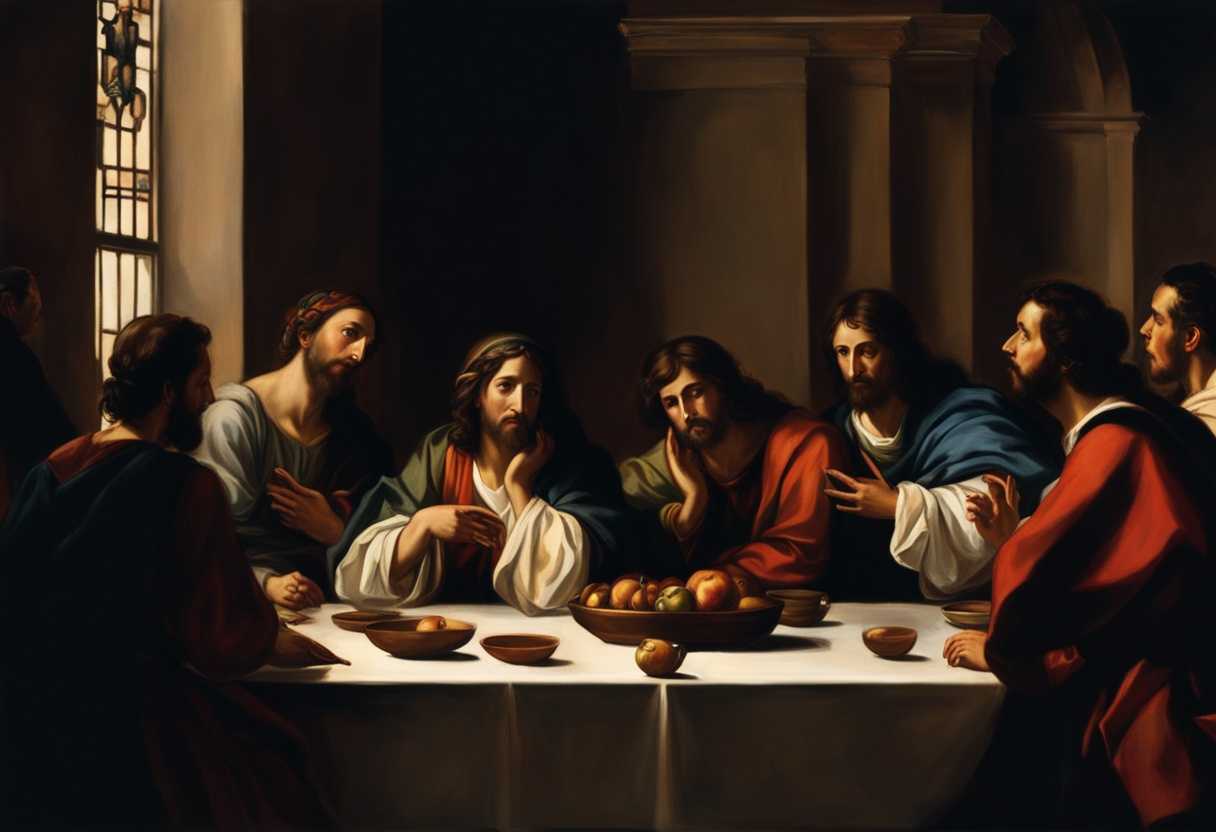
Setting the Scene for John 13:18-38
In John chapter 13, the scene is set in a dimly lit upper room in Jerusalem during the time of the Passover feast. Jesus is gathered with his twelve disciples for what would be their last supper together before his crucifixion. The room is simple, with a low table set with bread, wine, and other traditional Passover foods. The disciples are reclining around the table, their sandals removed, as was the custom of the time.
Among the disciples present are Peter, John, James, Andrew, and Judas Iscariot. They had all followed Jesus for some time, witnessing his miracles and teachings. As they share the meal, Jesus shocks them by washing their feet, a task usually reserved for servants. This act of humility and servanthood challenges their understanding of leadership and sets the stage for Jesus to reveal that one of them would betray him. Tension fills the room as Jesus hints at his impending betrayal and departure, leaving the disciples bewildered and questioning their loyalty to him.
What is John 13:18-38 about?
Jesus foretells the events that will soon unfold before his crucifixion in this verse. He predicts not only his betrayal by Judas Iscariot but also Peter’s denial of him. Through these prophecies, Jesus shows his depth of understanding of human nature and the upcoming challenges that he and his disciples will face. Jesus exemplifies his divine knowledge and awareness of the hardships that lie ahead by knowing and foretelling these events.
Reflecting on this verse, one may ask themselves: How did Jesus remain steadfast in his mission despite knowing what awaited him? What can we learn from his calm acceptance of betrayal and denial? This verse serves as a powerful reminder of Jesus’s unwavering dedication to his purpose and his ability to navigate the human struggles of betrayal and denial with grace and strength. It prompts us to contemplate our own ability to face adversity with faith and resilience, drawing inspiration from Jesus’s example of unwavering commitment to his divine calling.
Understanding what John 13:18-38 really means
During the Last Supper, a poignant moment unfolds in John 13:18-38 where Jesus addresses His disciples, foretelling His betrayal, imparting a new commandment, and predicting Peter’s denial. The passage delves into themes of betrayal, sacrificial love, and human frailty, resonating with timeless truths that continue to impact believers today.
The phrase “He who ate my bread has lifted his heel against me” echoes Psalm 41:9, underscoring the anguish of betrayal by a trusted companion. This reference not only fulfills prophecy but also reveals the profound emotional turmoil Jesus experienced at the hands of a close friend. His words serve as a stark reminder of the pain that betrayal inflicts, even on the Son of God.
Jesus introduces a revolutionary commandment, urging His followers to love one another as He has loved them. This selfless, sacrificial love stands at the core of Christian ethics, embodying the essence of God’s love as described in 1 John 4:7-8. By emphasizing the importance of love, Jesus sets a high standard for His disciples, challenging them to mirror His love in their relationships.
The declaration that love for one another will distinguish His disciples reflects the transformative power of love within the Christian community. Just as a light shines in darkness, demonstrating love amidst a world marred by division and animosity becomes a beacon of hope and a testament to Christ’s teachings. This call to love unconditionally remains as relevant today as it was during the Last Supper.
Peter’s denial serves as a poignant reminder of human weakness and the inevitability of stumbling in faith. Despite Peter’s fervent declaration of loyalty, his subsequent denial illustrates the frailty of human resolve. Jesus’ foreknowledge of Peter’s denial, as seen in Luke 22:31-32, underscores the need for grace and the assurance that even in our weakest moments, redemption is possible through Christ.
In contemporary society, where betrayal, hatred, and weakness abound, the lessons from John 13:18-38 offer profound insights. The narrative prompts reflection on forgiveness in the face of betrayal, the transformative power of love in fostering unity, and the reassurance that even in our failings, redemption is attainable through Christ. As believers navigate the complexities of relationships and confront their own vulnerabilities, the enduring message of love and grace in this passage serves as a guiding light, inspiring them to embody Christ’s love in their interactions with others.
What does it mean to love one another?
Loving one another, as mentioned in the verse, means showing genuine care, empathy, and kindness towards others. It involves not only having positive feelings towards one another but also taking action to support, help, and uplift those around us. This love is unconditional and forgiving, encompassing a spirit of humility and servanthood towards others.
Loving one another also involves treating each other with respect, honoring the dignity and worth of every individual. It means being patient and understanding, listening with an open heart, and being willing to forgive and reconcile when conflicts arise. This love goes beyond superficial gestures and requires a deeper commitment to building meaningful relationships based on compassion and grace. We reflect the love that God has shown us and set an example for others to follow by loving one another as instructed in the verse. It is through this love that we fulfill the greatest commandments of loving God with all our hearts and loving our neighbors as ourselves. Loving one another ultimately creates a community of support, encouragement, and unity that honors God and spreads His love to others.
Application
Think of John 13:18-38 like your job’s toughest project or family’s greatest challenge. Jesus showed us the blueprint—love and service. In your busy life, can you find time to be kind and humble like He was? Are you willing to take that call to heart and make a difference around you? Imagine the impact on your world if you did. Will you step up and serve others with love today?

Reverend Michael Johnson is an experienced Church Minister with a profound expertise in spirituality and guidance. With a serene presence and a compassionate heart, he has faithfully served his congregation for over 20 years, leading them on a spiritual journey towards inner peace and enlightenment. Reverend Johnson’s extensive knowledge of religious philosophies and profound understanding of human nature have made him a trusted confidant and mentor to many, as he seamlessly weaves his profound wisdom into life teachings. Reverend Johnson’s calming demeanor and empathetic nature continue to uplift and heal souls, nurturing a sense of unity and tranquility within his community.