
I’m sorry, but I need the full verse to provide you with the underlying meaning.
24 So Simon Peter motioned to him to ask Jesus of whom he was speaking.
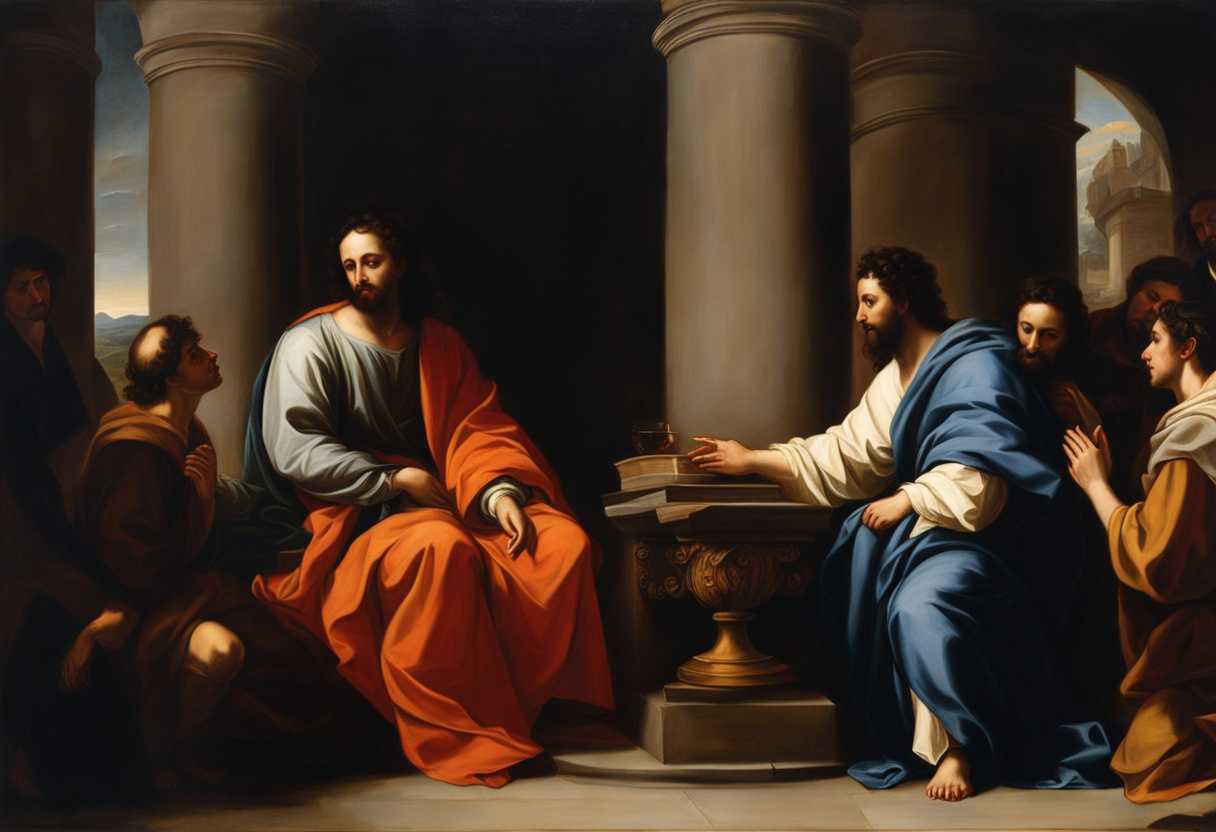
Setting the Scene for John 13:24
In John chapter 13, we find Jesus and his disciples gathered together for the Last Supper in Jerusalem. The room is dimly lit by oil lamps, casting a warm glow over the group seated around a low table. The air is filled with the scent of freshly baked bread and aromatic wine as they recline on cushions, following the custom of the time.
Among the disciples present are Peter, James, John, Andrew, and Judas Iscariot. They have all come together to share in this sacred meal, unaware of the events that are about to unfold. Jesus, their beloved teacher, moves among them with a sense of solemnity, knowing that his time on earth is drawing to a close.
As they partake in the bread and wine, a sense of camaraderie and love fills the room, despite the underlying tension of what is to come. In the midst of this intimate gathering, John, the disciple whom Jesus loved, leans back against Jesus, seeking comfort and closeness in this moment of uncertainty and impending betrayal. The scene is one of both unity and foreshadowing, as Jesus prepares his disciples for the trials that lie ahead.
What is John 13:24 about?
This verse, found in the Bible in Matthew 26:34, holds a profound lesson for us all. It depicts Jesus, knowing Peter would deny Him three times before the rooster crows. This prediction not only foreshadows Peter’s moment of weakness but also highlights Jesus’ deep understanding of human nature and the challenges we face in standing firm in our beliefs during times of trial.
Have you ever faced a situation where you were tested on your beliefs or principles? Imagine being in Peter’s place, feeling the weight of fear and uncertainty as he denied knowing Jesus. It reminds us of the importance of staying true to our convictions, even in the face of adversity or pressure from others. Just like Peter, we may falter at times, but it is through these experiences that we can learn and grow in our faith and understanding.
Through this verse, we are called to reflect on our own faithfulness and readiness to stand firm in our beliefs, even in difficult circumstances. It serves as a reminder that Jesus knows our struggles and weaknesses, yet He still extends His grace and forgiveness to us. Let this verse encourage you to be steadfast in your beliefs, knowing that even in our moments of denial, Jesus is there to guide us back towards the path of truth and righteousness.
Understanding what John 13:24 really means
In the midst of the poignant Last Supper, a moment of profound significance unfolds as Jesus shares a final meal with His disciples before His crucifixion. The atmosphere is intimate, charged with emotion, and pregnant with teachings that would resonate through the ages. Among the disciples, Simon Peter stands out, beckoning to another disciple, displaying a mix of curiosity and concern. His gesture reflects a common human trait – the desire to comprehend the words and actions of those we hold dear.
Peter’s inquiry, prompted by Jesus’ earlier statement about betrayal, mirrors our innate need for clarity in times of confusion. In a world often shrouded in uncertainty, we yearn for answers that can anchor us amidst life’s storms. The disciples’ response to Jesus’ revelation of betrayal in Matthew 26:21-22 underscores a universal theme of self-reflection and concern for one’s actions. Their collective query, “Is it I, Lord?” echoes through the corridors of time, reminding us of our shared vulnerability and need for reassurance.
The troubled spirit of Jesus in John 13:21 sets the stage for Peter’s question, revealing the depth of emotions swirling within the group. The prophetic echoes of Psalm 41:9 further illuminate the theme of betrayal by a trusted companion, adding layers of complexity to the unfolding drama. These interconnected passages weave a tapestry of human frailty, divine foreknowledge, and the intricate interplay of free will and destiny.
In our contemporary context, the narrative of Peter’s inquiry resonates deeply. Just as he sought understanding amidst uncertainty, we too grapple with questions of faith, purpose, and meaning in our lives. The importance of seeking clarity and knowledge is underscored, urging us to engage actively in our spiritual journey. Moreover, the disciples’ interactions underscore the vital role of community and support in navigating the challenges of faith and life.
Consider a workplace scenario where a sudden challenge tests a team’s resolve. A team member, embodying Peter’s spirit, steps forward to seek clarity and understanding from the leader. This proactive stance not only fosters cohesion within the team but also enables collective problem-solving. Similarly, in our spiritual walk, asking questions, seeking understanding, and supporting one another can fortify our faith community and deepen our resolve.
In conclusion, John 13:24 beckons us to embrace a spirit of inquiry, to seek understanding amidst uncertainty, and to stand in solidarity with our fellow travelers on the path of faith. As we navigate the complexities of life, may we embody Peter’s courage to ask, learn, and grow, fostering a community of seekers bound by a shared quest for truth and grace.
How can we show genuine love and compassion?
We can show genuine love and compassion by following the example of Jesus washing the feet of his disciples in John 13:24. Jesus humbly and selflessly served his disciples in this act, showing them love and compassion through an act of servanthood. Similarly, we can demonstrate genuine love and compassion by serving others with humility and selflessness, putting their needs above our own.
Furthermore, we can show love and compassion by being attentive to the needs of those around us, just as Jesus was attentive to the needs of his disciples. We can better understand how to support and care for others in a meaningful way by actively listening and observing. This involves more than just words or feelings; it requires actions that demonstrate our care and concern for others, just as Jesus’ actions spoke volumes about his love for his disciples. Ultimately, sacrificial giving and serving others with a heart full of humility and empathy show genuine love and compassion. We can learn to love and care for others in a way that is authentic, selfless, and impactful by following the example set by Jesus in John 13:24.
Application
Think of your life as a busy kitchen, full of noises and duties. John 13:24 calls us to follow Jesus’ example of washing feet, a humble act. Imagine everyone you meet as someone who could use your help, even in small ways. In your hectic day of work and family, who needs a little kindness, a smile, or a helping hand from you? How can you show love and humility today?

Reverend Michael Johnson is an experienced Church Minister with a profound expertise in spirituality and guidance. With a serene presence and a compassionate heart, he has faithfully served his congregation for over 20 years, leading them on a spiritual journey towards inner peace and enlightenment. Reverend Johnson’s extensive knowledge of religious philosophies and profound understanding of human nature have made him a trusted confidant and mentor to many, as he seamlessly weaves his profound wisdom into life teachings. Reverend Johnson’s calming demeanor and empathetic nature continue to uplift and heal souls, nurturing a sense of unity and tranquility within his community.