
John 18:1-19:42 is about the betrayal, trial, crucifixion, and death of Jesus Christ, emphasizing the sacrifice he made for the salvation of humanity and the fulfillment of the divine plan for redemption.
1 When Jesus had spoken these words, he went out with his disciples across the Kidron Valley, where there was a garden, which he and his disciples entered.
2 Now Judas, who betrayed him, also knew the place, for Jesus often met there with his disciples.
3 So Judas, having procured a band of soldiers and some officers from the chief priests and the Pharisees, went there with lanterns and torches and weapons.
4 Then Jesus, knowing all that would happen to him, came forward and said to them, “Whom do you seek?”
5 They answered him, “Jesus of Nazareth.” Jesus said to them, “I am he.” Judas, who betrayed him, was standing with them.
6 When Jesus said to them, “I am he,” they drew back and fell to the ground.
7 So he asked them again, “Whom do you seek?” And they said, “Jesus of Nazareth.”
8 Jesus answered, “I told you that I am he. So, if you seek me, let these men go.”
9 This was to fulfill the word that he had spoken: “Of those whom you gave me I have lost not one.”
10 Then Simon Peter, having a sword, drew it and struck the high priest’s servant and cut off his right ear. The servant’s name was Malchus.
11 So Jesus said to Peter, “Put your sword into its sheath; shall I not drink the cup that the Father has given me?”
12 So the band of soldiers and their captain and the officers of the Jews arrested Jesus and bound him.
13 First they led him to Annas, for he was the father-in-law of Caiaphas, who was high priest that year.
14 Now it was Caiaphas who had advised the Jews that it would be expedient that one man should die for the people.
15 Simon Peter followed Jesus, and so did another disciple. Since that disciple was known to the high priest, he entered with Jesus into the courtyard of the high priest,
16 but Peter stood outside at the door. So the other disciple, who was known to the high priest, went out and spoke to the servant girl who kept watch at the door, and brought Peter in.
17 The servant girl at the door said to Peter, “You also are not one of this man’s disciples, are you?” He said, “I am not.”
18 Now the servants and officers had made a charcoal fire, because it was cold, and they were standing and warming themselves. Peter also was with them, standing and warming himself.
19 The high priest then questioned Jesus about his disciples and his teaching.
20 Jesus answered him, “I have spoken openly to the world. I have always taught in synagogues and in the temple, where all Jews come together. I have said nothing in secret.
21 Why do you ask me? Ask those who have heard me what I said to them; they know what I said.”
22 When he had said these things, one of the officers standing by struck Jesus with his hand, saying, “Is that how you answer the high priest?”
23 Jesus answered him, “If I have spoken wrongly, bear witness to the wrong; but if I have spoken rightly, why do you strike me?”
24 Annas then sent him bound to Caiaphas the high priest.
25 Now Simon Peter was standing and warming himself. So they said to him, “You also are not one of his disciples, are you?” He denied it and said, “I am not.”
26 One of the servants of the high priest, a relative of the man whose ear Peter had cut off, asked, “Did I not see you in the garden with him?”
27 Peter again denied it, and at once a rooster crowed.
28 Then they led Jesus from the house of Caiaphas to the governor’s headquarters. It was early morning. They themselves did not enter the governor’s headquarters, so that they would not be defiled, but could eat the Passover.
29 So Pilate went outside to them and said, “What accusation do you bring against this man?”
30 They answered him, “If this man were not doing evil, we would not have delivered him over to you.”
31 Pilate said to them, “Take him yourselves and judge him by your own law.” The Jews said to him, “It is not lawful for us to put anyone to death.”
32 This was to fulfill the word that Jesus had spoken to show by what kind of death he was going to die.
33 So Pilate entered his headquarters again and called Jesus and said to him, “Are you the King of the Jews?”
34 Jesus answered, “Do you say this of your own accord, or did others say it to you about me?”
35 Pilate answered, “Am I a Jew? Your own nation and the chief priests have delivered you over to me. What have you done?”
36 Jesus answered, “My kingdom is not of this world. If my kingdom were of this world, my servants would have been fighting, that I might not be delivered over to the Jews. But my kingdom is not from the world.”
37 Then Pilate said to him, “So you are a king?” Jesus answered, “You say that I am a king. For this purpose I was born and for this purpose I have come into the world—to bear witness to the truth. Everyone who is of the truth listens to my voice.”
38 Pilate said to him, “What is truth?”
39 But you have a custom that I should release one man for you at the Passover. So do you want me to release to you the King of the Jews?”
40 They cried out again, “Not this man, but Barabbas!” Now Barabbas was a robber.
1 Then Pilate took Jesus and flogged him.
2 And the soldiers twisted together a crown of thorns and put it on his head and arrayed him in a purple robe.
3 They came up to him, saying, “Hail, King of the Jews!” and struck him with their hands.
4 Pilate went out again and said to them, “See, I am bringing him out to you that you may know that I find no guilt in him.”
5 So Jesus came out, wearing the crown of thorns and the purple robe. Pilate said to them, “Behold the man!”
6 When the chief priests and the officers saw him, they cried out, “Crucify him, crucify him!” Jesus said to them, “Take him yourselves and crucify him, for I find no guilt in him.”
7 The Jews answered him, “We have a law, and according to that law he ought to die because he has made himself the Son of God.”
8 When Pilate heard this statement, he was even more afraid.
9 He entered his headquarters again and said to Jesus, “Where are you from?” But Jesus gave him no answer.
10 So Pilate said to him, “You will not speak to me? Do you not know that I have authority to release you and authority to crucify you?”
11 Jesus answered him, “You would have no authority over me at all unless it had been given you from above. Therefore he who delivered me over to you has the greater sin.”
12 From then on Pilate sought to release him, but the Jews cried out, “If you release this man, you are not Caesar’s friend. Everyone who makes himself a king opposes Caesar.”
19 When Pilate heard these words, he brought Jesus out and sat down on the judgment seat at a place called The Stone Pavement, and in Aramaic Gabbatha.
14 Now it was the day of Preparation of the Passover. It was about the sixth hour. He said to the Jews, “Behold your King!”
15 They cried out, “Away with him, away with him, crucify him!” Pilate said to them, “Shall I crucify your King?” The chief priests answered, “We have no king but Caesar.”
16 So he delivered him over to them to be crucified.
17 and he went out, bearing his own cross, to the place called The Place of a Skull, which in Aramaic is called Golgotha.
18 There they crucified him, and with him two others, one on either side, and Jesus between them.
19 Pilate also wrote an inscription and put it on the cross. It read, “Jesus of Nazareth, the King of the Jews.”
20 Many of the Jews read this inscription, for the place where Jesus was crucified was near the city, and it was written in Aramaic, in Latin, and in Greek.
21 So the chief priests of the Jews said to Pilate, “Do not write, ‘The King of the Jews,’ but rather, ‘This man said, I am King of the Jews.’”
22 Pilate answered, “What I have written I have written.”
23 When the soldiers had crucified Jesus, they took his garments and divided them into four parts, one part for each soldier; also his tunic. But the tunic was seamless, woven in one piece from top to bottom.
24 so they said to one another, “Let us not tear it, but cast lots for it to see whose it shall be.” This was to fulfill the Scripture which says, “They divided my garments among them, and for my clothing they cast lots.” So the soldiers did these things,
25 but standing by the cross of Jesus were his mother and his mother’s sister, Mary the wife of Clopas, and Mary Magdalene.
26 When Jesus saw his mother and the disciple whom he loved standing nearby, he said to his mother, “Woman, behold, your son!”
27 Then he said to the disciple, “Behold, your mother!” And from that hour the disciple took her to his own home.
28 After this, Jesus, knowing that all was now finished, said (to fulfill the Scripture), “I thirst.”
29 A jar full of sour wine stood there, so they put a sponge full of the sour wine on a hyssop branch and held it to his mouth.
30 When Jesus had received the sour wine, he said, “It is finished,” and he bowed his head and gave up his spirit.
31 Since it was the day of Preparation, and so that the bodies would not remain on the cross on the Sabbath (for that Sabbath was a high day), the Jews asked Pilate that their legs might be broken and that they might be taken away.
32 So the soldiers came and broke the legs of the first, and of the other who had been crucified with him.
33 But when they came to Jesus and saw that he was already dead, they did not break his legs.
34 But one of the soldiers pierced his side with a spear, and at once there came out blood and water.
35 He who saw it has borne witness—his testimony is true, and he knows that he is telling the truth—that you also may believe.
36 For these things took place that the Scripture might be fulfilled: “Not one of his bones will be broken.”
37 And again another Scripture says, “They will look on him whom they have pierced.”
38 After these things Joseph of Arimathea, who was a disciple of Jesus, but secretly for fear of the Jews, asked Pilate that he might take away the body of Jesus, and Pilate gave him permission. So he came and took away his body.
39 Nicodemus also, who earlier had come to Jesus by night, came bringing a mixture of myrrh and aloes, about seventy-five pounds in weight.
40 So they took the body of Jesus and bound it in linen cloths with the spices, as is the burial custom of the Jews.
41 Now in the place where he was crucified there was a garden, and in the garden a new tomb in which no one had yet been laid.
42 So because of the Jewish day of Preparation, since the tomb was close at hand, they laid Jesus there.
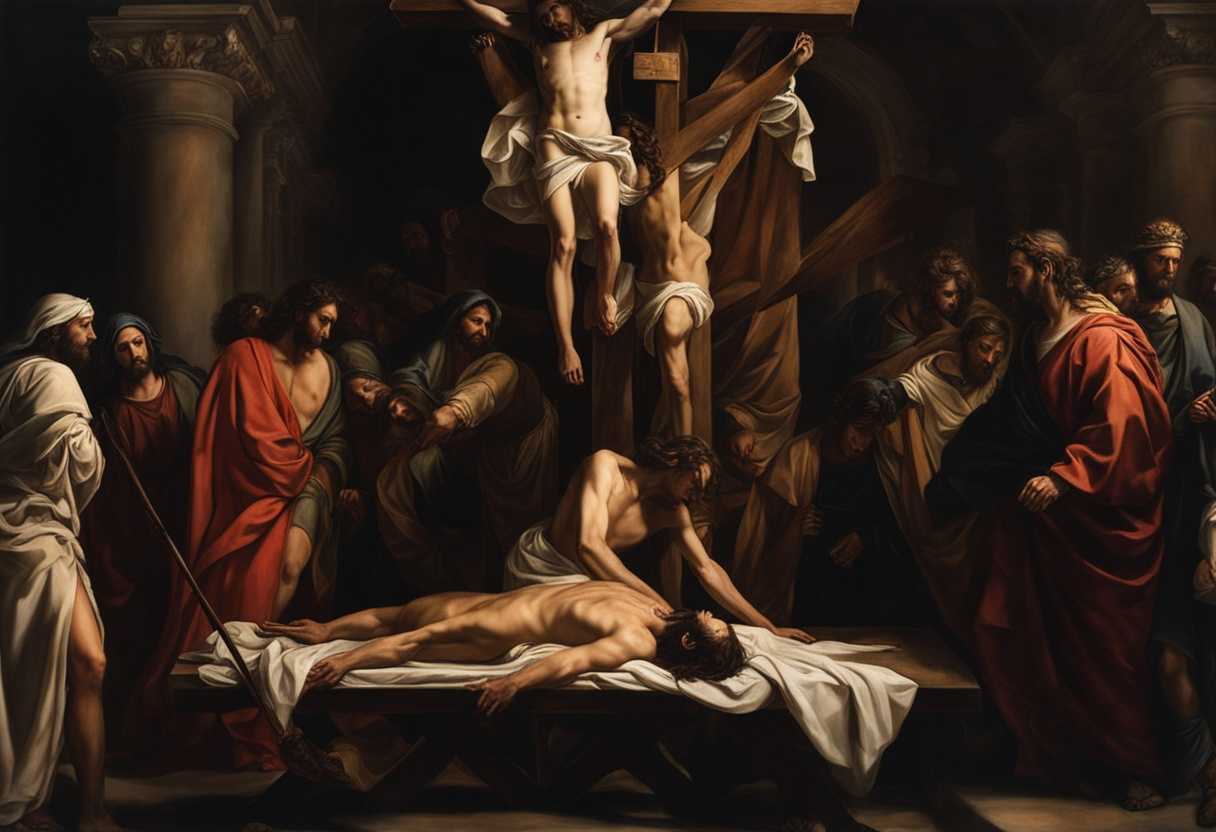
Setting the Scene for John 18:1-19:42
The scene described in John chapters 18-19 takes place in the Garden of Gethsemane, the house of the high priest, and ultimately at Golgotha where Jesus is crucified. The main characters in this scene are Jesus, his disciples, Judas Iscariot, the high priest Caiaphas, Pontius Pilate, and a crowd of people.
The events unfold as Jesus and his disciples, including Judas Iscariot, go to the Garden of Gethsemane to pray. Judas betrays Jesus by leading a group of soldiers and officials to arrest him. Jesus is then taken to the house of the high priest Caiaphas, where he is questioned and condemned to death. The scene shifts to Pontius Pilate’s residence, where Jesus is brought for trial before the Roman governor. Despite Pilate finding no fault in Jesus, he succumbs to the pressure of the crowd and sentences Jesus to be crucified.
The surroundings are tense and charged with emotion as Jesus faces betrayal, arrest, trial, and crucifixion. The Garden of Gethsemane is depicted as a place of prayer and anguish, the house of the high priest is filled with hostility and accusations, and Golgotha is a place of suffering and sacrifice. The scene captures the climax of Jesus’ earthly ministry, highlighting themes of betrayal, injustice, and ultimately redemption through his sacrificial death on the cross.
What is John 18:1-19:42 about?
This verse encapsulates the profound suffering and sacrifice of Jesus Christ, central to the Christian faith. Think about the betrayal of Jesus by one of his closest disciples, the unfair trial where he was condemned despite his innocence, the excruciating crucifixion where he endured immense physical and emotional pain, and finally, his burial as the ultimate sacrifice for humanity’s sins. Each aspect of this verse reveals the depth of love and sacrifice that Jesus willingly underwent for the salvation of all.
Reflect on the magnitude of Jesus’ betrayal by Judas, the denial by Peter, and the abandonment by his disciples during the crucial hour. Jesus highlighted his humility and meekness in the face of severe injustice during the unjust trial where he was falsely accused and condemned. Contemplate the excruciating crucifixion, a brutal form of execution, where Jesus bore the weight of the sins of the world, enduring excruciating suffering and torment with unwavering love and forgiveness. Finally, ponder the solemnity of his burial, marking the completion of his earthly journey and the beginning of his victorious resurrection, fulfilling the divine purpose of redemption and reconciliation with God.
Understanding what John 18:1-19:42 really means
In John 18:1-19:42, we delve into the profound events surrounding the arrest, trial, crucifixion, and burial of Jesus, pivotal moments in Christian faith. These passages encapsulate themes of sacrifice, redemption, and love, central tenets that underpin the Christian belief system. As we journey through these accounts, we witness the unfolding of divine purpose and the ultimate demonstration of God’s love for humanity.
“Jesus went out with his disciples,” a simple yet powerful statement that underscores Jesus’ leadership and the intimate bond He shared with His followers. This highlights the significance of community and fellowship in the Christian walk, reminding us of the importance of walking alongside fellow believers in our spiritual journey. The question, “Whom do you seek?” posed by Jesus to those who came to arrest Him, reveals His unwavering resolve to face His destiny, showcasing His control over the situation and His obedience to God’s plan.
“I am He,” a declaration by Jesus echoing God’s self-identification in Exodus 3:14, “I AM WHO I AM,” emphasizes His divinity and role as the Messiah. His proclamation asserts His identity and mission, solidifying the foundation of Christian faith. When Jesus states, “My kingdom is not of this world,” He redirects our focus to spiritual values over earthly pursuits, urging us to seek eternal treasures rather than fleeting worldly gains. The profound words, “It is finished,” uttered by Jesus on the cross, signify the completion of His redemptive work, fulfilling prophecies and offering salvation to all who believe.
Connecting these events to other biblical passages enriches our understanding of Jesus’ sacrifice and the fulfillment of prophecy. Isaiah 53:5 foretells the suffering of the Messiah, linking Jesus’ ordeal to the prophesied suffering servant. In Matthew 26:39, we witness Jesus’ human struggle and submission to God’s will, mirroring His unwavering resolve in John 18-19. Hebrews 12:2 encourages believers to emulate Jesus’ endurance and faith, fixing their gaze on Him as the pioneer and perfecter of faith.
The relevance of these passages to contemporary life is profound. Jesus’ sacrifice serves as a poignant reminder of God’s boundless love and His redemptive plan for humanity. His example of facing trials with unwavering faith inspires believers to trust in God’s sovereignty amidst their own challenges. By prioritizing spiritual values over material concerns, we align ourselves with Jesus’ teachings, fostering a deeper relationship with God and embracing eternal truths.
Consider the story of an individual who, like Jesus, faced significant trials or sacrifices with unwavering faith. Their journey mirrors Jesus’ experience, illustrating how faith and trust in God can sustain us through adversity and imbue our suffering with purpose. By embracing the transformative power of Jesus’ sacrifice in our lives, we find strength, hope, and a renewed sense of purpose in our own trials.
In conclusion, the events depicted in John 18:1-19:42 invite us to reflect on the profound love and sacrifice of Jesus, urging us to deepen our faith and commitment to living out His teachings. Let us ponder the significance of these passages and strive to embody the principles of sacrifice, redemption, and love exemplified by Jesus, as we walk in His footsteps and share His message of hope with the world.
How can we show unwavering faith under pressure?
To exemplify unwavering faith under pressure, we can draw inspiration from the events described in John 18:1-19:42. During this time, Jesus faced betrayal, arrest, ridicule, torture, and ultimately crucifixion. Despite the immense pressure and suffering, Jesus maintained a steadfast belief in his mission and in God’s plan. He showed unwavering faith by willingly accepting the trials and tribulations that came his way, trusting in God’s greater purpose. We can emulate Jesus’ unwavering faith by staying rooted in our beliefs and trusting in the divine plan, even when circumstances seem dire, in the face of adversity and pressure. We can remember that trials and challenges are a part of life, and by staying connected to our faith, we can find the strength to persevere. We can show unwavering faith under pressure by surrendering to God’s will and remaining steadfast in our trust, knowing that our faith will sustain us through any trial, just as Jesus remained resolute in his faith until the end.
Application
Just as a loving parent or dedicated worker pours their heart into their family or tasks, Christ poured out His love through His ultimate sacrifice. This profound act calls us to live our faith boldly. Step out, share His message of hope, and embody His love in every action. Don’t just be a bystander—be an active messenger of this incredible gift. How will you respond to this call to spread God’s love and share Christ’s sacrifice with those around you?

Reverend Michael Johnson is an experienced Church Minister with a profound expertise in spirituality and guidance. With a serene presence and a compassionate heart, he has faithfully served his congregation for over 20 years, leading them on a spiritual journey towards inner peace and enlightenment. Reverend Johnson’s extensive knowledge of religious philosophies and profound understanding of human nature have made him a trusted confidant and mentor to many, as he seamlessly weaves his profound wisdom into life teachings. Reverend Johnson’s calming demeanor and empathetic nature continue to uplift and heal souls, nurturing a sense of unity and tranquility within his community.