
John 18:12-18 is about Peter’s denial of Jesus three times before the rooster crowed, highlighting the theme of human weakness and the struggle to remain faithful in the face of fear and pressure.
12 So the band of soldiers and their captain and the officers of the Jews arrested Jesus and bound him.
13 First they led him to Annas, for he was the father-in-law of Caiaphas, who was high priest that year.
14 Now it was Caiaphas who had advised the Jews that it would be expedient that one man should die for the people.
15 Simon Peter followed Jesus, and so did another disciple. Since that disciple was known to the high priest, he entered with Jesus into the courtyard of the high priest,
16 but Peter stood outside at the door. So the other disciple, who was known to the high priest, went out and spoke to the servant girl who kept watch at the door, and brought Peter in.
17 The servant girl at the door said to Peter, “You also are not one of this man’s disciples, are you?” He said, “I am not.”
18 Now the servants and officers had made a charcoal fire, because it was cold, and they were standing and warming themselves. Peter also was with them, standing and warming himself.
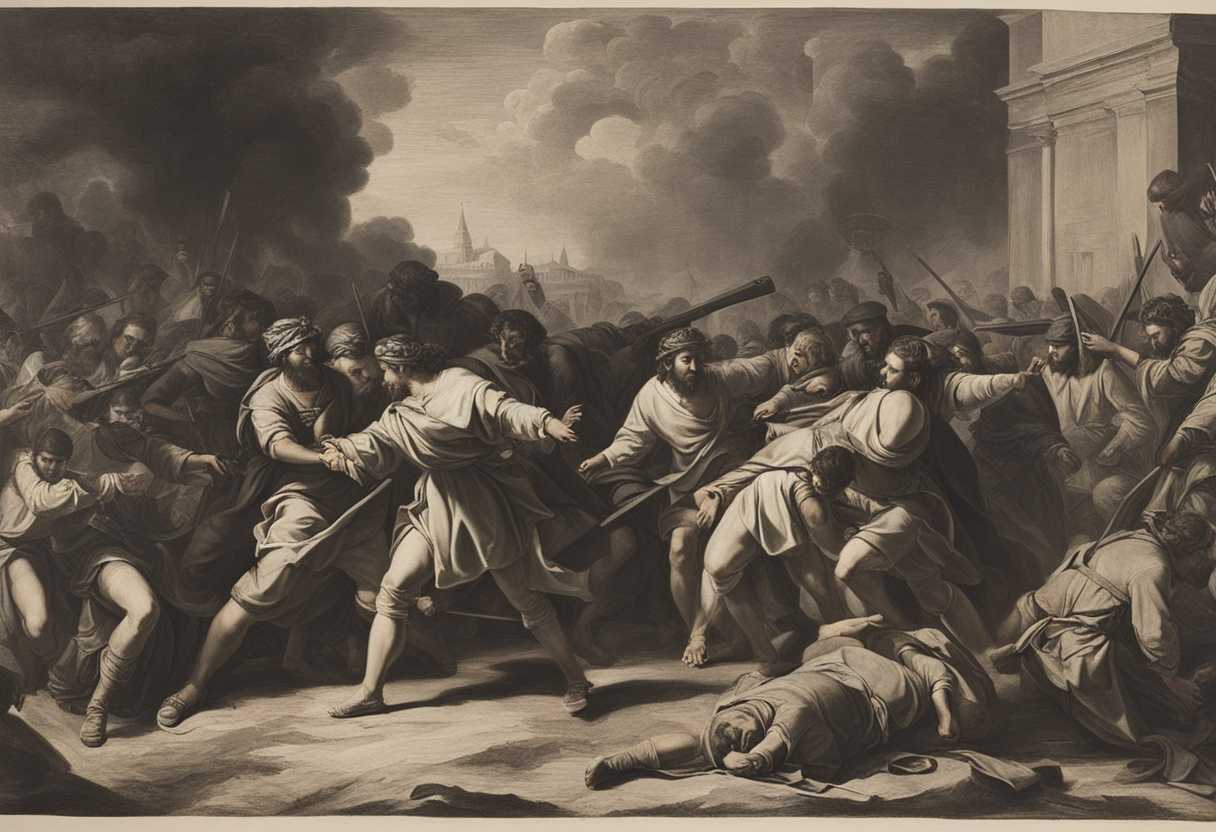
Setting the Scene for John 18:12-18
In John chapter 18, we find Jesus being arrested in the Garden of Gethsemane. The scene is tense and filled with emotion as Judas, accompanied by a detachment of soldiers and officials from the chief priests and Pharisees, approaches Jesus. Judas, one of Jesus’ own disciples, betrays him with a kiss, identifying Jesus as the one they are seeking. The disciples with Jesus are caught off guard and react with confusion and fear as the soldiers move in to arrest their beloved teacher.
Among the disciples present in the garden are Peter, James, and John. Peter, known for his impulsive nature, draws his sword and cuts off the ear of the high priest’s servant in a misguided attempt to defend Jesus. Jesus, however, rebukes Peter and willingly surrenders himself to the soldiers, demonstrating his submission to the Father’s will. The atmosphere is charged with tension and apprehension as Jesus is led away, leaving his disciples scattered and afraid, unsure of what the future holds. The garden is dimly lit by the moonlight, casting shadows on the faces of those present, adding to the somber mood of the moment.
What is John 18:12-18 about?
This verse from the Bible holds deep significance as it showcases a powerful moment in the life of Peter and Jesus. It highlights the human struggle of Peter, a loyal disciple of Jesus, who denies his beloved teacher three times in the face of danger. This event serves as a reminder of the frailty and flaws present in all of us, even those closest to Jesus. It shows us that even the most faithful can falter under pressure and fear.
Reflecting on this verse prompts us to ponder our own actions in times of adversity. It compels us to examine our faith, courage, and loyalty to our beliefs. It challenges us to consider whether we, too, would stand firm in our convictions or waver when faced with hardships or persecution. This verse ultimately serves as a cautionary tale but also a source of hope, demonstrating that even in moments of weakness, there is room for redemption, forgiveness, and growth. So, as we contemplate Peter’s denial of Jesus, let us also reflect on our own responses to challenges and strive to strengthen our faith and resolve in the face of adversity.
Understanding what John 18:12-18 really means
In John 18:12-18, we witness the gripping account of Jesus’ arrest, His confrontation with the authorities, and Peter’s denial. This narrative is a pivotal moment in the Passion story, leading up to the crucifixion of Jesus. To truly grasp the weight of these events, it is essential to delve into the context surrounding Jesus’ arrest and Peter’s actions.
The passage begins with a stark image of Roman soldiers and Jewish officials collaborating to apprehend Jesus, underscoring the widespread rejection He faced. The act of binding Jesus not only physically restrains Him but also symbolically represents the attempt to contain the divine freedom and truth He embodies. As Simon Peter follows Jesus, we see the juxtaposition of loyalty and fear, setting the stage for Peter’s eventual denial. Peter’s choice to stand near the fire, warming himself, serves as a poignant foreshadowing of the danger and temptation he will soon face.
In parallel passages like Matthew 26:69-75, Luke 22:54-62, and Mark 14:66-72, we gain additional insights into Peter’s denial, his remorse, and the fulfillment of Jesus’ prophecies. These accounts deepen our understanding of the emotional turmoil and human frailty displayed in this momentous event. The betrayal and denial depicted in these passages resonate with the struggles many face today, reminding us of our capacity for failure and the hope of redemption.
Peter’s internal conflict between courage and fear mirrors the universal human experience of grappling with difficult choices. His eventual denial serves as a cautionary tale, urging readers to confront their fears and seek forgiveness when they stumble. Despite the chaos and darkness of this narrative, it reassures believers that God’s plan is unfolding, even in the midst of confusion and uncertainty.
Consider a scenario where a young professional compromises their values under pressure, only to later regret their actions and seek reconciliation. This echoes Peter’s denial and subsequent repentance, illustrating that failure is not the end but a stepping stone towards growth and redemption. Ultimately, this passage serves as a poignant reminder of human fallibility and the boundless grace offered through faith, prompting us to reflect on our own moments of weakness and strive for spiritual renewal.
How do we respond when faced with denial?
When faced with denial, we should remember that even those close to Jesus, like Peter, can deny their association with Him. Denial can come from fear, doubt, or a desire to protect oneself. However, just as Jesus knew Peter would deny Him, He also knew Peter’s potential for growth and redemption. Those who deny may eventually find forgiveness, restoration, and a renewed commitment to their beliefs, like Peter did.
It is important to approach denial with understanding and compassion, recognizing that it is a natural response in times of difficulty or uncertainty. We can help those who deny to confront their actions, seek forgiveness, and move towards a deeper connection with their faith by showing empathy and support. Denial in the grand scheme of salvation and grace is not an irreversible condemnation but a moment for introspection, repentance, and spiritual growth.
Application
Think of your faith like a beacon guiding you through the storm. When life’s pressures mount from work and family, will you let your light dim or shine even brighter? Jesus stood firm in His darkest hour—so can you. Will you rise above the chaos and deepen your faith, even when it’s hardest?

Reverend Michael Johnson is an experienced Church Minister with a profound expertise in spirituality and guidance. With a serene presence and a compassionate heart, he has faithfully served his congregation for over 20 years, leading them on a spiritual journey towards inner peace and enlightenment. Reverend Johnson’s extensive knowledge of religious philosophies and profound understanding of human nature have made him a trusted confidant and mentor to many, as he seamlessly weaves his profound wisdom into life teachings. Reverend Johnson’s calming demeanor and empathetic nature continue to uplift and heal souls, nurturing a sense of unity and tranquility within his community.