
John 18:15-27 is about Peter’s denial of Jesus three times before the rooster crowed, illustrating the human tendency to falter in faith and the importance of repentance and forgiveness.
15 Simon Peter followed Jesus, and so did another disciple. Since that disciple was known to the high priest, he entered with Jesus into the courtyard of the high priest,
16 but Peter stood outside at the door. So the other disciple, who was known to the high priest, went out and spoke to the servant girl who kept watch at the door, and brought Peter in.
17 The servant girl at the door said to Peter, “You also are not one of this man’s disciples, are you?” He said, “I am not.”
18 Now the servants and officers had made a charcoal fire, because it was cold, and they were standing and warming themselves. Peter also was with them, standing and warming himself.
19 The high priest then questioned Jesus about his disciples and his teaching.
20 Jesus answered him, “I have spoken openly to the world. I have always taught in synagogues and in the temple, where all Jews come together. I have said nothing in secret.
21 Why do you ask me? Ask those who have heard me what I said to them; they know what I said.”
22 When he had said these things, one of the officers standing by struck Jesus with his hand, saying, “Is that how you answer the high priest?”
23 Jesus answered him, “If I have spoken wrongly, bear witness to the wrong; but if I have spoken rightly, why do you strike me?”
24 Annas then sent him bound to Caiaphas the high priest.
25 Now Simon Peter was standing and warming himself. So they said to him, “You also are not one of his disciples, are you?” He denied it and said, “I am not.”
26 One of the servants of the high priest, a relative of the man whose ear Peter had cut off, asked, “Did I not see you in the garden with him?”
27 Peter again denied it, and at once a rooster crowed.
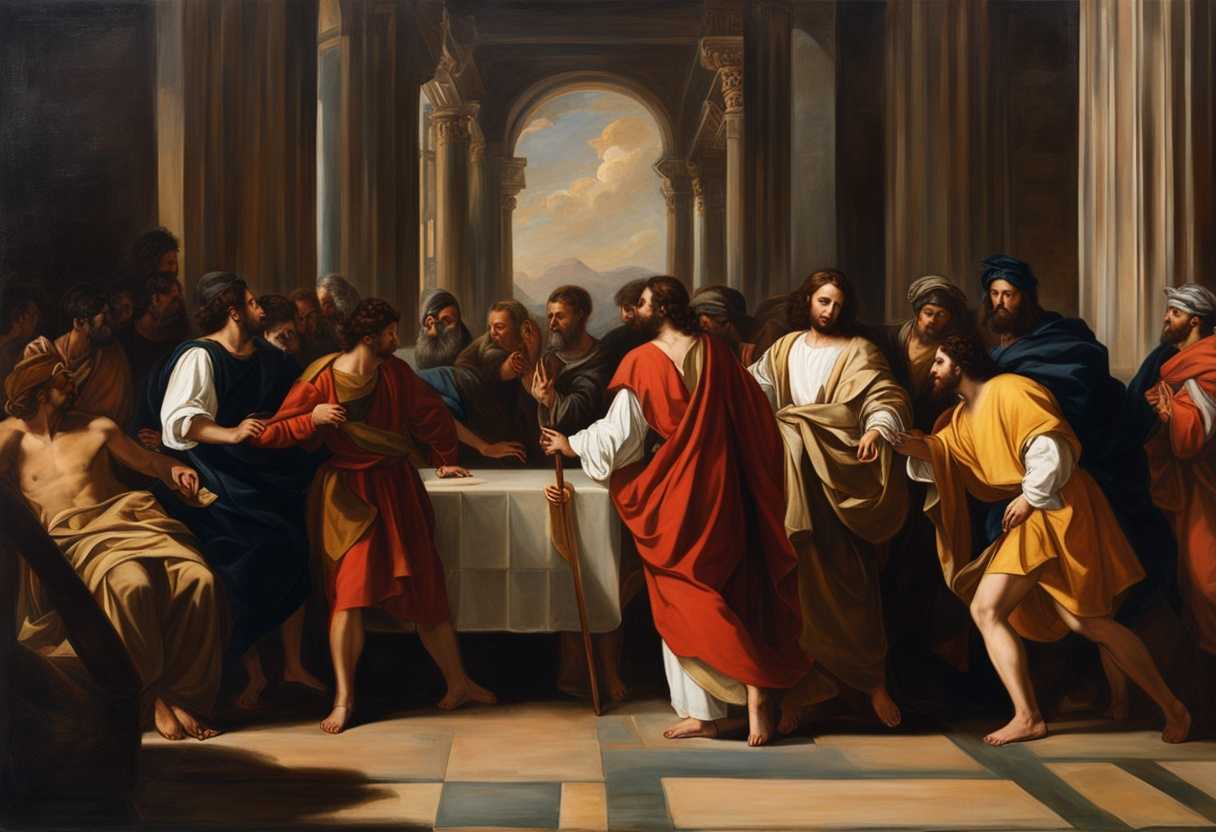
Setting the Scene for John 18:15-27
The scene in John chapter 18:15-27 takes place in the courtyard of the high priest’s house in Jerusalem. After Jesus was arrested in the Garden of Gethsemane, Peter and another disciple followed at a distance to see what would happen to him. The other disciple, who is believed to be John himself, was known to the high priest and was able to enter the courtyard with Jesus, while Peter had to wait outside.
Inside the courtyard, a servant girl recognized Peter as one of Jesus’ disciples and questioned him about it. Peter, fearing for his safety, denied knowing Jesus three times, just as Jesus had predicted. As Peter denied Jesus for the third time, a rooster crowed, fulfilling Jesus’ prophecy that Peter would deny him before the rooster crowed.
The atmosphere in the courtyard would have been tense and filled with a sense of betrayal and impending danger. The flickering torches casting shadows, the murmurs of the crowd, and Peter’s inner turmoil would have all contributed to the dramatic unfolding of events that ultimately led to Peter’s denial of Jesus.
What is John 18:15-27 about?
This verse is a powerful reminder of the fallibility of humans, even in the face of strong faith. Peter, one of Jesus’ closest disciples, denies him three times – a betrayal that must have deeply pained both Peter and Jesus. This moment serves as a cautionary tale about the weaknesses and doubts that can creep into even the most steadfast believers, showing that everyone is susceptible to moments of weakness and fear.
Reflecting on this verse, we are prompted to consider the importance of humility and self-awareness in our faith journey. How do we react when faced with challenges or situations that test our beliefs? Do we stand firm in our convictions, or do we falter under pressure? The story of Peter’s denial teaches us to examine our own hearts and motivations, and to strive for greater faithfulness and courage in our relationship with God. We can learn from Peter’s experience and find strength by acknowledging our vulnerabilities, relying on God’s grace to guide us through moments of doubt and temptation.
Understanding what John 18:15-27 really means
The passage in John 18:15-27 recounts the heartbreaking moment when Peter, one of Jesus’ closest disciples, denies knowing Him three times. This denial takes place in the high priest’s courtyard after Jesus’ arrest, fulfilling the prophecy Jesus made about Peter’s actions. Despite Peter’s earlier declaration of unwavering loyalty, fear and human frailty lead him to disown his beloved teacher and friend.
One key phrase in this narrative is “The other disciple,” likely referring to John, who had a level of access to the courtyard due to his acquaintance with the high priest. This detail highlights the varying degrees of connection and influence among Jesus’ followers. Peter’s repeated response of “I am not” when asked about his association with Jesus underscores the universal struggle of succumbing to fear and denying one’s beliefs, even for the most devoted followers.
The crowing of the rooster marks the moment of realization for Peter, as it signals the fulfillment of Jesus’ prophecy. This event serves as a catalyst for Peter’s deep remorse and regret, leading him to confront the gravity of his actions. The related passages in Matthew, Luke, and Mark further emphasize the profound emotional and spiritual impact of Peter’s denial and subsequent repentance.
In today’s context, Peter’s denial serves as a poignant reminder of human weakness and the possibility of redemption. Just as Peter found forgiveness and restoration despite his failure, individuals today can seek solace in the boundless grace offered through Jesus. The story also speaks to the challenges of maintaining faith under pressure, urging believers to draw strength and courage from their convictions, even in the face of adversity.
Consider a scenario where a devout Christian in a secular workplace denies their faith during a contentious discussion to avoid conflict. The ensuing guilt and remorse echo Peter’s experience, illustrating the universal struggle of standing firm in one’s beliefs amidst challenging circumstances. This anecdote underscores the timeless message of Peter’s denial – that despite moments of faltering, there is always a path to redemption and forgiveness through faith and humility.
In conclusion, Peter’s denial and subsequent repentance serve as a powerful testament to the complexities of faith and the unwavering grace available through Jesus. This narrative encourages believers to acknowledge their vulnerabilities, seek forgiveness when they stumble, and strive to uphold their faith with steadfastness and courage, even in the face of trials.
How can we remain faithful under pressure?
We can remain faithful under pressure by being surrounded by a community of believers who can support and encourage us. We can learn from Peter’s mistake in the passage by surrounding ourselves with fellow believers who can keep us accountable and strengthen our faith during challenging times. Having a community of believers to lean on can help us remain steadfast in our faith even when facing trials and temptations.
Additionally, we can stay faithful under pressure by staying connected to God through prayer and studying His Word. Peter’s faith faltered when he distanced himself from Jesus physically and emotionally, as we see in the passage. We can learn from this by making sure to maintain a strong relationship with God through prayer and continually seeking His guidance in our daily lives. We can find the strength and courage to stand firm in our faith even in the face of adversity by staying connected to God and grounding ourselves in His Word.
Lastly, we can remain faithful under pressure by remembering the promises of God and His faithfulness. Despite Peter’s denial, Jesus had already predicted that Peter would deny Him, showing His foreknowledge and sovereign control over all situations. We can find the courage and assurance to remain faithful even in the midst of trials and persecution by trusting in God’s promises and remembering His faithfulness in the past. Keeping our focus on God’s promises can help us navigate through challenging times with a sense of peace and trust in His ultimate plan for our lives.
Application
Think about how Peter denied Jesus and take a moment to examine your own faithfulness. Have you ever hesitated to stand up for your beliefs, like ignoring a family need for the sake of convenience or letting work stress overshadow your values? This is your chance to recommit to your faith, just as Peter did after his mistake. Will you choose to stand firm and be the rock others can rely on, even when life gets tough?

Reverend Michael Johnson is an experienced Church Minister with a profound expertise in spirituality and guidance. With a serene presence and a compassionate heart, he has faithfully served his congregation for over 20 years, leading them on a spiritual journey towards inner peace and enlightenment. Reverend Johnson’s extensive knowledge of religious philosophies and profound understanding of human nature have made him a trusted confidant and mentor to many, as he seamlessly weaves his profound wisdom into life teachings. Reverend Johnson’s calming demeanor and empathetic nature continue to uplift and heal souls, nurturing a sense of unity and tranquility within his community.