
John 18:28-19:16 is about the trial and crucifixion of Jesus, highlighting the irony of the religious leaders condemning the innocent Son of God while unknowingly fulfilling the prophecy of his sacrificial death for the salvation of humanity.
28 Then they led Jesus from the house of Caiaphas to the governor’s headquarters. It was early morning. They themselves did not enter the governor’s headquarters, so that they would not be defiled, but could eat the Passover.
29 So Pilate went outside to them and said, “What accusation do you bring against this man?”
30 They answered him, “If this man were not doing evil, we would not have delivered him over to you.”
31 Pilate said to them, “Take him yourselves and judge him by your own law.” The Jews said to him, “It is not lawful for us to put anyone to death.”
32 This was to fulfill the word that Jesus had spoken to show by what kind of death he was going to die.
33 So Pilate entered his headquarters again and called Jesus and said to him, “Are you the King of the Jews?”
34 Jesus answered, “Do you say this of your own accord, or did others say it to you about me?”
35 Pilate answered, “Am I a Jew? Your own nation and the chief priests have delivered you over to me. What have you done?”
36 Jesus answered, “My kingdom is not of this world. If my kingdom were of this world, my servants would have been fighting, that I might not be delivered over to the Jews. But my kingdom is not from the world.”
37 Then Pilate said to him, “So you are a king?” Jesus answered, “You say that I am a king. For this purpose I was born and for this purpose I have come into the world—to bear witness to the truth. Everyone who is of the truth listens to my voice.”
38 Pilate said to him, “What is truth?”
39 But you have a custom that I should release one man for you at the Passover. So do you want me to release to you the King of the Jews?”
40 They cried out again, “Not this man, but Barabbas!” Now Barabbas was a robber.
1 Then Pilate took Jesus and flogged him.
2 And the soldiers twisted together a crown of thorns and put it on his head and arrayed him in a purple robe.
3 They came up to him, saying, “Hail, King of the Jews!” and struck him with their hands.
4 Pilate went out again and said to them, “See, I am bringing him out to you that you may know that I find no guilt in him.”
5 So Jesus came out, wearing the crown of thorns and the purple robe. Pilate said to them, “Behold the man!”
6 When the chief priests and the officers saw him, they cried out, “Crucify him, crucify him!” Jesus said to them, “Take him yourselves and crucify him, for I find no guilt in him.”
7 The Jews answered him, “We have a law, and according to that law he ought to die because he has made himself the Son of God.”
8 When Pilate heard this statement, he was even more afraid.
9 He entered his headquarters again and said to Jesus, “Where are you from?” But Jesus gave him no answer.
10 So Pilate said to him, “You will not speak to me? Do you not know that I have authority to release you and authority to crucify you?”
11 Jesus answered him, “You would have no authority over me at all unless it had been given you from above. Therefore he who delivered me over to you has the greater sin.”
12 From then on Pilate sought to release him, but the Jews cried out, “If you release this man, you are not Caesar’s friend. Everyone who makes himself a king opposes Caesar.”
19 When Pilate heard these words, he brought Jesus out and sat down on the judgment seat at a place called The Stone Pavement, and in Aramaic Gabbatha.
14 Now it was the day of Preparation of the Passover. It was about the sixth hour. He said to the Jews, “Behold your King!”
15 They cried out, “Away with him, away with him, crucify him!” Pilate said to them, “Shall I crucify your King?” The chief priests answered, “We have no king but Caesar.”
16 So he delivered him over to them to be crucified.
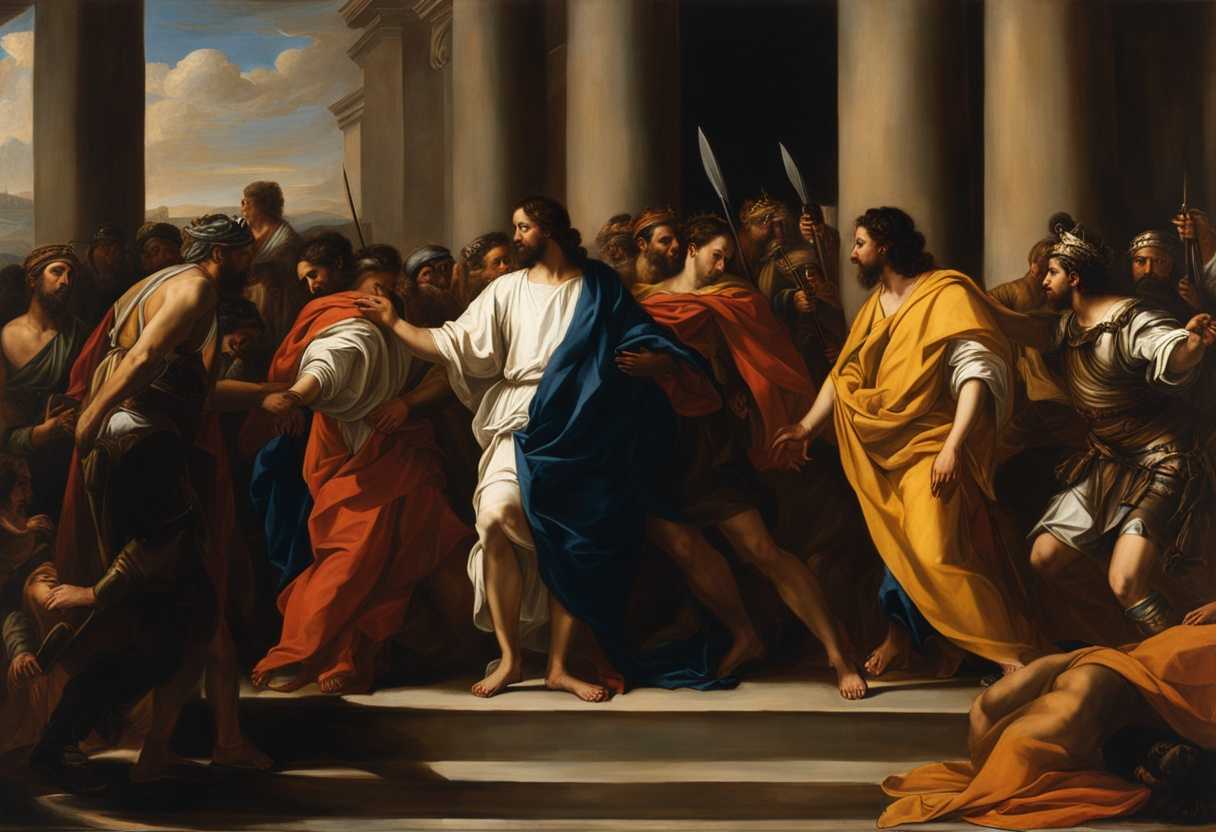
Setting the Scene for John 18:28-19:16
The scene described in John 18:28-19:16 takes place in Jerusalem during the early hours of the morning. The main characters in this scene are Jesus, Pontius Pilate, and a crowd of Jewish religious leaders. Jesus has been arrested by the Jewish authorities and brought before Pilate, the Roman governor of Judea, to face charges of claiming to be the King of the Jews.
Pilate, seated on his judgment seat in the Praetorium, questions Jesus about the accusations brought against him. The Jewish leaders, who refuse to enter the Gentile governor’s residence to avoid ceremonial defilement, stand outside, urging Pilate to condemn Jesus to death. The atmosphere is tense as Pilate struggles with the decision of what to do with Jesus, a man he finds innocent but who is being accused of a crime punishable by death.
The setting is filled with a sense of political intrigue and religious tension as Pilate tries to navigate the demands of the Jewish leaders and his own conscience. The Praetorium is likely bustling with activity as soldiers, officials, and onlookers gather to witness the unfolding drama. The fate of Jesus hangs in the balance as Pilate ultimately succumbs to the pressure and orders his crucifixion, leading to the dramatic events that follow in the crucifixion and death of Jesus.
What is John 18:28-19:16 about?
Pilate finds Jesus innocent but still condemns him to crucifixion, revealing an unfolding injustice in this verse. This highlights the flawed nature of human systems of justice and the power dynamics at play during that time. Despite the lack of guilt, Jesus is subjected to a punishment reserved for the worst criminals, showing the depth of suffering He was willing to endure for the sake of humanity.
Reflecting on this verse, it raises important questions about the nature of innocence, guilt, and justice. How often do we see innocent individuals being unfairly treated or condemned in our world today? How do power dynamics influence decision-making processes, leading to outcomes that may be unjust? The profound sacrifice Jesus made challenges us to critically examine our own beliefs and actions, and to strive for a more just and compassionate society where we protect the innocent and hold the guilty accountable fairly.
Understanding what John 18:28-19:16 really means
The passage from John 18:28-19:16 vividly portrays the pivotal moments leading to Jesus Christ’s crucifixion, centering on His trial before Pontius Pilate. As Jesus stands before Pilate, accused by the Jewish leaders of claiming kingship, we witness a clash between earthly power and divine truth. Pilate, torn between justice and appeasing the crowd, questions Jesus but finds no fault in Him. In a moment of philosophical inquiry, Pilate asks, “What is truth?” revealing the moral and existential confusion of the time, contrasting sharply with Jesus, who embodies absolute truth.
Jesus’ profound statement, “My kingdom is not of this world,” underscores the spiritual nature of His reign, challenging conventional notions of power and authority. Pilate’s declaration, “Behold the man!” highlights Jesus’ innocence and humanity, yet the crowd’s relentless demand for His crucifixion exposes the depths of human depravity and injustice. This narrative echoes the prophetic words of Isaiah 53:3-7, foretelling the suffering servant, a role fulfilled by Jesus in His sacrificial death.
The relevance of this passage extends to contemporary society, prompting us to examine our responses to truth and justice amidst societal pressures. Like Pilate, we face moral dilemmas where standing for truth may clash with worldly interests. The story compels believers to stand firm in their faith, even when misunderstood or opposed, echoing the humility and obedience exemplified by Jesus in Philippians 2:8.
Consider a modern-day parallel where an individual risks personal loss to uphold justice, akin to a whistleblower exposing corporate misconduct despite potential repercussions. This mirrors Jesus’ unwavering commitment to His mission, challenging us to emulate His courage and integrity in our own contexts. The narrative urges us to reflect on the nature of truth, justice, and sacrifice, inviting us to align our lives with the values of Jesus’ kingdom, which transcends earthly powers and ideologies.
In conclusion, the trial of Jesus before Pilate serves as a poignant reminder of the eternal struggle between worldly power and divine truth. By internalizing the lessons from this passage, we can navigate our moral and spiritual challenges with clarity and conviction, striving to embody the principles of Jesus’ kingdom in a world often marred by injustice and moral ambiguity.
How can we remain true to our beliefs under pressure?
To remain true to our beliefs under pressure, we can look to the example of Jesus in the verses you provided. Despite facing intense pressure, false accusations, and relentless questioning, Jesus stayed true to his mission and purpose. He did not compromise his beliefs or his identity, even when faced with the threat of death. We can stay grounded in our beliefs by remembering our core values and principles in moments of pressure or adversity. We can anchor ourselves in what we believe to be right and true, just as Jesus held onto his faith and stayed committed to his purpose. Through prayer, reflection, and support from others who share our beliefs, we can find the strength to stand firm in the face of challenges. Recognizing that we are not alone in our struggles can provide us with courage and inspiration. Jesus endured his trials with grace and fortitude, showing us that it is possible to remain steadfast in our beliefs even in the most difficult circumstances. We can navigate through pressures and challenges while remaining true to what we hold sacred by trusting in our faith, staying connected to our community, and drawing strength from the example of those who have come before us.
Application
Imagine the grit it takes to balance work deadlines and family responsibilities. Now, think about the strength Christ showed as He faced Pilate, knowing what lay ahead. His sacrifice isn’t just a story but a call to action in your life. Are you ready to embrace this courage in living out your faith each day? How will you honor such a profound love and sacrifice?

Reverend Michael Johnson is an experienced Church Minister with a profound expertise in spirituality and guidance. With a serene presence and a compassionate heart, he has faithfully served his congregation for over 20 years, leading them on a spiritual journey towards inner peace and enlightenment. Reverend Johnson’s extensive knowledge of religious philosophies and profound understanding of human nature have made him a trusted confidant and mentor to many, as he seamlessly weaves his profound wisdom into life teachings. Reverend Johnson’s calming demeanor and empathetic nature continue to uplift and heal souls, nurturing a sense of unity and tranquility within his community.