
John 18:33 is about Jesus being questioned by Pilate about the nature of His kingship and revealing that His kingdom is not of this world.
33 So Pilate entered his headquarters again and called Jesus and said to him, “Are you the King of the Jews?”
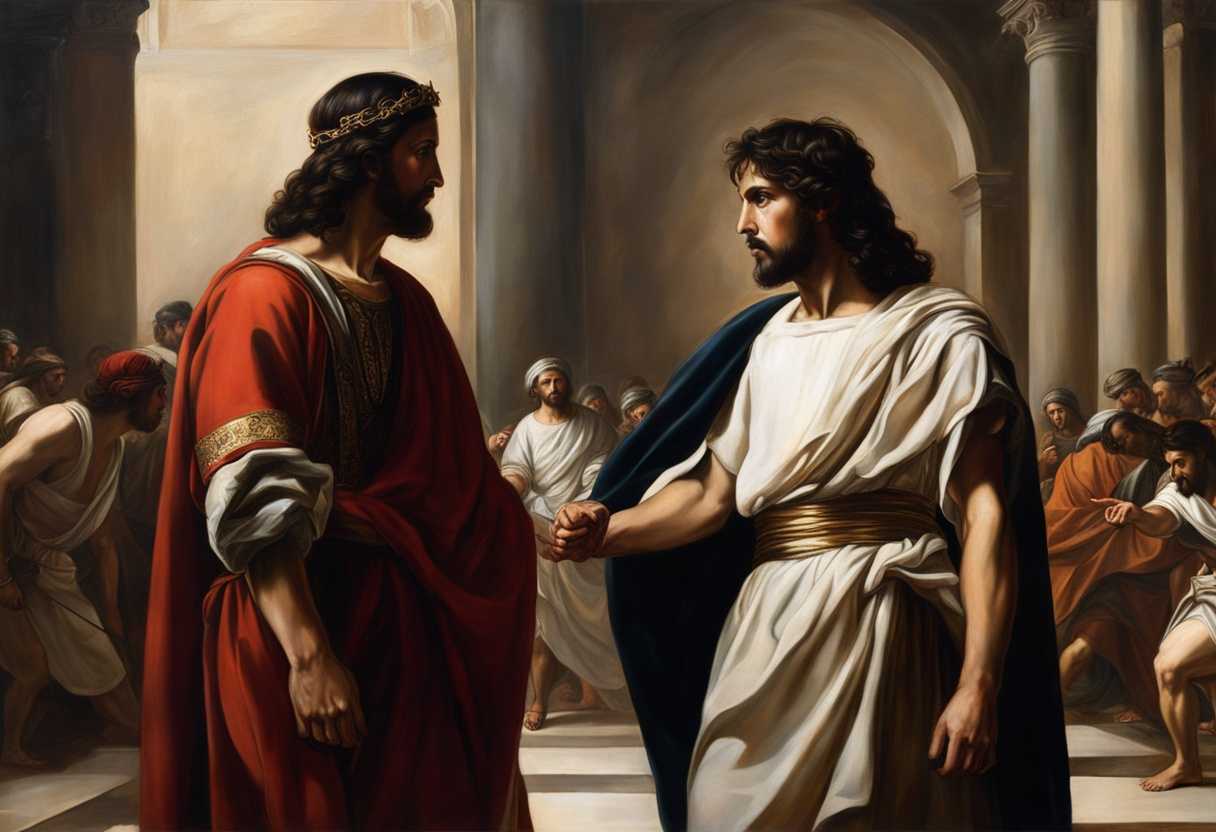
Setting the Scene for John 18:33
In John chapter 18, we find the scene where Jesus is brought before Pontius Pilate, the Roman governor of Judea. The setting is the Praetorium in Jerusalem, a grand and imposing structure that serves as the official residence and administrative headquarters of Pilate. The atmosphere is tense as the Jewish religious leaders, including the chief priests and Pharisees, have brought Jesus to Pilate to be tried for blasphemy and sedition.
Pilate, a powerful and shrewd politician, is seated on a judgment seat, surrounded by his advisors and guards. Jesus, standing before him, is calm and composed, a stark contrast to the agitated crowd outside clamoring for his crucifixion. The religious leaders accuse Jesus of claiming to be the King of the Jews, a charge that could be seen as a challenge to Roman authority.
As the dialogue unfolds between Pilate and Jesus, the themes of power, truth, and the nature of Jesus’ kingdom are brought to the forefront. Pilate, intrigued by Jesus’ enigmatic responses, struggles to understand the man before him. The scene is charged with dramatic tension as Pilate grapples with the decision of what to do with Jesus, a decision that will have far-reaching consequences.
What is John 18:33 about?
Pilate questions Jesus about whether he is the King of the Jews in this verse. This interrogation by Pilate is a significant moment in the trial of Jesus, as it highlights the political tension of the time. Pilate, as the Roman governor, is concerned about any potential threat to Roman authority, especially claims of kingship which could incite rebellion. Pilate is trying to ascertain the true nature of Jesus’ identity and intentions by asking Jesus about being the King of the Jews. We can ponder the deeper meaning behind Pilate’s question as we reflect on this verse. Is he truly seeking to understand Jesus’ role as a king, or is he trying to manipulate the situation for his own political gain? Through this questioning, we see Jesus’ unwavering commitment to his divine mission, even in the face of intense scrutiny and potential danger. His response to Pilate’s question is a powerful reminder of his ultimate kingship, which transcends earthly political systems and asserts a spiritual authority that brings salvation to all who believe in him.
So, as we meditate on this interaction between Pilate and Jesus, we are invited to consider our own response to the claims of Christ. Do we acknowledge him as our true King, the one who reigns over our hearts and lives? May we be inspired by Jesus’ courage and conviction in the face of adversity, and may we reaffirm our allegiance to him as the King of Kings.
Understanding what John 18:33 really means
In the unfolding drama of Jesus’ trial before Pontius Pilate, we are presented with a pivotal moment in the narrative of His earthly ministry. As Pilate re-enters the headquarters, we sense the weight of his authority and the gravity of the situation. The summoning of Jesus underscores the formality and seriousness of the interrogation, setting the stage for a crucial exchange that will reverberate through history.
When Pilate poses the question, “Are you the King of the Jews?” we are confronted with the central issue at hand. This inquiry cuts to the heart of the charges against Jesus and exposes the political undertones of His claim to kingship. In this charged atmosphere, the clash of earthly power and divine authority is palpable, inviting us to ponder the implications of Jesus’ response.
In John 18:36, Jesus clarifies that His kingdom is not of this world, shedding light on the spiritual nature of His kingship. This distinction challenges our conventional understanding of power and sovereignty, urging us to contemplate the transcendent nature of Christ’s reign. The parallel accounts in Matthew 27:11 and the prophecies of Isaiah 9:6-7 further illuminate the significance of Jesus’ claim to kingship and His fulfillment of ancient promises.
Amidst the political intrigue and theological implications, this passage resonates with contemporary relevance. It beckons us to grapple with questions of authority and truth in a world marked by skepticism and uncertainty. As we meditate on Pilate’s interrogation of Jesus, we are compelled to examine our own perceptions of Christ’s kingship and the implications for our lives today.
Consider a modern courtroom scene, where truth hangs in the balance and the search for justice is paramount. In a similar vein, Pilate’s questioning of Jesus transcends mere legal proceedings; it delves into the profound truth of Christ’s identity and mission. Just as individuals today yearn for truth and justice, we are called to explore the deeper reality of Jesus’ kingship and its transformative impact on our lives.
Ultimately, this verse prompts us to reaffirm our faith in Jesus as the true King whose kingdom surpasses earthly powers. It challenges us to navigate our allegiance to a higher authority amidst the complexities of contemporary society. By engaging with the timeless truths encapsulated in this passage, we are invited to deepen our understanding of Jesus’ identity and His eternal kingdom, resonating with relevance for believers today.
What does it mean to be a king?
Being a king means having authority over a kingdom or realm, ruling over subjects with power and leadership. A king is someone who holds a position of supreme authority, making decisions that govern the people under their rule. Kings are seen as symbols of strength, stability, and sovereignty, responsible for ensuring the well-being and prosperity of their kingdom. The question posed to Jesus about whether he is the king of the Jews in John 18:33 prompts reflection on the nature of kingship. Jesus’ response challenges conventional understandings of kingship by emphasizing a kingdom that is not of this world. This suggests a different kind of authority and power that transcends earthly boundaries, focusing on spiritual truths and a different way of ruling that prioritizes love, justice, and righteousness. Thus, being a king in the sense that Jesus describes goes beyond earthly titles and positions, embodying a deeper, more profound form of leadership based on divine principles.
Application
Picture your life as a bustling city with endless responsibilities—family, work, dreams. Who’s in control amidst the chaos? Surrender your plans and goals to Christ, the ultimate King. Let His wisdom guide your decisions, bringing peace and purpose to every action. Will you let Christ lead the city of your life today?

Reverend Michael Johnson is an experienced Church Minister with a profound expertise in spirituality and guidance. With a serene presence and a compassionate heart, he has faithfully served his congregation for over 20 years, leading them on a spiritual journey towards inner peace and enlightenment. Reverend Johnson’s extensive knowledge of religious philosophies and profound understanding of human nature have made him a trusted confidant and mentor to many, as he seamlessly weaves his profound wisdom into life teachings. Reverend Johnson’s calming demeanor and empathetic nature continue to uplift and heal souls, nurturing a sense of unity and tranquility within his community.