
John 18:9-32 is about the unfolding of Jesus’ arrest and trials, highlighting his obedient acceptance of God’s will despite facing betrayal, denial, and interrogation, ultimately leading to his crucifixion as the ultimate sacrifice for humanity’s redemption.
9 This was to fulfill the word that he had spoken: “Of those whom you gave me I have lost not one.”
10 Then Simon Peter, having a sword, drew it and struck the high priest’s servant and cut off his right ear. The servant’s name was Malchus.
11 So Jesus said to Peter, “Put your sword into its sheath; shall I not drink the cup that the Father has given me?”
12 So the band of soldiers and their captain and the officers of the Jews arrested Jesus and bound him.
13 First they led him to Annas, for he was the father-in-law of Caiaphas, who was high priest that year.
14 Now it was Caiaphas who had advised the Jews that it would be expedient that one man should die for the people.
15 Simon Peter followed Jesus, and so did another disciple. Since that disciple was known to the high priest, he entered with Jesus into the courtyard of the high priest,
16 but Peter stood outside at the door. So the other disciple, who was known to the high priest, went out and spoke to the servant girl who kept watch at the door, and brought Peter in.
17 The servant girl at the door said to Peter, “You also are not one of this man’s disciples, are you?” He said, “I am not.”
18 Now the servants and officers had made a charcoal fire, because it was cold, and they were standing and warming themselves. Peter also was with them, standing and warming himself.
19 The high priest then questioned Jesus about his disciples and his teaching.
20 Jesus answered him, “I have spoken openly to the world. I have always taught in synagogues and in the temple, where all Jews come together. I have said nothing in secret.
21 Why do you ask me? Ask those who have heard me what I said to them; they know what I said.”
22 When he had said these things, one of the officers standing by struck Jesus with his hand, saying, “Is that how you answer the high priest?”
23 Jesus answered him, “If I have spoken wrongly, bear witness to the wrong; but if I have spoken rightly, why do you strike me?”
24 Annas then sent him bound to Caiaphas the high priest.
25 Now Simon Peter was standing and warming himself. So they said to him, “You also are not one of his disciples, are you?” He denied it and said, “I am not.”
26 One of the servants of the high priest, a relative of the man whose ear Peter had cut off, asked, “Did I not see you in the garden with him?”
27 Peter again denied it, and at once a rooster crowed.
28 Then they led Jesus from the house of Caiaphas to the governor’s headquarters. It was early morning. They themselves did not enter the governor’s headquarters, so that they would not be defiled, but could eat the Passover.
29 So Pilate went outside to them and said, “What accusation do you bring against this man?”
30 They answered him, “If this man were not doing evil, we would not have delivered him over to you.”
31 Pilate said to them, “Take him yourselves and judge him by your own law.” The Jews said to him, “It is not lawful for us to put anyone to death.”
32 This was to fulfill the word that Jesus had spoken to show by what kind of death he was going to die.
Setting the Scene for John 18:9-32
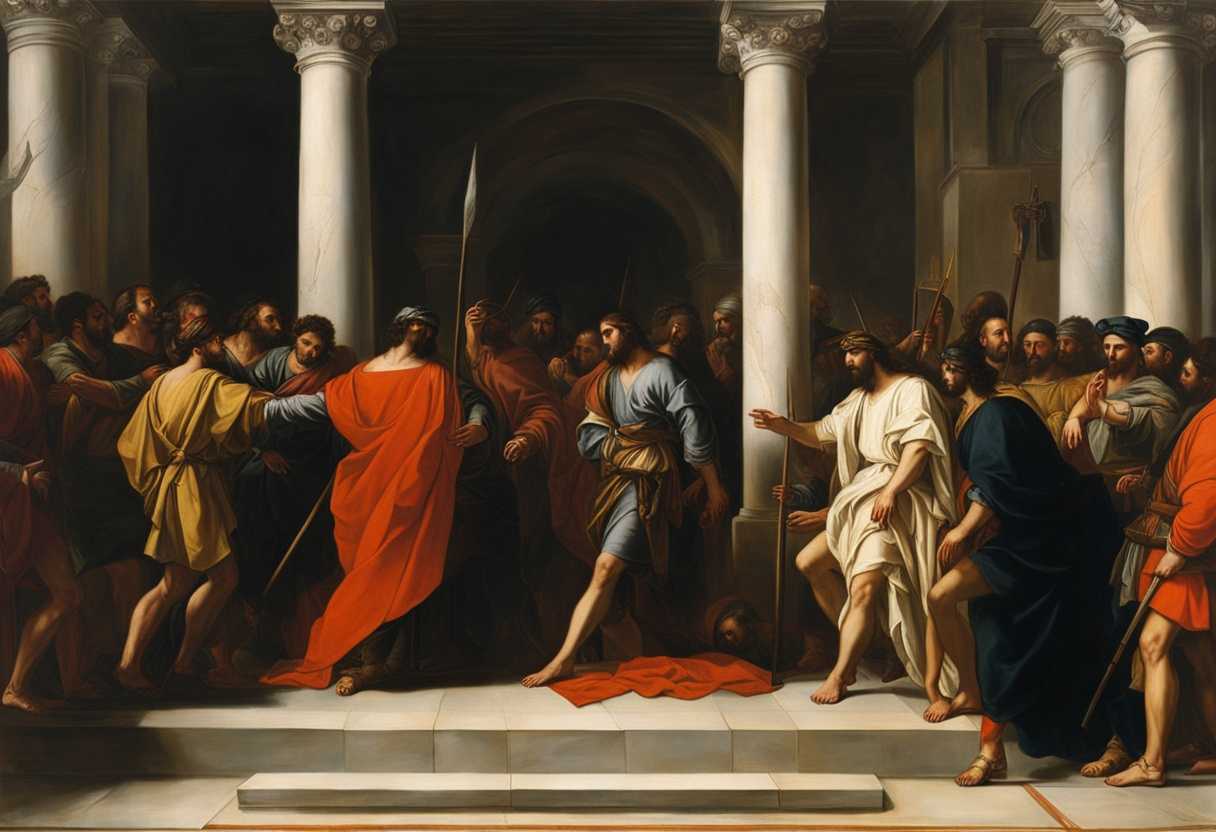
In John chapter 18, we find Jesus in the Garden of Gethsemane with his disciples. The scene is tense as Judas, one of Jesus’ own disciples, arrives with a detachment of soldiers and officials sent by the chief priests and Pharisees. Judas betrays Jesus with a kiss, identifying him as the one they are to arrest. The disciples, including Peter, are alarmed and confused by the sudden turn of events.
The garden is dimly lit by the moonlight, casting eerie shadows among the olive trees. Jesus stands calmly before the soldiers, fully aware of what is about to unfold. Peter, impulsive and protective of his beloved teacher, draws his sword and strikes one of the high priest’s servants, cutting off his ear. Jesus, in a display of his divine power and mercy, heals the man’s ear and admonishes Peter to put away his sword, stating, “Shall I not drink the cup the Father has given me?” The soldiers then seize Jesus and lead him away, while the disciples scatter in fear and confusion, fulfilling the prophecy that the shepherd will be struck and the sheep will be scattered.
What is John 18:9-32 about?
We witness a pivotal moment in the Christian faith in this verse – the arrest, trial, and crucifixion of Jesus Christ. It signifies the ultimate sacrifice made by Jesus to fulfill God’s plan for the salvation of humanity. Jesus willingly goes through immense suffering and ultimately gives up His life on the cross, in order to offer redemption and forgiveness for the sins of all. This act is believed to be an expression of God’s unconditional love and mercy for His creation, demonstrating the depths of His grace and the extent of His commitment to humanity.
Reflect on the significance of this verse. What does it mean for you personally? How does it inspire you to deepen your faith and understanding of God’s plan for salvation? Jesus made an immense sacrifice and endured such suffering because of the profound love that motivated Him. Let this verse serve as a reminder of the power of God’s love and the transformative impact of Jesus’ sacrifice on our lives. Embrace the message of salvation and redemption embedded in this verse, and allow it to guide you in your spiritual journey towards a closer relationship with God.
Understanding what John 18:9-32 really means
In the midst of chaos and betrayal, Jesus’ arrest and trial unfold, marking the fulfillment of His prophecies and the beginning of His journey towards crucifixion. His words, “I am he,” resonate with a profound sense of identity and purpose, showcasing His unwavering resolve to face the challenges ahead. As Jesus acknowledges, “Shall I not drink the cup the Father has given me?” we witness His profound acceptance of suffering as part of God’s divine will, a poignant reminder of His obedience and trust in the Father’s plan.
Moreover, when Jesus declares, “My kingdom is not of this world,” He offers a profound insight into the nature of His kingdom, one that transcends earthly boundaries and political structures. This spiritual kingdom emphasizes eternal values and spiritual growth over fleeting worldly success, inviting us to reevaluate our priorities and focus on what truly matters in the grand scheme of things.
Drawing parallels to Jesus’ unwavering faith and trust in God’s plan, we are reminded of our own call to trust in God’s providence, even in the face of adversity and hardship. Just as Jesus submitted to the Father’s will in Gethsemane, we are challenged to embrace our own crosses with courage and trust, knowing that God’s plan for our lives surpasses our understanding.
Jesus’ courage in the face of false accusations and His unwavering commitment to truth serve as a timeless example of integrity and moral fortitude. In a world where compromise often seems easier than standing firm in our convictions, Jesus’ resolute stance inspires us to uphold truth and righteousness, even when it comes at a cost.
Reflecting on the profound lessons embedded in this passage, we are called to emulate Jesus’ example of courage, integrity, and unwavering faith. Just as Jesus’ kingdom transcends earthly confines, we are encouraged to seek spiritual growth and eternal values, anchoring our lives in the unshakeable foundation of God’s eternal kingdom. Let us heed the call to embrace our faith with courage and integrity, trusting in God’s greater plan, and prioritizing the eternal over the temporal in our pursuit of a life that honors Him.
What is truth?
Truth, in the context of the verse, refers to something that is genuine, reliable, and accurate. It encompasses principles or beliefs that are in alignment with reality and fact. Jesus speaks about being a witness to the truth, indicating his commitment to upholding honesty and righteousness in all circumstances.
The dialogue in the verse highlights the clash between the truth Jesus represents and the deception and falsehoods that his accusers are trying to bring against him. It underscores the importance of standing firm in one’s principles and staying true to what is right and just. Jesus’ steadfastness in the face of adversity exemplifies the unwavering nature of truth, even when faced with opposition or persecution. The verse ultimately serves as a reminder to prioritize truth in all aspects of life, to seek authenticity and integrity in our words and actions. It urges individuals to emulate the unwavering commitment to truth demonstrated by Jesus, even in the midst of adversity or challenges. Embracing truth leads to clarity, wisdom, and liberation from the chains of deceit and falsehood.
Application
Embrace the truth of Christ’s sacrifice and stand strong in your faith, no matter the obstacles. Let your light shine brightly and share the message of love and redemption with all. Will you rise up today and boldly live out your faith, even in the face of adversity?

Reverend Michael Johnson is an experienced Church Minister with a profound expertise in spirituality and guidance. With a serene presence and a compassionate heart, he has faithfully served his congregation for over 20 years, leading them on a spiritual journey towards inner peace and enlightenment. Reverend Johnson’s extensive knowledge of religious philosophies and profound understanding of human nature have made him a trusted confidant and mentor to many, as he seamlessly weaves his profound wisdom into life teachings. Reverend Johnson’s calming demeanor and empathetic nature continue to uplift and heal souls, nurturing a sense of unity and tranquility within his community.