
John 19:1-16 is about the trial and crucifixion of Jesus Christ, showcasing the contrast between the worldly power of Pilate and the divine sovereignty of Jesus as the King of the Jews.
1 Then Pilate took Jesus and flogged him.
2 And the soldiers twisted together a crown of thorns and put it on his head and arrayed him in a purple robe.
3 They came up to him, saying, “Hail, King of the Jews!” and struck him with their hands.
4 Pilate went out again and said to them, “See, I am bringing him out to you that you may know that I find no guilt in him.”
5 So Jesus came out, wearing the crown of thorns and the purple robe. Pilate said to them, “Behold the man!”
6 When the chief priests and the officers saw him, they cried out, “Crucify him, crucify him!” Jesus said to them, “Take him yourselves and crucify him, for I find no guilt in him.”
7 The Jews answered him, “We have a law, and according to that law he ought to die because he has made himself the Son of God.”
8 When Pilate heard this statement, he was even more afraid.
9 He entered his headquarters again and said to Jesus, “Where are you from?” But Jesus gave him no answer.
10 So Pilate said to him, “You will not speak to me? Do you not know that I have authority to release you and authority to crucify you?”
11 Jesus answered him, “You would have no authority over me at all unless it had been given you from above. Therefore he who delivered me over to you has the greater sin.”
12 From then on Pilate sought to release him, but the Jews cried out, “If you release this man, you are not Caesar’s friend. Everyone who makes himself a king opposes Caesar.”
19 When Pilate heard these words, he brought Jesus out and sat down on the judgment seat at a place called The Stone Pavement, and in Aramaic Gabbatha.
14 Now it was the day of Preparation of the Passover. It was about the sixth hour. He said to the Jews, “Behold your King!”
15 They cried out, “Away with him, away with him, crucify him!” Pilate said to them, “Shall I crucify your King?” The chief priests answered, “We have no king but Caesar.”
16 So he delivered him over to them to be crucified.
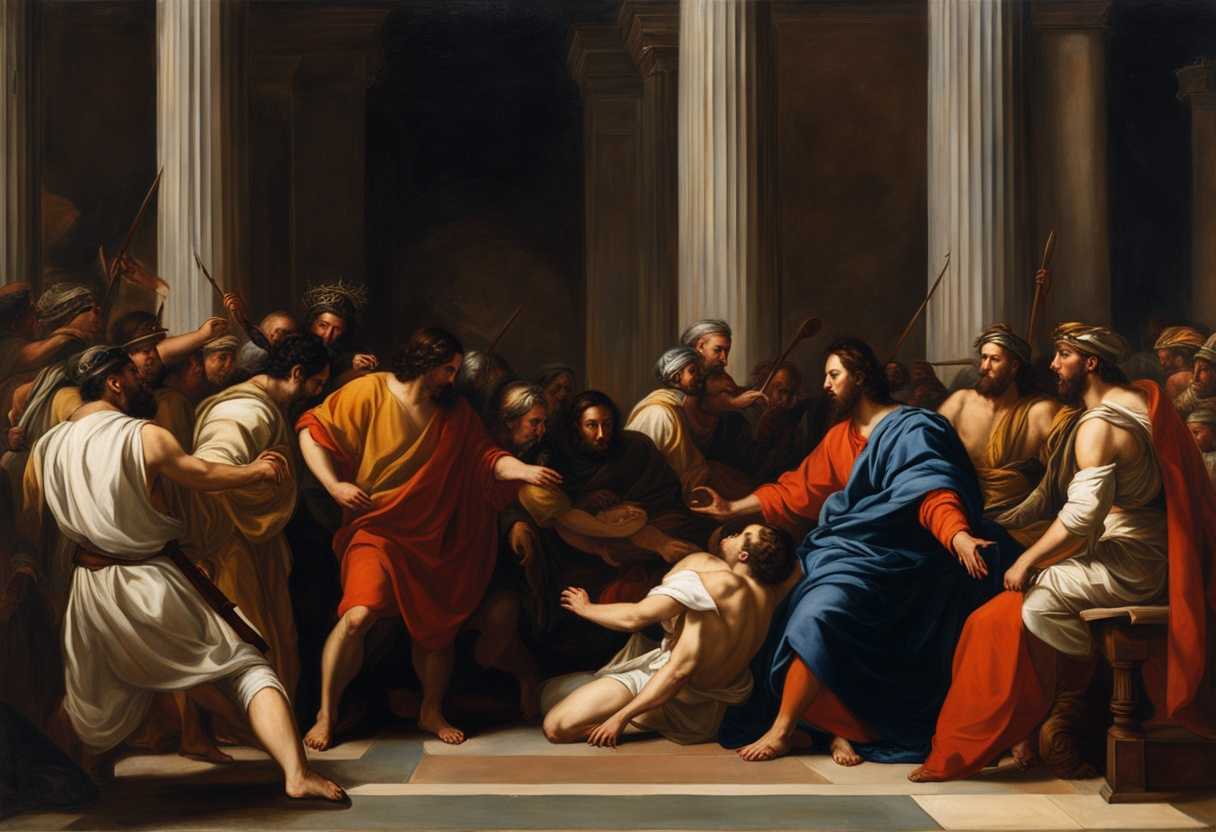
Setting the Scene for John 19:1-16
The scene described in John 19:1-16 takes place in Jerusalem during the time of Jesus’ crucifixion. The main characters in this scene are Jesus, Pontius Pilate, and a crowd of Jewish religious leaders and people. Jesus has been brought before Pilate, the Roman governor, by the religious leaders who are seeking his death. The atmosphere is tense and charged with emotion as the crowd demands that Pilate condemn Jesus to death.
Pilate, seated on his judgment seat, questions Jesus about the accusations brought against him. Jesus stands before Pilate, calm and composed, answering his questions with wisdom and authority. The crowd outside grows more agitated, calling for Jesus to be crucified. Pilate, torn between his desire to release Jesus and the pressure from the crowd, ultimately gives in to their demands and sentences Jesus to be crucified. The scene is filled with a sense of injustice and betrayal as Jesus, an innocent man, is condemned to die on the cross.
The setting is likely in a courtyard or open area within the Roman governor’s residence in Jerusalem. The crowd is made up of a mix of Jewish religious leaders, Roman soldiers, and ordinary people who have gathered to witness the events unfolding. The tension in the air is palpable as the fate of Jesus hangs in the balance, with Pilate ultimately succumbing to the will of the crowd and ordering Jesus to be led away to be crucified.
What is John 19:1-16 about?
Pilate unjustly condemns Jesus and ultimately hands him over to be crucified in this powerful verse, showcasing one of the most crucial moments in the Christian faith. This event symbolizes the immense suffering, sacrifice, and love that Jesus endured for humanity. It exemplifies the selflessness and obedience of Jesus to fulfill his ultimate purpose of salvation for all.
Contemplate the profound agony and pain that Jesus must have felt during this moment in time. Think about the staggering unfairness of his condemnation and how he willingly accepted this fate for the greater good. This verse serves as a reminder of the immense love that Jesus has for each and every one of us, as well as the importance of forgiveness and redemption in the face of adversity. Let this verse inspire you to reflect on the sacrifices made for your salvation and to live a life that honors the teachings and example of Jesus.
Understanding what John 19:1-16 really means
In John 19:1-16, we delve into the poignant narrative of Jesus’ trial before Pilate, a pivotal moment leading to His crucifixion. This passage encapsulates the profound suffering and sacrificial love of Jesus, central to the Christian faith. As we unpack the key phrases within this text, we encounter the brutal flogging of Jesus, symbolizing the physical torment He endured for humanity’s redemption. The twisted crown of thorns placed on His head not only mocks His kingship but also signifies the excruciating pain He bore for our sins. When Pilate presents Jesus to the crowd, declaring, “Here is the man!” he underscores Jesus’ humanity and the unjust treatment He faced.
The rejection of Jesus as King in favor of Caesar by the Jewish leaders echoes spiritual blindness, a stark irony that prompts reflection on our own allegiances. Isaiah 53:5’s prophecy of the Messiah’s suffering finds fulfillment in Jesus’ trial and crucifixion, emphasizing the divine plan unfolding through His sacrifice. In Matthew 27:24, Pilate’s symbolic act of washing his hands reveals the complexity of human guilt and the struggle for justice in the face of moral dilemmas. This narrative resonates with contemporary relevance, urging us to confront injustice, emulate Jesus’ selfless sacrifice, and examine our spiritual sight.
Consider a modern-day scenario where an innocent person faces wrongful accusations, evoking a visceral response for justice. Similarly, Jesus’ unjust trial should ignite a passion for righteousness and compassion within us. Reflect on individuals who bravely stood for truth despite adversity, mirroring Jesus’ unwavering commitment to His mission. As we contemplate Jesus’ trial, let us be inspired to champion justice, embody compassion, and uphold unwavering faith in our daily lives. May this reflection lead us to emulate Jesus’ sacrificial love and commitment to truth, fostering a world marked by justice, compassion, and unwavering faith. Let us pray for strength to endure trials, wisdom to discern truth, and courage to stand for righteousness in a world often plagued by injustice.
How can we respond to injustice with love?
One way to respond to injustice with love is to embody the message of forgiveness and compassion. Instead of succumbing to anger or seeking revenge, we can choose to offer understanding and grace to those who have wronged us. We bring healing to ourselves and have the potential to spark transformation in others by extending love in the face of injustice.
Another way to respond to injustice with love is by standing up for what is right in a peaceful and non-violent manner. We can advocate for justice, equality, and human rights with a spirit of kindness and empathy, seeking to create positive change without perpetuating harm. We can inspire others to join us in building a more just and compassionate world by approaching injustice with love. Actively working towards reconciliation and restoration involves responding to injustice with love. This may entail engaging in dialogue, listening with an open heart, and making efforts to bridge divides and mend relationships. We can sow the seeds of healing and unity by choosing love over hatred and division, bringing about a more harmonious and empathetic society.
Application
Think of juggling work and family—the constant struggle to find balance. John 19:1-16 spotlights the ultimate sacrifice made for you. Take a moment to truly ponder: how can you mirror that kind of love and selflessness in your daily grind? Just as you give time and energy to those you care for, can you extend that same care to others around you? Will you let this example transform the way you live and love today?

Reverend Michael Johnson is an experienced Church Minister with a profound expertise in spirituality and guidance. With a serene presence and a compassionate heart, he has faithfully served his congregation for over 20 years, leading them on a spiritual journey towards inner peace and enlightenment. Reverend Johnson’s extensive knowledge of religious philosophies and profound understanding of human nature have made him a trusted confidant and mentor to many, as he seamlessly weaves his profound wisdom into life teachings. Reverend Johnson’s calming demeanor and empathetic nature continue to uplift and heal souls, nurturing a sense of unity and tranquility within his community.