
John 19:12-16 is about Pilate feeling pressured by the Jewish leaders and the crowd to crucify Jesus despite his attempts to release him, ultimately highlighting the political and religious dynamics at play during Jesus’ trial and execution.
12 From then on Pilate sought to release him, but the Jews cried out, “If you release this man, you are not Caesar’s friend. Everyone who makes himself a king opposes Caesar.”
19 When Pilate heard these words, he brought Jesus out and sat down on the judgment seat at a place called The Stone Pavement, and in Aramaic Gabbatha.
14 Now it was the day of Preparation of the Passover. It was about the sixth hour. He said to the Jews, “Behold your King!”
15 They cried out, “Away with him, away with him, crucify him!” Pilate said to them, “Shall I crucify your King?” The chief priests answered, “We have no king but Caesar.”
16 So he delivered him over to them to be crucified.
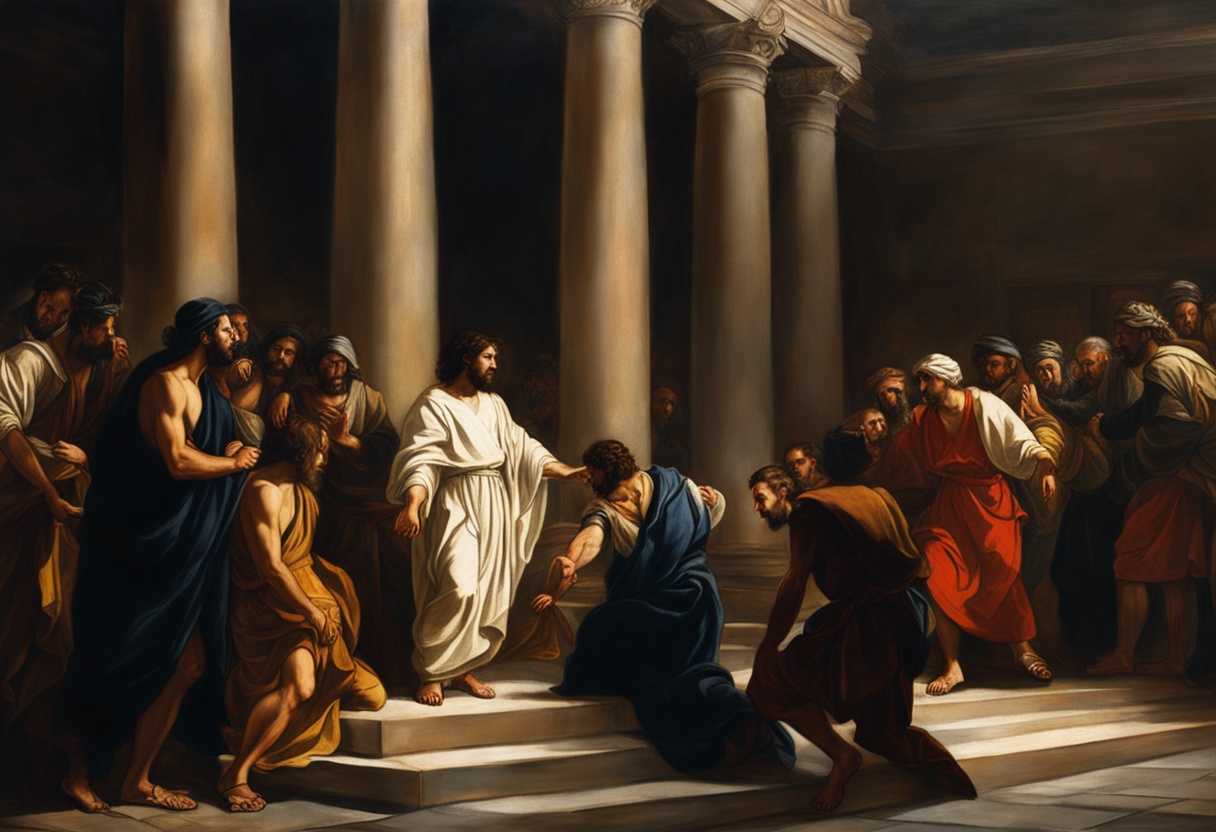
Setting the Scene for John 19:12-16
In John chapter 19, we find ourselves in the midst of a tense and dramatic scene at the Praetorium in Jerusalem. The main characters in this scene are Pontius Pilate, the Roman governor of Judea, and Jesus of Nazareth, who has been brought before Pilate by the Jewish religious leaders. The Praetorium is a grand and imposing structure, reflecting the power and authority of the Roman Empire.
Pilate, seated on his judgment seat, is faced with the difficult decision of what to do with Jesus, as the Jewish leaders are demanding his crucifixion. Jesus, standing before Pilate, embodies a sense of calm and dignity amidst the chaos and hostility surrounding him. The atmosphere is charged with tension as Pilate questions Jesus and struggles with the conflicting pressures from the Jewish leaders and his own conscience.
As the dialogue unfolds between Pilate and Jesus, the gravity of the situation becomes increasingly apparent. The fate of Jesus hangs in the balance as Pilate wrestles with the decision that will ultimately lead to Jesus being sentenced to death by crucifixion. The scene is a poignant reminder of the clash between earthly power and divine purpose, as the events of Jesus’ crucifixion are set in motion.
What is John 19:12-16 about?
This verse is a poignant reminder of the unjust suffering that Jesus endured before his crucifixion. It sheds light on the betrayal and the grave injustice faced by Jesus at the hands of Pilate, emphasizing his innocence in the face of harsh condemnation. It showcases the sacrifice and love of Jesus, who bore the weight of humanity’s sins despite his purity and righteousness. Jesus willingly took on the burden of our sins to offer us redemption and salvation, reminding us of his selflessness and compassion as we reflect on this verse. It prompts us to contemplate the profound sacrifice made by Jesus and the depth of his love for us. This verse challenges us to examine our own actions and how we treat others, urging us to strive for justice, compassion, and empathy in our own lives. Jesus being handed over to be crucified, despite his innocence, is significant for us to ponder on. What does this reveal about the nature of sacrifice and the depths of God’s love for us? How does this verse inspire us to embody the values of compassion, justice, and selflessness in our interactions with others? May we carry the message of this verse in our hearts, seeking to emulate the unwavering love and sacrifice exemplified by Jesus in our daily lives.
Understanding what John 19:12-16 really means
In the poignant narrative of John 19:12-16, we witness the unfolding drama leading to the crucifixion of Jesus Christ. Pilate, the Roman governor, finds himself entangled in a moral quandary as he grapples with the conflicting demands of his judgment and the accusations brought forth by the Jewish leaders. The Jewish authorities, driven by their fear of Jesus’ claim to kingship, press Pilate to act against him, citing it as a challenge to Caesar’s authority.
Amidst the mounting tension, the phrase “From then on Pilate sought to release him” unveils Pilate’s inner turmoil and his acknowledgment of Jesus’ innocence. However, the cunning manipulation of the Jewish leaders, warning Pilate that releasing Jesus would jeopardize his loyalty to Caesar, adds a layer of complexity to the unfolding narrative. Pilate’s ironic proclamation, “Behold your King!”, as he presents the scourged and humiliated Jesus to the crowd, underscores the tragic irony of the situation.
The resolute declaration of the Jewish leaders, “We have no king but Caesar,” starkly contrasts with the divine truth of Jesus’ kingship, rejected by those who should have recognized Him as the promised Messiah. This rejection echoes the prophetic words of Isaiah 53:3, foretelling the Messiah’s rejection and suffering, now vividly playing out before our eyes in these verses. The parallel accounts in Matthew 27:24 and Luke 23:20-23 further illuminate Pilate’s futile attempts to absolve himself of guilt and his struggle against the relentless demands of the crowd.
In contemplating the relevance of this passage to our lives today, we are confronted with timeless themes of moral dilemmas, peer pressure, and the recognition of true authority. Just as Pilate faced a momentous decision, we too encounter situations where we must choose between righteousness and expediency, between standing firm in our convictions or succumbing to external pressures. The insidious influence of peer pressure, exemplified by the Jewish leaders’ manipulation of Pilate, serves as a cautionary tale, reminding us of the dangers of compromising our values for the sake of societal approval.
Consider a scenario akin to Pilate’s plight: a high school student torn between upholding their integrity by refusing to cheat on an exam and yielding to the coercive demands of peers. This modern-day parallel underscores the timeless struggle between conscience and conformity, urging us to reflect on the choices we make when confronted with ethical dilemmas. Ultimately, the narrative of John 19:12-16 beckons us to introspection, challenging us to examine our allegiances and the unwavering commitment we hold to the ultimate authority in our lives.
What does it mean to choose Barabbas over Jesus?
Choosing Barabbas over Jesus represents choosing a way of the world over a way of God. Barabbas was a known criminal, a revolutionary who sought to bring about change through violence and power. Jesus represented a message of love, forgiveness, and peace in contrast. The people prioritized worldly values and short-term gains over the teachings of Jesus about love, kindness, and humility by opting for Barabbas.
This choice illustrates the human tendency to prefer quick fixes and immediate gratification over the harder path of righteousness and spiritual growth. The people succumbed to fear, peer pressure, and the desire for a hero who would give them what they wanted in that moment by choosing Barabbas. This decision reflects a broader issue of placing material desires and personal agendas above the deeper, more profound truths that Jesus embodied and taught. Choosing Barabbas over Jesus ultimately demonstrates a rejection of the spiritual path and a failure to recognize the transformative power of Jesus’ teachings. It highlights how easily people can be swayed by the values of the world and lose sight of the eternal principles of love, grace, and redemption that Jesus represented.
Application
In the journey of life, challenges may come knocking at your door. Just like Jesus stood strong in the face of adversity, it’s time for you to embrace courage and unwavering faith in the storms of modern life. Let’s not cower away from our beliefs, but stand tall like a beacon of light in the dark. Will you rise up to the challenge and let your convictions shine brightly in the world around you?

Reverend Michael Johnson is an experienced Church Minister with a profound expertise in spirituality and guidance. With a serene presence and a compassionate heart, he has faithfully served his congregation for over 20 years, leading them on a spiritual journey towards inner peace and enlightenment. Reverend Johnson’s extensive knowledge of religious philosophies and profound understanding of human nature have made him a trusted confidant and mentor to many, as he seamlessly weaves his profound wisdom into life teachings. Reverend Johnson’s calming demeanor and empathetic nature continue to uplift and heal souls, nurturing a sense of unity and tranquility within his community.