
John 19:17-22 is about Jesus being led to his crucifixion at Golgotha and the fulfillment of prophecy as the soldiers divided His garments and cast lots for His seamless tunic.
17 and he went out, bearing his own cross, to the place called The Place of a Skull, which in Aramaic is called Golgotha.
18 There they crucified him, and with him two others, one on either side, and Jesus between them.
19 Pilate also wrote an inscription and put it on the cross. It read, “Jesus of Nazareth, the King of the Jews.”
20 Many of the Jews read this inscription, for the place where Jesus was crucified was near the city, and it was written in Aramaic, in Latin, and in Greek.
21 So the chief priests of the Jews said to Pilate, “Do not write, ‘The King of the Jews,’ but rather, ‘This man said, I am King of the Jews.’”
22 Pilate answered, “What I have written I have written.”
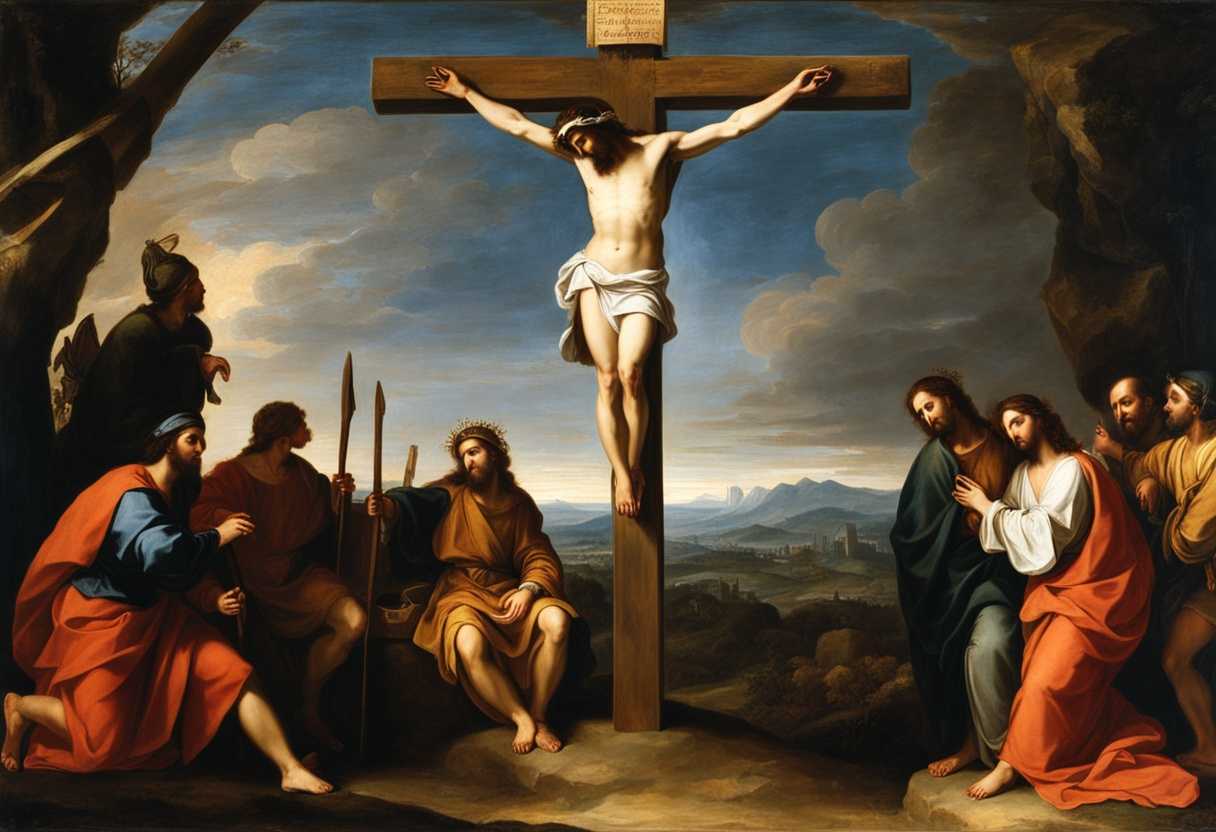
Setting the Scene for John 19:17-22
The scene in John chapter 19:17-22 takes place at Golgotha, the place of the Skull, where Jesus was crucified. The Roman soldiers led Jesus, carrying his own cross, to the hill where they would crucify him. Along the way, a crowd followed, including Mary, the mother of Jesus, and some of his disciples like John. The atmosphere was heavy with sorrow and tension as they made their way to the execution site.
Upon reaching Golgotha, Jesus was nailed to the cross, and the soldiers divided his garments among themselves. The onlookers, including the chief priests and Pharisees, mocked Jesus and challenged his claim to be the Son of God. The scene was chaotic, with the sound of hammering nails, the cries of the crowd, and the anguish of those who loved Jesus witnessing his crucifixion.
In the midst of this heartbreaking scene, Jesus showed incredible strength and compassion, even asking God to forgive those who were crucifying him. The setting of Golgotha, with its stark and brutal landscape, served as a backdrop to the ultimate sacrifice of Jesus for the sins of humanity.
What is John 19:17-22 about?
Imagine witnessing the significance of Jesus being crucified, not only as a historical event but as a powerful demonstration of fulfillment of prophecy. Jesus willingly submits to God’s plan in this verse, displaying ultimate obedience and trust. This act of sacrifice not only fulfills ancient prophecies about the Messiah but also symbolizes Jesus’ unwavering commitment to his divine mission.
Have you ever considered the depth of Jesus’ obedience in the face of such immense suffering and rejection? The crucifixion is not just a brutal act, but a profound display of love and faith. Jesus exemplifies the ultimate sacrifice for humanity’s salvation by willingly enduring this horrific death. Let the reflection on this verse serve as a reminder of the profound love and obedience that Jesus demonstrated on the cross, and the significance of his sacrifice in fulfilling God’s redemptive plan.
Understanding what John 19:17-22 really means
The passage in John 19:17-22 vividly portrays Jesus’ journey to Golgotha, where He is crucified, bearing His own cross. This act of carrying His cross symbolizes the weight of humanity’s sins that He willingly took upon Himself, showcasing His selfless love and willingness to endure suffering for the sake of others. The location of Golgotha, known as the “place of the Skull,” adds a layer of significance as a place of death and execution, underscoring the gravity of Jesus’ sacrifice on the cross. The brutal act of crucifixion emphasizes the extent of Jesus’ suffering and the depth of His love for humanity, as He endures this excruciating form of execution.
Pilate’s decision to have a notice prepared and fastened to the cross, declaring Jesus as “Jesus of Nazareth, the King of the Jews,” carries profound irony. While Pilate may have intended it as a form of mockery or political maneuvering, this inscription inadvertently proclaims a profound truth about Jesus’ identity as the true King and Messiah. This title, meant to be derisive, actually affirms Jesus’ kingship and messianic role, highlighting the divine irony at play in the events leading to His crucifixion. The juxtaposition of human intentions and divine truth is striking in this moment, revealing the sovereignty of God even in the midst of human injustice and cruelty.
The passage resonates with related biblical texts, such as Isaiah 53:5, which prophesies about the sacrificial nature of Jesus’ death, and Philippians 2:8, emphasizing His humility and obedience even unto death on the cross. Jesus’ forgiveness and love, exemplified in His words on the cross in Luke 23:34, serve as a powerful reminder of His divine mercy and compassion towards humanity. These themes of sacrifice, forgiveness, and love remain timeless and universally applicable, offering hope and redemption to all who turn to Him.
In today’s world, marked by suffering and injustice, Jesus’ example of selfless love and forgiveness stands as a beacon of light. His sacrificial death on the cross challenges us to reflect on our own lives and respond with gratitude, humility, and a commitment to follow His example. The inscription “King of the Jews” prompts us to recognize Jesus’ true identity and authority in our lives, inviting us to surrender to His lordship and embrace His teachings with faith and devotion.
To illustrate the magnitude of Jesus’ sacrifice, one can consider the story of a firefighter who selflessly rushes into a burning building to save a child, risking his own life in the process. Just as the firefighter’s act of bravery inspires gratitude and admiration, Jesus’ ultimate sacrifice on the cross calls us to respond with faith and devotion, recognizing the depth of His love and the magnitude of His sacrifice for humanity. Reflecting on this passage, we are reminded of the profound love and sacrifice of Jesus, urging us to live lives marked by gratitude, humility, and a steadfast commitment to follow His example of selfless love.
How can we show love and forgiveness to our enemies?
One way to show love and forgiveness to our enemies is by praying for them. We can ask God to bless, guide, and soften the hearts of those who have wronged us. We show that we genuinely care about our enemies’ well-being and desire reconciliation and peace by lifting them up in prayer.
Another way to demonstrate love and forgiveness to our enemies is by treating them with kindness and respect. Rather than seeking revenge or holding onto bitterness, we can choose to respond with compassion and understanding. Showing grace and mercy to our enemies can help break down barriers and create opportunities for healing and reconciliation.
Additionally, extending forgiveness to our enemies, even when they may not deserve it, can be a powerful way to demonstrate love. Forgiveness is a choice to release the anger and resentment we hold towards those who have hurt us, and it allows us to move forward in freedom and peace. We not only show love and grace to our enemies by forgiving them, but we also experience the transformative power of God’s forgiveness in our own lives.
Application
Imagine balancing your career and family, showing up every day despite the challenges. Jesus carried His cross, facing unimaginable struggles, for you. It’s time to step up and embrace your own responsibilities in faith, walking with Him. How will you act on His ultimate love and sacrifice?

Reverend Michael Johnson is an experienced Church Minister with a profound expertise in spirituality and guidance. With a serene presence and a compassionate heart, he has faithfully served his congregation for over 20 years, leading them on a spiritual journey towards inner peace and enlightenment. Reverend Johnson’s extensive knowledge of religious philosophies and profound understanding of human nature have made him a trusted confidant and mentor to many, as he seamlessly weaves his profound wisdom into life teachings. Reverend Johnson’s calming demeanor and empathetic nature continue to uplift and heal souls, nurturing a sense of unity and tranquility within his community.