
John 19:17-27 is about the profound act of Jesus entrusting his mother Mary to the care of the disciple whom he loved, symbolizing the establishment of a new spiritual family and exemplifying the importance of honoring and caring for one another within the Christian community.
17 and he went out, bearing his own cross, to the place called The Place of a Skull, which in Aramaic is called Golgotha.
18 There they crucified him, and with him two others, one on either side, and Jesus between them.
19 Pilate also wrote an inscription and put it on the cross. It read, “Jesus of Nazareth, the King of the Jews.”
20 Many of the Jews read this inscription, for the place where Jesus was crucified was near the city, and it was written in Aramaic, in Latin, and in Greek.
21 So the chief priests of the Jews said to Pilate, “Do not write, ‘The King of the Jews,’ but rather, ‘This man said, I am King of the Jews.’”
22 Pilate answered, “What I have written I have written.”
23 When the soldiers had crucified Jesus, they took his garments and divided them into four parts, one part for each soldier; also his tunic. But the tunic was seamless, woven in one piece from top to bottom.
24 so they said to one another, “Let us not tear it, but cast lots for it to see whose it shall be.” This was to fulfill the Scripture which says, “They divided my garments among them, and for my clothing they cast lots.” So the soldiers did these things,
25 but standing by the cross of Jesus were his mother and his mother’s sister, Mary the wife of Clopas, and Mary Magdalene.
26 When Jesus saw his mother and the disciple whom he loved standing nearby, he said to his mother, “Woman, behold, your son!”
27 Then he said to the disciple, “Behold, your mother!” And from that hour the disciple took her to his own home.
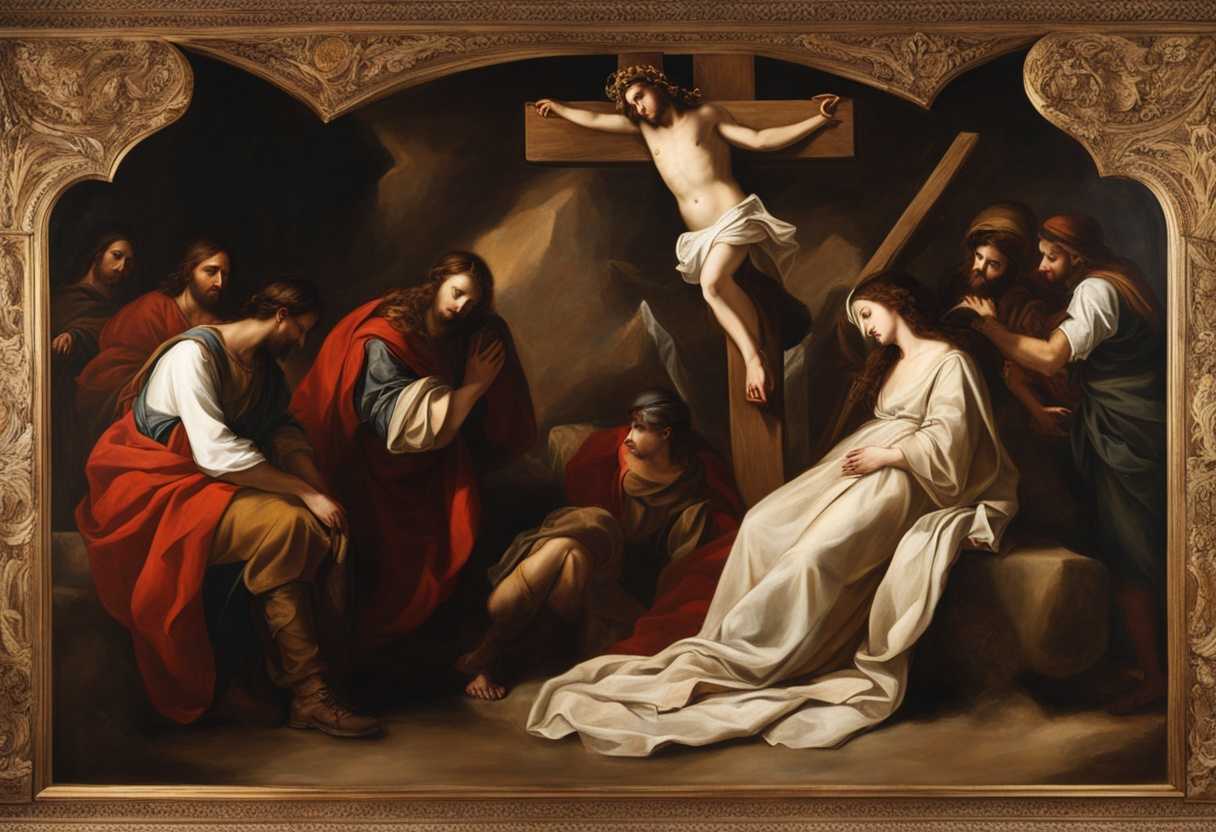
Setting the Scene for John 19:17-27
The scene in John chapter 19:17-27 takes place at Golgotha, the place of the Skull, where Jesus was crucified. The Roman soldiers led Jesus to this hill outside Jerusalem, along with two other criminals who were also being crucified that day. The atmosphere is heavy with the weight of what is about to happen, as Jesus carries his own cross to the place of execution.
At Golgotha, we see Jesus being nailed to the cross, with Mary, his mother, standing nearby, along with Mary Magdalene and the disciple whom Jesus loved, traditionally believed to be John. These faithful women had followed Jesus throughout his ministry and were now witnessing the culmination of his sacrifice for humanity. Despite the anguish and sorrow in the air, there is also a sense of profound love and devotion among those present.
As Jesus hangs on the cross, he looks down at his mother and the disciple whom he loved, and in a moment of compassion, he entrusts Mary to John’s care, symbolizing the formation of a new family among believers. The scene is poignant and powerful, illustrating the depth of Jesus’ love for his followers and the intimate relationships that were formed through his ministry and sacrifice.
What is John 19:17-27 about?
We witness a deeply profound and compassionate moment during Jesus’s crucifixion in this verse. Jesus entrusts His mother, Mary, to the care of John, one of His beloved disciples as He hangs on the cross. This act not only fulfills a prophecy, indicating Jesus’s divine purpose, but also demonstrates His deep love and concern for His family even in His most agonizing hour.
Have you considered the significance of Jesus entrusting Mary to John? This act reveals Jesus’s humanity and His desire to ensure the well-being of His loved ones, even amid His suffering. It also exemplifies the importance of community and caregiving within the Christian faith. Jesus sets an example for us all to care for one another and uphold familial bonds, even in times of great adversity, by entrusting Mary to John.
Reflecting on this verse, we can contemplate the profound love and humanity of Jesus, as well as the importance of family and community support in our own lives. How can we emulate Jesus’s care and compassion towards our loved ones? What does this act teach us about the value of familial relationships and the significance of fulfilling one another’s needs, especially in times of hardship? Let us inspire others with love and empathy by embodying these virtues in our interactions.
Understanding what John 19:17-27 really means
The passage in John 19:17-27 vividly portrays the crucifixion of Jesus, emphasizing His journey to Golgotha, the act of crucifixion itself, and His poignant interactions with His mother and the beloved disciple. This moment holds profound significance in Christian faith, symbolizing the ultimate sacrifice and the fulfillment of ancient prophecies. As Jesus carries His own cross, we see a powerful symbol of Him bearing the weight of humanity’s sins, showcasing His unwavering commitment to endure suffering for our salvation. The mention of Golgotha, the “place of the Skull,” underscores the physical and spiritual importance of the location, transforming a site of death into a place of redemption through Christ’s sacrifice.
In the tender exchange between Jesus, His mother, and the beloved disciple, we witness a demonstration of care and provision even amidst the agony of the crucifixion. Jesus entrusts His mother to the disciple and vice versa, establishing a new familial bond among His followers. These key phrases not only reveal Jesus’ compassion but also highlight the importance of forming supportive relationships within the community of believers. The passage resonates with other biblical texts, such as Isaiah 53:4-5, which prophesies the suffering servant who bears our iniquities, a prophecy fulfilled in Jesus’ crucifixion. Additionally, Luke 23:34 showcases Jesus’ plea for forgiveness for His executioners, exemplifying His boundless mercy, while Matthew 27:46 captures His cry of abandonment, underscoring His human suffering and the fulfillment of ancient Psalms.
Today, the crucifixion narrative remains relevant as it prompts reflection on themes of sacrifice, redemption, compassion, and care. Jesus’ ultimate sacrifice serves as a poignant reminder of God’s profound love for humanity, urging us to contemplate the depth of His sacrificial act. His care for His mother and the beloved disciple teaches us about the importance of compassion and support, especially in times of suffering. Moreover, the establishment of a new familial relationship among believers encourages us to view the church as a united family in Christ, fostering a sense of community and mutual care.
Consider a poignant anecdote: envision a soldier in a war zone, wounded yet selflessly ensuring the safety of his comrades. This act mirrors Jesus’ concern for others even in His moment of greatest suffering, challenging us to emulate His compassion and care for those around us, even amidst our own trials. As we reflect on the depth of Jesus’ sacrifice and His example of love and care, let us contemplate how this passage calls us to live out our faith practically, showing compassion and forming strong, supportive communities. May personal reflection lead us to consider how we can bear our own crosses and support others in their journeys, embodying the love and compassion exemplified by Christ on the cross.
How can we show love and care for others?
One way we can show love and care for others, as demonstrated in this passage, is by standing by them and providing support during difficult times. We too can offer our support to those in need, whether it be through physical assistance, emotional comfort, or spiritual guidance, just as Jesus entrusted the care of His mother to the disciple He loved. We can show that we care for others deeply by being present and attentive to their needs.
Additionally, we can show love and care for others by taking on responsibilities that may come with sacrifice, as exemplified by Jesus’ actions on the cross and in making sure His mother was cared for after His departure. This can involve making selfless choices, putting the needs of others before our own, and being willing to help shoulder the burdens of those we love. Through our actions and genuine concern, we demonstrate our love and care for others in tangible ways that have a lasting impact. Jesus showed love and care for others by forgiving and extending grace, just as He did for those who crucified Him. Practicing forgiveness not only shows compassion and understanding towards others, but also creates an environment of reconciliation and restoration. We show a deep level of love and care that transcends any bitterness or resentment, ultimately fostering healing and unity by extending grace to those who may have wronged us.
Application
Imagine working your toughest job, yet still finding a moment to ensure your family is taken care of. That’s exactly what Jesus did. In His darkest hour, He made sure His mother was looked after. Just as you balance work and family, Jesus trusted you to care for those in need. Take action now; lend a hand, offer a kind word, and support those around you. Will you step up and show compassion like Jesus did?

Reverend Michael Johnson is an experienced Church Minister with a profound expertise in spirituality and guidance. With a serene presence and a compassionate heart, he has faithfully served his congregation for over 20 years, leading them on a spiritual journey towards inner peace and enlightenment. Reverend Johnson’s extensive knowledge of religious philosophies and profound understanding of human nature have made him a trusted confidant and mentor to many, as he seamlessly weaves his profound wisdom into life teachings. Reverend Johnson’s calming demeanor and empathetic nature continue to uplift and heal souls, nurturing a sense of unity and tranquility within his community.