
John 19:4 is about Pilate presenting Jesus to the crowd, trying to show them that Jesus did not deserve to be condemned, highlighting the theme of authority and the clash between human judgment and divine innocence.
4 Pilate went out again and said to them, “See, I am bringing him out to you that you may know that I find no guilt in him.”
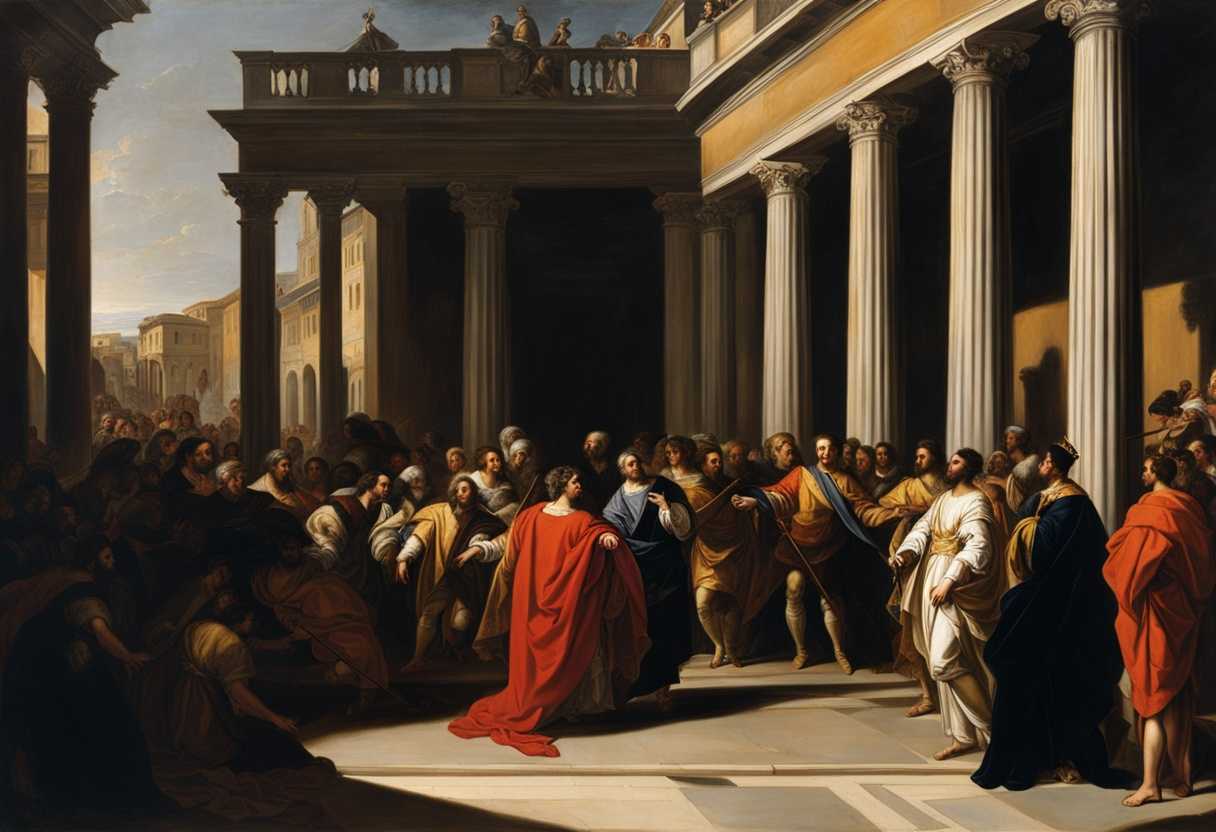
Setting the Scene for John 19:4
In John chapter 19, we find the scene where Jesus is brought before Pontius Pilate, the Roman governor of Judea, for questioning. The setting is the Praetorium in Jerusalem, a grand palace where Pilate resided during his time in the city. The room is likely filled with Roman soldiers, advisors, and other officials, creating a tense and intimidating atmosphere.
Jesus, the central figure in this scene, stands before Pilate, who is trying to determine whether Jesus is guilty of the charges brought against him by the Jewish religious leaders. The Jewish leaders, including the chief priests and Pharisees, are also present, vehemently accusing Jesus of blasphemy and inciting rebellion against Rome. The crowd outside the Praetorium is growing restless, with some calling for Jesus to be crucified.
As the dialogue between Pilate and Jesus unfolds, the weight of the impending decision hangs heavy in the air. Pilate, torn between his desire to maintain order and his uncertainty about Jesus’ guilt, struggles to come to a resolution that will satisfy both the Jewish leaders and the crowd. The scene is charged with emotion, political intrigue, and the clash of religious and secular authority, setting the stage for the dramatic events that will follow.
What is John 19:4 about?
This verse depicts a pivotal moment in the life of Jesus before his crucifixion. Imagine standing in the crowd witnessing this scene: Jesus, who was known for his teachings of love and compassion, is presented by Pilate, the Roman governor, adorned mockingly with a crown of thorns and a purple robe, symbols of both mockery and derision. This moment symbolizes the ultimate contrast between the values of the earthly powers and the divine message of Jesus.
Reflect on the power dynamics at play here – a scene where the authority of the world is juxtaposed with the humility and grace of Jesus. Despite the humiliation and suffering depicted in this verse, it also carries a profound message of redemption and sacrifice. This moment serves as a reminder of the depth of Jesus’ love for humanity, as he endures mockery and suffering to fulfill his divine purpose of salvation. Through this verse, we are encouraged to contemplate the immense sacrifice made by Jesus and the unwavering strength of his love, which ultimately triumphs over the cruelty and hatred of the world.
Understanding what John 19:4 really means
In the Gospel of John, specifically in chapter 19, we find a pivotal moment in the Passion narrative where Jesus stands before Pontius Pilate, the Roman governor. Pilate, having Jesus flogged and presented to the crowd, utters a profound statement in verse 4: “I find no basis for a charge against him.” This declaration by Pilate not only proclaims Jesus’ innocence of any crime deserving death but also serves as a poignant reminder of the purity and blamelessness of Jesus, despite the false accusations leveled against Him.
As we delve into the significance of Pilate’s words, “I find no basis for a charge against him,” we are confronted with the stark contrast between the innocence of Jesus and the unjust treatment He is subjected to. This moment encapsulates the theme of unjust suffering that runs through the Passion narrative, echoing the prophetic words of Isaiah 53:3-5, which foretold the suffering of the servant who would bear the sins of many. In this light, Pilate’s acknowledgment of Jesus’ innocence not only underscores the unjust persecution Jesus faced but also highlights the fulfillment of Old Testament prophecies in His life.
The parallel between Pilate’s declaration of Jesus’ innocence and the subsequent actions of the crowd underscores a poignant truth about human nature. Despite Pilate’s attempt to appeal to the crowd’s sense of justice and mercy by presenting Jesus to them, their response reveals the fickleness of public opinion and the prevalence of mob mentality. This dynamic serves as a sobering reflection on the dangers of succumbing to societal pressures and the importance of upholding principles of truth and justice, even in the face of opposition.
In a contemporary context, the themes encapsulated in John 19:4 resonate deeply with the human experience. The prevalence of injustice and the suffering of the innocent in today’s world mirror the unjust treatment Jesus endured. This verse serves as a poignant reminder that, just as Jesus faced false accusations and undeserved suffering, many individuals today grapple with similar challenges. It prompts us to reflect on our responses to injustice and our commitment to seeking truth and justice in a world marred by sin and brokenness.
Imagine a scenario where someone is wrongfully accused and subjected to public scrutiny despite their innocence. The feelings of frustration and helplessness that arise in such situations are all too familiar in a world where injustice often prevails. Yet, in the midst of such turmoil, the example of Jesus, who bore unjust suffering with patience and trust in God, offers a beacon of hope and resilience. His life serves as a testament to the possibility of redemption and justice, even in the face of overwhelming adversity.
In conclusion, John 19:4, though rooted in a historical event, transcends its temporal setting to convey timeless truths about innocence, justice, and compassion. It challenges us to examine our own attitudes and actions, urging us to embody the principles of truth and mercy in our interactions with others. As we navigate a world fraught with injustice and suffering, may we draw inspiration from the example of Jesus, who, in the face of unfounded accusations and unjust treatment, remained steadfast in His commitment to truth and righteousness.
What is truth?
Pilate declares in the verse that he finds no basis for a charge against Jesus. This declaration can be understood as a statement about the truth in this situation. The truth here is that, in Pilate’s assessment, Jesus is not guilty of a crime that warrants punishment. This moment highlights the importance of seeking truth in matters of justice and righteousness. Truth, in a broader sense, aligns with what is right, just, and honest. It involves seeking understanding and clarity in situations, allowing for fair judgment and decisions to be made. The truth in the context of this verse implies a recognition of innocence and a refusal to participate in unjust actions. Truth ultimately shines light on darkness, revealing what is authentic and genuine. It is a powerful force that guides individuals towards righteousness and justice. The truth in John 19:4 points towards Jesus’ innocence and challenges the authorities to act in accordance with this truth.
Application
Think about Jesus standing before Pilate, unjustly accused and mistreated. How can you channel this image into compassion and action in your own life? Imagine your workplace, your community—are there people facing unfair treatment or prejudice? Can you be their advocate, their voice, their source of comfort? What kind of world do you want to build for your family and loved ones?

Reverend Michael Johnson is an experienced Church Minister with a profound expertise in spirituality and guidance. With a serene presence and a compassionate heart, he has faithfully served his congregation for over 20 years, leading them on a spiritual journey towards inner peace and enlightenment. Reverend Johnson’s extensive knowledge of religious philosophies and profound understanding of human nature have made him a trusted confidant and mentor to many, as he seamlessly weaves his profound wisdom into life teachings. Reverend Johnson’s calming demeanor and empathetic nature continue to uplift and heal souls, nurturing a sense of unity and tranquility within his community.