
John 1:19-51 is about the testimony of John the Baptist pointing to Jesus as the Son of God, the promised Messiah, and the calling of the first disciples to follow Jesus and spread his message.
19 And this is the testimony of John, when the Jews sent priests and Levites from Jerusalem to ask him, “Who are you?”
20 He confessed, and did not deny, but confessed, “I am not the Christ.”
21 And they asked him, “What then? Are you Elijah?” He said, “I am not.” “Are you the Prophet?” And he answered, “No.”
22 So they said to him, “Who are you? We need to give an answer to those who sent us. What do you say about yourself?”
23 He said, “I am the voice of one crying out in the wilderness, ‘Make straight the way of the Lord,’ as the prophet Isaiah said.”
24 (Now they had been sent from the Pharisees.)
25 They asked him, “Then why are you baptizing, if you are neither the Christ, nor Elijah, nor the Prophet?”
26 John answered them, “I baptize with water, but among you stands one you do not know,
27 He it is who coming after me is preferred before me, whose shoe’s latchet I am not worthy to unloose.
28 These things took place in Bethany across the Jordan, where John was baptizing.
29 The next day he saw Jesus coming toward him, and said, “Behold, the Lamb of God, who takes away the sin of the world!
30 This is he of whom I said, ‘After me comes a man who ranks before me, because he was before me.’
31 I myself did not know him, but for this purpose I came baptizing with water, that he might be revealed to Israel.”
32 And John bore witness: “I saw the Spirit descend from heaven like a dove, and it remained on him.
33 I myself did not know him, but he who sent me to baptize with water said to me, ‘He on whom you see the Spirit descend and remain, this is he who baptizes with the Holy Spirit.’
34 And I have seen and have borne witness that this is the Son of God.”
35 The next day again John was standing with two of his disciples,
36 and he looked at Jesus as he walked by and said, “Behold, the Lamb of God!”
37 The two disciples heard him say this, and they followed Jesus.
38 Jesus turned and saw them following and said to them, “What are you seeking?” And they said to him, “Rabbi” (which means Teacher), “where are you staying?”
39 He said to them, “Come and you will see.” So they came and saw where he was staying, and they stayed with him that day, for it was about the tenth hour.
40 One of the two who heard John speak and followed Jesus was Andrew, Simon Peter’s brother.
41 He first found his own brother Simon and said to him, “We have found the Messiah” (which means Christ).
42 He brought him to Jesus. Jesus looked at him and said, “You are Simon the son of John. You shall be called Cephas” (which means Peter).
43 The next day Jesus decided to go to Galilee. He found Philip and said to him, “Follow me.”
44 Now Philip was from Bethsaida, the city of Andrew and Peter.
45 Philip found Nathanael and said to him, “We have found him of whom Moses in the Law and also the prophets wrote, Jesus of Nazareth, the son of Joseph.”
46 Nathanael said to him, “Can anything good come out of Nazareth?” Philip said to him, “Come and see.”
47 Jesus saw Nathanael coming toward him and said of him, “Behold, an Israelite indeed, in whom there is no deceit!”
48 Nathanael said to him, “How do you know me?” Jesus answered him, “Before Philip called you, when you were under the fig tree, I saw you.”
49 Nathanael answered him, “Rabbi, you are the Son of God! You are the King of Israel!”
50 Jesus answered him, “Because I said to you, ‘I saw you under the fig tree,’ do you believe? You will see greater things than these.”
51 And he said to him, “Truly, truly, I say to you, you will see heaven opened, and the angels of God ascending and descending on the Son of Man.”
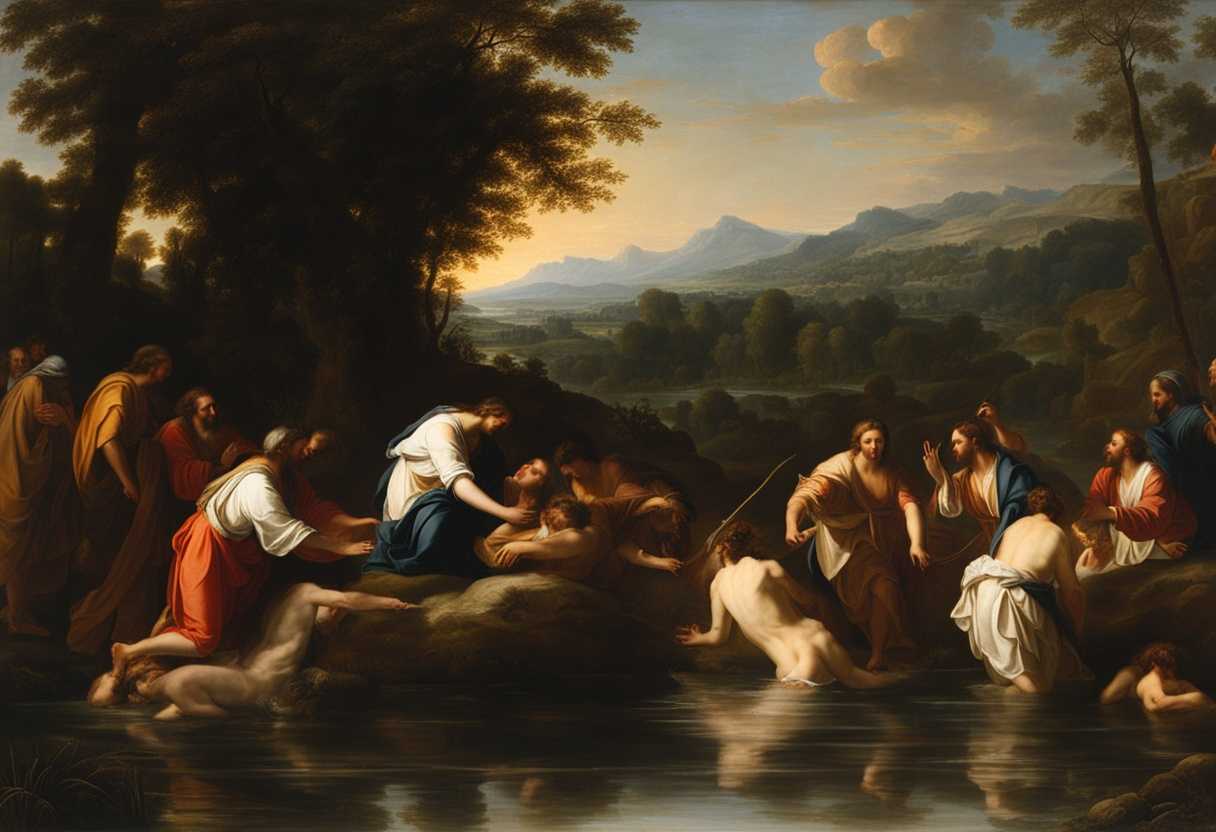
Setting the Scene for John 1:19-51
The scene in John chapter 1 opens with the Jewish religious leaders sending priests and Levites from Jerusalem to question John the Baptist. John had been baptizing people in the Jordan River, preaching about the coming of the Messiah. The priests and Levites were curious about his identity and whether he was the long-awaited Messiah, Elijah, or the Prophet.
As the priests and Levites questioned John, he made it clear that he was not the Messiah but rather the voice crying out in the wilderness, preparing the way for the Lord. John pointed to Jesus as the Lamb of God, the one who would take away the sins of the world. Andrew, one of John’s disciples, was present during this interaction and decided to follow Jesus. Andrew then brought his brother Simon Peter to meet Jesus.
Jesus, sensing Simon Peter’s significance, gave him the name Cephas (Peter), which means “rock.” The scene continues with Jesus calling Philip to follow him, who then brings Nathanael to meet Jesus. Nathanael initially doubts that anything good could come from Nazareth, but Jesus impresses him by revealing that he saw him under the fig tree before Philip called him. This encounter leads Nathanael to declare Jesus as the Son of God and the King of Israel. The scene is set in the region of Bethany beyond the Jordan, a significant location where John the Baptist was baptizing and where Jesus began to gather his disciples.
What is John 1:19-51 about?
This verse is a powerful testament to the arrival of Jesus, the awaited Messiah. John the Baptist, a prominent figure in the New Testament, testifies to the divinity and significance of Jesus Christ. His recognition of Jesus as the chosen one marks a critical moment in the narrative of Christianity, signaling the beginning of Jesus’ earthly ministry. The profound impact of hearing the truth and responding to the call of faith is highlighted as Andrew and Philip choose to follow Jesus after John the Baptist’s testimony. Their decision to follow Jesus represents a shift towards a new way of life, one that is centered on belief in Jesus as the Savior and the Son of God. It invites us to reflect on our own responses to the presence of Jesus in our lives and consider how we can actively follow and serve Him with conviction and dedication.
Can you imagine being present during this pivotal moment of testimony and decision-making? How would you have responded to John the Baptist’s words about Jesus? Reflecting on Andrew and Philip’s swift decision to follow Jesus, what does it teach us about the power of faith and the transformative impact of encountering the truth? Engaging with this verse can inspire us to deepen our relationship with Jesus and commit to following Him wholeheartedly in our own lives.
Understanding what John 1:19-51 really means
In John 1:19-51, we delve into a pivotal moment in the Gospel narrative, where John the Baptist testifies about Jesus, the calling of the first disciples takes place, and the early recognition of Jesus as the Messiah begins to unfold. This passage serves as a crucial foundation for understanding Jesus’ ministry and underscores the divine identity attributed to Him.
One of the key phrases in this passage is “Behold, the Lamb of God,” uttered by John the Baptist. This declaration not only identifies Jesus as the sacrificial lamb, drawing parallels to Old Testament references like the Passover lamb in Exodus and the suffering servant in Isaiah, but also symbolizes His role in atoning for the sins of humanity. It sets the stage for Jesus’ redemptive mission and highlights His sacrificial love.
Moreover, John the Baptist’s humility shines through in his statement, “The one who comes after me, the straps of whose sandals I am not worthy to untie.” This expression underscores the profound greatness of Jesus and the humility required in His presence, echoing similar sentiments found in the Gospels. It serves as a poignant reminder of the reverence and awe we should have for Christ.
Jesus’ invitation to the disciples, “Come and see,” encapsulates a profound call to experience His teachings and miracles firsthand. This invitation extends beyond the disciples to all believers, urging them to seek a personal encounter with Jesus and deepen their understanding of His transformative message. It beckons us to embark on a journey of faith and discovery, inviting us to witness the power and truth of Christ for ourselves.
Drawing connections to other biblical passages enriches our understanding of John 1:19-51. The fulfillment of Isaiah’s prophecy in John the Baptist’s ministry, the parallel calling of the first disciples in Matthew, and the imagery of Jesus as the slain Lamb in Revelation all converge to paint a cohesive picture of Jesus’ identity and mission. These cross-references deepen our appreciation of the interconnectedness of Scripture and the fulfillment of God’s plan through Christ.
Today, the themes in this passage remain relevant and impactful. Just as John the Baptist and the first disciples recognized Jesus’ divine nature, we are called to acknowledge Him as our Savior and follow Him wholeheartedly. The importance of sharing our testimony, modeled by John the Baptist, underscores the significance of bearing witness to the transformative power of Christ in our lives. The invitation to “come and see” challenges us to explore our faith, seek personal encounters with Jesus, and grow in our relationship with Him.
Consider a scenario where a skeptic encounters a renowned doctor who can cure a rare disease. Initially hesitant, they are convinced by the testimonies of healed patients and decide to seek treatment. After experiencing the doctor’s healing firsthand, they become a fervent advocate. Similarly, John the Baptist’s testimony and the disciples’ encounters with Jesus invite us to witness the life-changing power of faith in our lives, compelling us to share this transformative experience with others.
In conclusion, John 1:19-51 unveils essential aspects of Jesus’ identity and mission, urging believers to recognize Him as the Messiah, share their faith boldly, and seek personal encounters with Him. The timeless themes and phrases within this passage continue to resonate, offering guidance and inspiration to all who seek to deepen their relationship with Jesus and follow Him faithfully.
How can we recognize and follow the Messiah?
John the Baptist reveals the Messiah to the people in the verses from John 1:19-51. He testifies that the Messiah is among them, greater than he is, and the one they have been waiting for. John recognizes the Messiah by the sign given to him – the one on whom the Spirit descends and remains is the chosen one. This signifies that the Messiah will be filled with the Holy Spirit and have a close connection with God.
Furthermore, when Andrew and Philip encounter Jesus, they recognize Him as the Messiah based on their interaction with Him. Andrew immediately goes to tell his brother Peter, showing that recognizing the Messiah involves sharing the good news with others. Philip also recognizes Jesus as the Messiah after spending time with Him. This shows that recognizing the Messiah goes beyond just observing signs and requires a personal connection and relationship with Him. Recognizing and following the Messiah involves being open to the signs and revelations that point to His identity, having a personal encounter and relationship with Him, and sharing the good news with others. It requires spiritual discernment, faith, and a willingness to follow Him wherever He may lead.
Application
Imagine at work you find a game-changing idea that transforms everything for the better. That’s the impact John the Baptist had when he recognized Jesus as the Lamb of God. Let’s channel that kind of boldness in our daily lives. Embrace the chance to introduce your family, friends, and coworkers to this life-altering truth. Are you ready to be the light in someone’s darkest hour and share Jesus’ love in a world craving hope?

Reverend Michael Johnson is an experienced Church Minister with a profound expertise in spirituality and guidance. With a serene presence and a compassionate heart, he has faithfully served his congregation for over 20 years, leading them on a spiritual journey towards inner peace and enlightenment. Reverend Johnson’s extensive knowledge of religious philosophies and profound understanding of human nature have made him a trusted confidant and mentor to many, as he seamlessly weaves his profound wisdom into life teachings. Reverend Johnson’s calming demeanor and empathetic nature continue to uplift and heal souls, nurturing a sense of unity and tranquility within his community.