
John 20:1-16 is about the resurrection of Jesus Christ and Mary Magdalene’s encounter with him, highlighting the transformative power of faith and the profound personal relationship between Jesus and his followers.
1 Now on the first day of the week Mary Magdalene came to the tomb early, while it was still dark, and saw that the stone had been taken away from the tomb.
2 So she ran and went to Simon Peter and the other disciple, the one whom Jesus loved, and said to them, “They have taken the Lord out of the tomb, and we do not know where they have laid him.”
3 So Peter went out with the other disciple, and they were going toward the tomb.
4 Both of them were running together, but the other disciple outran Peter and reached the tomb first.
5 And stooping to look in, he saw the linen cloths lying there, but he did not go in.
6 Then Simon Peter came, following him, and went into the tomb. He saw the linen cloths lying there,
7 and the face cloth, which had been on Jesus’ head, not lying with the linen cloths but folded up in a place by itself.
8 Then the other disciple, who had reached the tomb first, also went in, and he saw and believed;
9 for as yet they did not understand the Scripture, that he must rise from the dead.
10 Then the disciples went back to their homes.
11 But Mary stood weeping outside the tomb, and as she wept she stooped to look into the tomb.
12 And she saw two angels in white, sitting where the body of Jesus had lain, one at the head and one at the feet.
13 They said to her, “Woman, why are you weeping?” She said to them, “They have taken away my Lord, and I do not know where they have laid him.”
14 Having said this, she turned around and saw Jesus standing, but she did not know that it was Jesus.
15 Jesus said to her, “Woman, why are you weeping? Whom are you seeking?” Supposing him to be the gardener, she said to him, “Sir, if you have carried him away, tell me where you have laid him, and I will take him away.”
16 Jesus said to her, “Mary.”
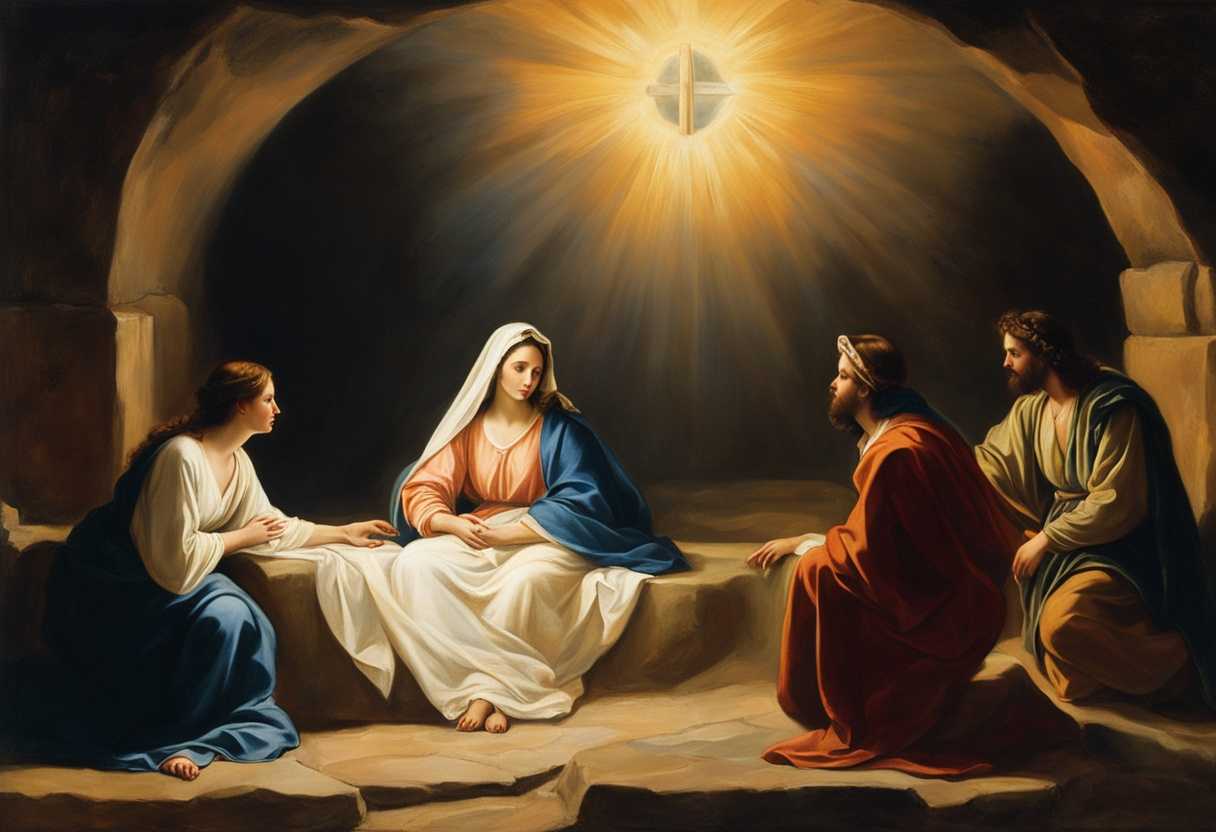
Setting the Scene for John 20:1-16
The scene in John chapter 20 opens with Mary Magdalene making her way to the tomb of Jesus early in the morning. She is accompanied by a few other women who had been followers of Jesus. The atmosphere is heavy with grief and confusion as they approach the burial site of their beloved teacher and friend. The surroundings are quiet and somber, with the first light of dawn breaking over the horizon.
As they reach the tomb, they are shocked to find the stone rolled away from the entrance. Mary, in a state of distress, runs to tell Peter and John about the missing body of Jesus. Peter and John, upon hearing the news, rush to the tomb to see for themselves. The two disciples find the burial cloths lying there but no sign of Jesus. The atmosphere is tense with disbelief and uncertainty as they try to make sense of what has happened.
In the midst of this confusion, Mary remains at the tomb, weeping. It is in this moment of deep sorrow and despair that Jesus appears to her, though she does not recognize him at first. The scene is transformed from one of mourning to one of joy and wonder as Mary realizes that Jesus is alive. The surroundings are filled with a sense of awe and amazement as Mary becomes the first witness to the resurrection, a moment that changes everything for the disciples and for all of humanity.
What is John 20:1-16 about?
The resurrection appearance of Jesus to Mary Magdalene is a powerful and significant moment in the Christian faith. It symbolizes the triumph of life over death, hope over despair, and love over fear. Jesus reveals himself to Mary Magdalene after his crucifixion in this verse, demonstrating that death could not hold him down. It is a profound reminder of the miraculous nature of Jesus’ resurrection and the fulfillment of God’s promises.
Imagine the joy and astonishment Mary Magdalene must have felt upon seeing Jesus alive again! This moment not only reaffirmed her faith but also served as a testament to the power of God’s love and grace. Through this resurrection appearance, Jesus shows us that even in our darkest moments, there is always hope and a promise of new beginnings. It reminds us that no matter how daunting our challenges may seem, God’s love and victory are always present to bring us comfort and strength. We can draw inspiration from Mary Magdalene’s encounter with the risen Christ and hold onto the belief that, just as Jesus conquered death, we too can overcome any obstacles with faith and perseverance.
Understanding what John 20:1-16 really means
In John 20:1-16, we witness the poignant account of the discovery of the empty tomb and Jesus’ appearance to Mary Magdalene. This passage holds immense significance as it marks the pivotal moment of Jesus’ resurrection, the cornerstone of the Christian faith. The events leading up to this passage, including the crucifixion and burial of Jesus, set the stage for the miraculous revelation of His victory over death. Understanding the cultural and historical context of the time sheds light on the remarkable role of women, like Mary Magdalene, in Jesus’ ministry, challenging societal norms and exemplifying unwavering devotion.
“Early on the first day of the week, while it was still dark,” sets the scene for a momentous event symbolizing a new beginning and the dawn of a new era in human history. The image of the stone being removed from the entrance of the tomb signifies the removal of barriers between humanity and God, paving the way for reconciliation and redemption. Mary Magdalene’s initial reaction, exclaiming, “They have taken the Lord out of the tomb,” reflects the confusion and fear that accompanied the discovery, highlighting the emotional turmoil of the moment.
As Mary stood outside the tomb crying, her deep sorrow and unwavering devotion to Jesus are palpable, underscoring the profound love she had for her Lord. When Jesus tenderly calls her by name, “Mary,” the personal and intimate nature of their relationship is revealed, signifying recognition and deep connection. This interaction mirrors Jesus’ role as the Good Shepherd who knows His sheep by name, emphasizing the individualized care and love He has for each believer.
Parallel biblical accounts in Matthew, Mark, and Luke corroborate the resurrection narrative, reinforcing the central message of hope and renewal that the resurrection brings. Drawing from 1 Corinthians, we understand the far-reaching implications of Christ’s resurrection for all believers, offering eternal life and victory over sin and death. Today, the theme of hope and new beginnings resonates with individuals facing challenges and uncertainties, inviting them to embrace the transformative power of the resurrection in their lives.
Through personal anecdotes of individuals experiencing profound change and renewal through their faith in the resurrection, we witness firsthand the life-transforming impact of the message of hope and new beginnings. Just as Mary Magdalene and the early disciples were transformed by encountering the risen Christ, believers today are invited to deepen their relationship with Jesus and embrace the hope that His resurrection offers. As we reflect on the significance of the resurrection and its enduring impact, may we be inspired to renew our faith, embrace the hope it brings, and walk in the light of His victory over death.
How can we have faith in the unseen?
We can have faith in the unseen by believing in the truth and power of God’s Word. It is through the Scriptures that we are able to understand the unseen, as they reveal the nature and promises of God. We can strengthen our faith and trust in the unseen realities of the spiritual realm by immersing ourselves in the teachings and wisdom found in the Bible.
Additionally, faith in the unseen is also supported by the testimony of others who have experienced the presence and work of God in their lives. We can draw confidence in our faith by learning from the experiences and encounters of those who have gone before us, just as Mary Magdalene and the disciples believed in the resurrection of Jesus even though they had not physically seen Him yet. Having faith in the unseen ultimately requires a firm conviction in the character and faithfulness of God. It is by trusting in His promises, knowing His love and sovereignty, and relying on His Spirit to guide and strengthen us, that we can confidently believe in that which we cannot see with our physical eyes.
Application
Think of a moment when everything changed in your career or family life, marking a new beginning. John 20:1-16 speaks of such a turning point with Christ’s resurrection and Mary Magdalene’s unwavering faith. Just as you would seize a game-changing opportunity at work or fiercely support your family through challenges, Christ asks us to trust His promises and share the news of His victory over death. Will you take this chance to spread His transformative love in your community today?

Reverend Michael Johnson is an experienced Church Minister with a profound expertise in spirituality and guidance. With a serene presence and a compassionate heart, he has faithfully served his congregation for over 20 years, leading them on a spiritual journey towards inner peace and enlightenment. Reverend Johnson’s extensive knowledge of religious philosophies and profound understanding of human nature have made him a trusted confidant and mentor to many, as he seamlessly weaves his profound wisdom into life teachings. Reverend Johnson’s calming demeanor and empathetic nature continue to uplift and heal souls, nurturing a sense of unity and tranquility within his community.