
John 21:1-12 is about Jesus revealing himself to his disciples for the third time after his resurrection, affirming his care and provision for them, and reminding them of their call to follow him faithfully despite challenges and doubts.
1 After this Jesus revealed himself again to the disciples by the Sea of Tiberias, and he revealed himself in this way.
2 Simon Peter, Thomas (called the Twin), Nathanael of Cana in Galilee, the sons of Zebedee, and two others of his disciples were together.
3 Simon Peter said to them, “I am going fishing.” They said to him, “We will go with you.” So they went out and got into the boat, but that night they caught nothing.
4 Just as day was breaking, Jesus stood on the shore; yet the disciples did not know that it was Jesus.
5 Jesus said to them, “Children, do you have any fish?” They answered him, “No.”
6 He said to them, “Cast the net on the right side of the boat, and you will find some.” So they cast it, and now they were not able to haul it in, because of the quantity of fish.
7 That disciple whom Jesus loved therefore said to Peter, “It is the Lord!” When Simon Peter heard that it was the Lord, he put on his outer garment, for he was stripped for work, and threw himself into the sea.
8 The other disciples came in the boat, dragging the net full of fish, for they were not far from the land, but about a hundred yards off.
9 When they got out on land, they saw a charcoal fire in place, with fish laid out on it, and bread.
10 Jesus said to them, “Bring some of the fish that you have just caught.”
11 So Simon Peter went aboard and hauled the net ashore, full of large fish, 153 of them. And although there were so many, the net was not torn.
12 Jesus said to them, “Come and have breakfast.” Now none of the disciples dared ask him, “Who are you?” They knew it was the Lord.
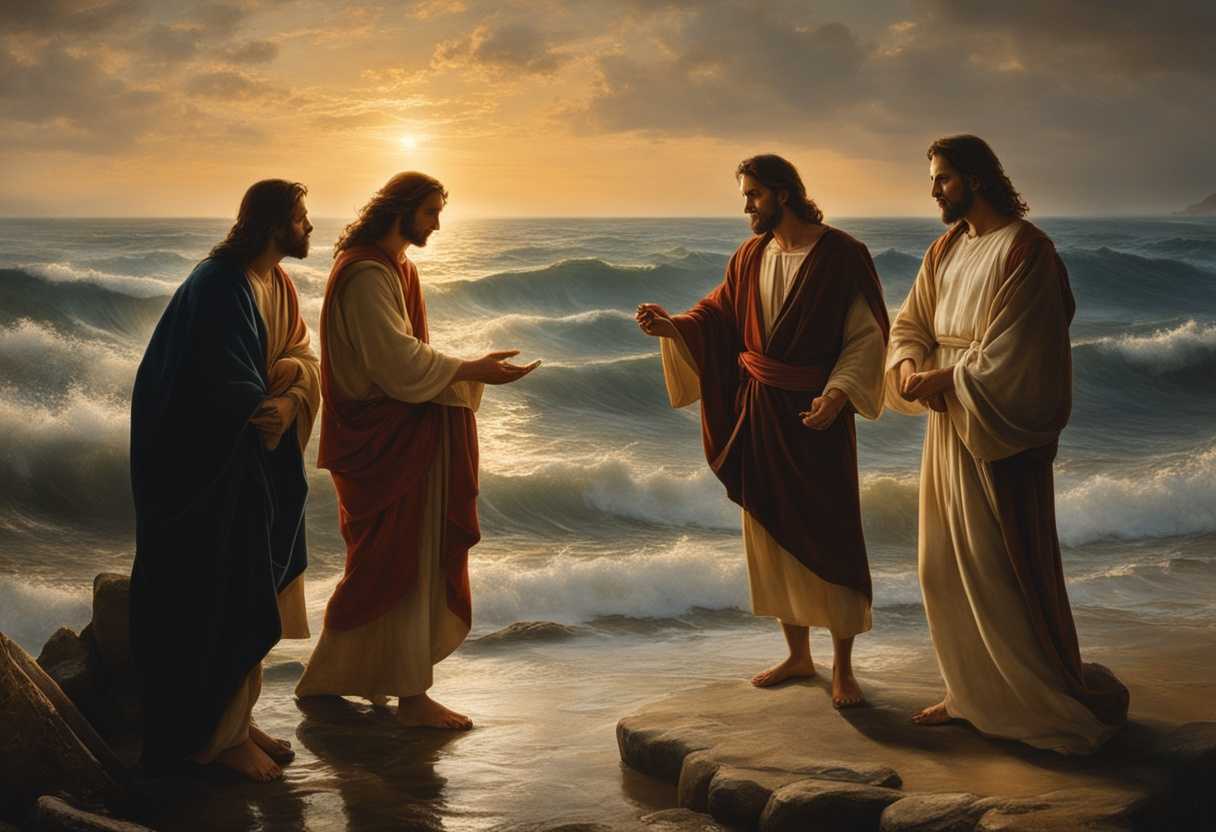
Setting the Scene for John 21:1-12
The scene in John chapter 21 opens with the disciples by the Sea of Tiberias, also known as the Sea of Galilee. The disciples present are Simon Peter, Thomas (called Didymus), Nathanael from Cana in Galilee, the sons of Zebedee (James and John), and two other disciples. They had returned to Galilee after Jesus’ crucifixion and resurrection, unsure of what to do next.
Feeling lost and uncertain, Simon Peter decides to go fishing, and the others join him. They spend the night fishing but catch nothing. As morning breaks, they see a figure standing on the shore, calling out to them. It is Jesus, although they do not recognize him at first. He instructs them to cast their net on the right side of the boat, leading to a miraculous catch of fish. In that moment, John recognizes Jesus, and Peter, overcome with emotion, jumps into the water to reach him.
As they come ashore, they find a charcoal fire with fish and bread already prepared. Jesus invites them to bring some of the fish they caught, and together they share a meal. This intimate and miraculous encounter by the sea solidifies the disciples’ faith and marks a significant moment of restoration and commissioning for Peter, who is asked three times by Jesus if he loves him, reinforcing his role in shepherding the followers of Christ.
What is John 21:1-12 about?
This verse from the Bible is a powerful reminder of Jesus’ divinity and love for his disciples. Jesus is showing his disciples that he is indeed the Son of God and that he has power over nature by appearing after his resurrection and performing a miraculous catch of fish. This event not only demonstrates Jesus’ miraculous abilities but also symbolizes the abundance and blessings that come from following him.
Imagine being one of the disciples present at that moment by the Sea of Galilee. How would you have felt witnessing such a miraculous event? The overflowing nets of fish would have served as a tangible sign of Jesus’ presence and his promise to provide for his followers. This verse teaches us to trust in Jesus’ power and provision, even when facing seemingly impossible circumstances. Jesus continues to provide for us today, showing his love and faithfulness in every aspect of our lives, just as he provided an abundance of fish to his disciples.
Understanding what John 21:1-12 really means
In the Gospel of John, we encounter a poignant narrative of Jesus appearing to His disciples by the Sea of Tiberias after His resurrection. This encounter holds profound significance, shedding light on themes of faith, obedience, and the recognition of Jesus in our lives. As we delve into the key phrases of this passage, we uncover layers of meaning that resonate with our daily walk with Christ. When the disciples toiled all night in their own strength and caught nothing, it serves as a stark reminder that human effort devoid of divine guidance often leads to barren outcomes. This mirrors our own struggles when we rely solely on our abilities, neglecting to seek God’s direction in our endeavors.
However, the pivotal moment arises when Jesus instructs the disciples to cast their nets on the right side of the boat. This simple command embodies the essence of obedience – a willingness to heed Jesus’ words even when they seem contrary to our logic. The disciples’ obedience leads to an overflowing abundance of fish, underscoring the principle that following Christ’s guidance yields bountiful blessings beyond our comprehension. In the exclamation, “It is the Lord!” we witness the disciples’ recognition of Jesus’ presence among them. This moment of realization signifies a profound awakening to the authority and power of Christ in their midst.
Drawing parallels from related Bible passages such as Luke 5:1-11 and Matthew 14:22-33, we discern a consistent thread of Jesus’ provision, the call to follow Him, and the importance of faith in His miraculous power. These passages serve as pillars reinforcing the foundational truths of trust, obedience, and recognition of Jesus in our lives. Today, we are called to embody the same faith and obedience displayed by the disciples. Just as they experienced a miraculous catch by following Jesus’ command, we too can witness God’s provision and guidance when we align our will with His.
Consider a contemporary scenario where a struggling business owner, despite exhaustive efforts, experiences a breakthrough after seeking divine guidance. This modern-day parallel echoes the disciples’ miraculous catch, illustrating the transformative power of trusting and obeying God’s direction in our lives. As we reflect on this passage, we are prompted to introspect on our own faith journey. Are we attuned to recognizing Jesus’ presence amidst the mundane aspects of our lives? Do we exhibit the same level of obedience and trust that the disciples demonstrated by the Sea of Tiberias?
In conclusion, the narrative in John 21:1-12 beckons us to trust in Jesus’ guidance, acknowledge His presence in our daily experiences, and align our efforts with His divine will. May we emulate the disciples’ unwavering faith, obedience, and recognition of Jesus, allowing His transformative power to manifest in our lives abundantly.
What is the significance of recognizing Jesus physically?
Recognizing Jesus physically in this passage emphasizes the theme of Jesus’ resurrection and presence among his disciples after his death. Jesus demonstrates not only that he has conquered death but also that he is still present with them, just as he promised, by appearing to the disciples in a tangible, physical form. His physical presence serves as a reassurance and a confirmation of his resurrection, strengthening the disciples’ faith in him.
Furthermore, recognizing Jesus physically highlights the intimacy and personal nature of the relationship between Jesus and his disciples. When the disciples see and recognize Jesus, it goes beyond just a spiritual or abstract understanding of his presence. It is a moment of connection and closeness, as they are able to interact with him as they would with any physical person. This encounter serves as a reminder that Jesus is not just a distant figure or a memory but a living, present reality in their lives. Recognizing Jesus physically in this passage underscores the reality and power of Jesus’ resurrection, the continued relationship between Jesus and his disciples, and the personal nature of faith. It portrays Jesus not as a distant or abstract figure but as a living, present Savior who is intimately involved in the lives of his followers.
Application
Imagine you’re juggling work deadlines and family responsibilities, feeling overwhelmed. Picture yourself like Peter, tired and frustrated after a fruitless fishing night. Then, a voice guides you to cast your nets one more time. Just as Peter trusted and found abundance, will you take that one more step today, trusting in a higher guidance? Obedience and faith can transform your circumstances. Are you ready to cast your net on the right side and see what miracles can unfold?

Reverend Michael Johnson is an experienced Church Minister with a profound expertise in spirituality and guidance. With a serene presence and a compassionate heart, he has faithfully served his congregation for over 20 years, leading them on a spiritual journey towards inner peace and enlightenment. Reverend Johnson’s extensive knowledge of religious philosophies and profound understanding of human nature have made him a trusted confidant and mentor to many, as he seamlessly weaves his profound wisdom into life teachings. Reverend Johnson’s calming demeanor and empathetic nature continue to uplift and heal souls, nurturing a sense of unity and tranquility within his community.