
John 21:1-23 is about Jesus revealing his continued presence and guidance to his disciples even after his resurrection, emphasizing the importance of following him faithfully and the unique calling placed on each individual disciple.
1 After this Jesus revealed himself again to the disciples by the Sea of Tiberias, and he revealed himself in this way.
2 Simon Peter, Thomas (called the Twin), Nathanael of Cana in Galilee, the sons of Zebedee, and two others of his disciples were together.
3 Simon Peter said to them, “I am going fishing.” They said to him, “We will go with you.” So they went out and got into the boat, but that night they caught nothing.
4 Just as day was breaking, Jesus stood on the shore; yet the disciples did not know that it was Jesus.
5 Jesus said to them, “Children, do you have any fish?” They answered him, “No.”
6 He said to them, “Cast the net on the right side of the boat, and you will find some.” So they cast it, and now they were not able to haul it in, because of the quantity of fish.
7 That disciple whom Jesus loved therefore said to Peter, “It is the Lord!” When Simon Peter heard that it was the Lord, he put on his outer garment, for he was stripped for work, and threw himself into the sea.
8 The other disciples came in the boat, dragging the net full of fish, for they were not far from the land, but about a hundred yards off.
9 When they got out on land, they saw a charcoal fire in place, with fish laid out on it, and bread.
10 Jesus said to them, “Bring some of the fish that you have just caught.”
11 So Simon Peter went aboard and hauled the net ashore, full of large fish, 153 of them. And although there were so many, the net was not torn.
12 Jesus said to them, “Come and have breakfast.” Now none of the disciples dared ask him, “Who are you?” They knew it was the Lord.
13 Jesus came and took the bread and gave it to them, and so with the fish.
14 This was now the third time that Jesus was revealed to the disciples after he was raised from the dead.
15 When they had finished breakfast, Jesus said to Simon Peter, “Simon, son of John, do you love me more than these?” He said to him, “Yes, Lord; you know that I love you.” Jesus said to him, “Feed my lambs.”
16 He said to him a second time, “Simon, son of John, do you love me?” He said to him, “Yes, Lord; you know that I love you.” He said to him, “Tend my sheep.”
17 He said to him the third time, “Simon, son of John, do you love me?” Peter was grieved because he said to him the third time, “Do you love me?” and he said to him, “Lord, you know everything; you know that I love you.” Jesus said to him, “Feed my sheep.
18 Truly, truly, I say to you, when you were young, you used to dress yourself and walk wherever you wanted, but when you are old, you will stretch out your hands, and another will dress you and carry you where you do not want to go.”
19 (This he said to show by what kind of death he was to glorify God.) And after saying this he said to him, “Follow me.”
20 Peter turned and saw the disciple whom Jesus loved following them, the one who also had leaned back against him during the supper and had said, “Lord, who is it that is going to betray you?”
21 When Peter saw him, he said to Jesus, “Lord, what about this man?”
22 Jesus said to him, “If it is my will that he remain until I come, what is that to you? You follow me!”
23 So the saying spread abroad among the brothers that this disciple was not to die; yet Jesus did not say to him that he was not to die, but, “If it is my will that he remain until I come, what is that to you?”
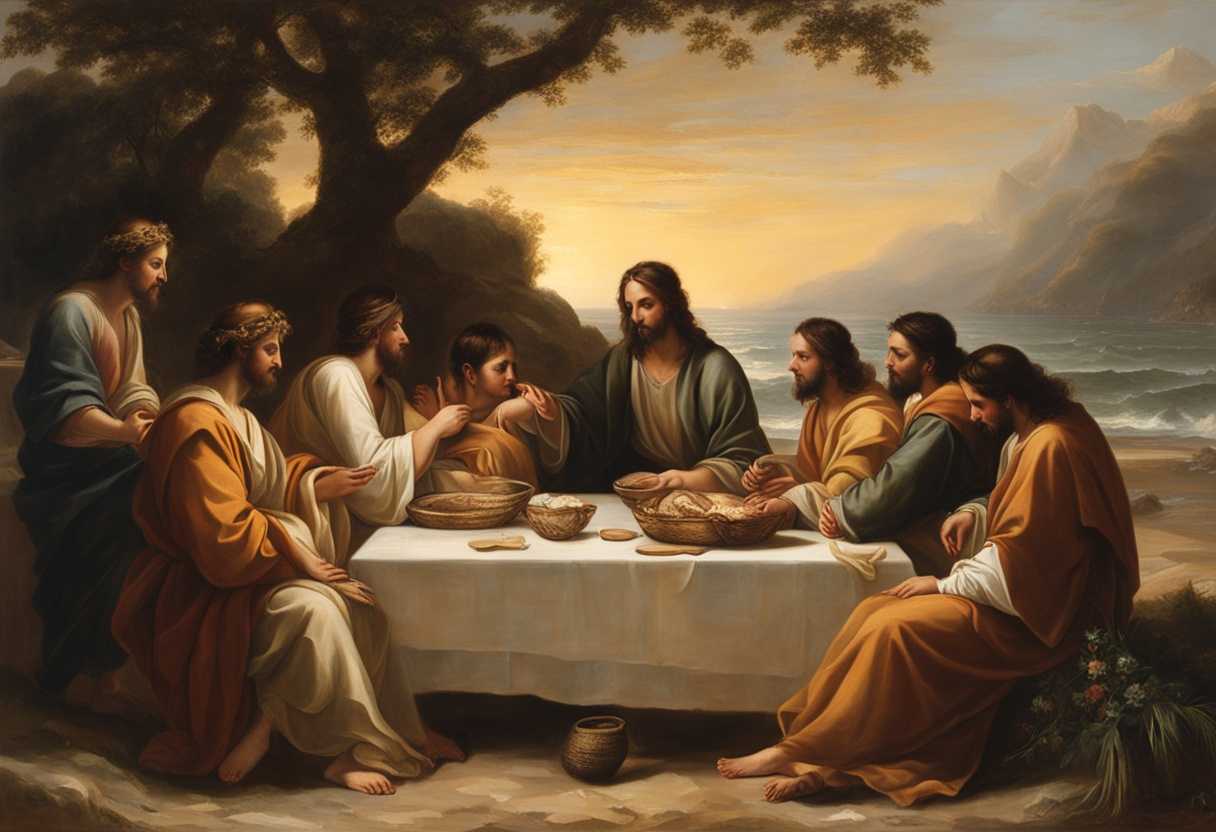
Setting the Scene for John 21:1-23
The scene in John chapter 21 opens with the disciples by the Sea of Tiberias, also known as the Sea of Galilee. The disciples present are Simon Peter, Thomas (called Didymus), Nathanael of Cana in Galilee, the sons of Zebedee (James and John), and two other disciples. They had returned to Galilee after Jesus’ crucifixion and resurrection, unsure of what to do next.
Peter, feeling restless and perhaps seeking solace in the familiar act of fishing, suggests they go fishing. The others agree, and they set out in a boat to fish through the night. However, despite their efforts, they catch nothing. As dawn breaks, they see a figure on the shore who calls out to them, instructing them to cast their net on the right side of the boat. When they do as he says, they catch so many fish that they struggle to haul in the net.
It is at this moment that John recognizes the figure on the shore as Jesus. Overjoyed, Peter jumps into the water and swims to shore to meet Jesus. The scene is one of reconciliation and restoration as Jesus shares a meal with his disciples, including the famous exchange between Jesus and Peter where Peter reaffirms his love for Jesus three times, symbolically undoing his earlier three denials.
What is John 21:1-23 about?
Jesus demonstrates the power of forgiveness and restoration in this verse. Despite Peter denying Jesus three times before His crucifixion, Jesus seeks to reaffirm Peter’s role as a leader within the disciples. This moment is a powerful display of unconditional love and grace. Jesus not only forgives Peter but also entrusts him with the responsibility of caring for His followers. This act highlights the transformative nature of forgiveness and the potential for growth and redemption even after making mistakes.
Have you ever experienced a moment where you were forgiven for a mistake or wrongdoing? How did that make you feel? This verse reminds us of the importance of forgiveness and second chances in our own lives, just as Jesus forgave Peter and welcomed him back into his circle. It challenges us to reflect on how we can extend grace to others and how we can embrace opportunities for growth and healing. This verse ultimately serves as a powerful reminder of the boundless love and mercy that Jesus offers to each of us, no matter our past actions.
Understanding what John 21:1-23 really means
In John 21:1-23, we witness a poignant post-resurrection encounter between Jesus and His disciples by the Sea of Tiberias. The narrative unfolds with themes of restoration, forgiveness, and the call to discipleship, resonating deeply with believers across time.
As the disciples, including Peter, return to fishing, Peter’s declaration, “I am going fishing,” symbolizes a retreat to familiarity and, perhaps, a sense of aimlessness post-Jesus’ crucifixion. This echoes Peter’s earlier call to be a “fisher of men” in Luke 5:1-11, highlighting the contrast between his former life and his new mission.
Jesus’ miraculous instruction to cast the net on the right side of the boat in verses 4-6 leads to an abundant catch, underscoring the fruitfulness of obedience to His word. This mirrors John 15:5, emphasizing the necessity of relying on Jesus for success in all endeavors.
The disciples’ recognition of Jesus in verses 7-14, with John exclaiming, “It is the Lord!” and Peter’s eager swim towards Him, showcases their deep love and longing for their Master. This moment of fellowship and recognition parallels the disciples’ realization of Jesus in the breaking of bread in Luke 24:30-31, emphasizing the importance of communal worship.
In verses 15-17, Jesus’ threefold questioning of Peter’s love serves to restore and reaffirm Peter’s commitment after his three denials, as seen in Matthew 26:75. This act of restoration highlights Jesus’ boundless grace and forgiveness, offering hope to all who have faltered in their faith.
The prophecy of Peter’s martyrdom in verses 18-19 underscores the cost of discipleship, reminding believers of the sacrifices that may accompany following Christ. Peter’s acceptance of this prophecy, as seen in 2 Peter 1:14, reflects his unwavering dedication to his calling despite the challenges ahead.
Jesus’ directive in verses 20-23 to the beloved disciple, “What is that to you? You follow me!” emphasizes the individual nature of discipleship and the futility of comparison. This echoes Hebrews 12:1-2, urging believers to focus on their unique journey with Christ, free from the distractions of comparison.
Today, the themes of restoration, obedience, and individual calling in this passage remain relevant. Just as Peter found forgiveness and purpose after his denial, we too can experience a fresh start in Jesus, as illustrated by anecdotes of personal transformation and renewal. By obeying Jesus’ guidance and embracing our individual callings, we can bear fruit in our lives and find fulfillment in our unique paths, free from the burden of comparison.
In conclusion, John 21:1-23 serves as a poignant reminder of Jesus’ love, forgiveness, and the transformative power of discipleship. It challenges believers to seek restoration, obey His teachings, and embrace their individual journeys with Him, fostering a deeper connection to the heart of Christ and His redemptive mission.
How can we demonstrate our love for Jesus?
We can demonstrate our love for Jesus by following His commandments. We can show our love for Him by caring for and serving others, just as Jesus instructed Peter to “feed his sheep.” We show our devotion to Jesus and follow in His footsteps by spreading love, kindness, and compassion to those around us.
Additionally, we can demonstrate our love for Jesus by spending time with Him in prayer and in the Word. Just like how Jesus often retreated to quiet places to pray and seek guidance from the Father, we can also deepen our relationship with Jesus through prayer and studying the Bible. This allows us to grow closer to Him and understand His teachings, ultimately strengthening our love for Him.
Lastly, we can demonstrate our love for Jesus by sharing His message with others. We can actively share the good news of Jesus with those around us, just as Jesus commanded His disciples to go and make disciples of all nations. We fulfill our purpose as followers of Jesus and show our love for Him in a tangible way by spreading the message of salvation and the love of Christ.
Application
Imagine the courage it takes to dive into the deep end of a pool without knowing how strong the currents are. Peter faced such a moment when Jesus called him. Today, you have your own currents at work and in your family life. Take that bold step of faith and trust in the path Jesus lays out. He’s asking you to follow Him with the same heart and determination you bring to your toughest challenges. Are you ready to answer that call?

Reverend Michael Johnson is an experienced Church Minister with a profound expertise in spirituality and guidance. With a serene presence and a compassionate heart, he has faithfully served his congregation for over 20 years, leading them on a spiritual journey towards inner peace and enlightenment. Reverend Johnson’s extensive knowledge of religious philosophies and profound understanding of human nature have made him a trusted confidant and mentor to many, as he seamlessly weaves his profound wisdom into life teachings. Reverend Johnson’s calming demeanor and empathetic nature continue to uplift and heal souls, nurturing a sense of unity and tranquility within his community.