
John 4:1-26 is about Jesus engaging in a conversation with a Samaritan woman at the well, breaking societal barriers and revealing His identity as the Messiah to her, demonstrating that He offers living water, fulfilling the spiritual thirst of all who believe in Him.
4 Now when Jesus learned that the Pharisees had heard that Jesus was making and baptizing more disciples than John
2 (though Jesus himself did not baptize, but only his disciples),
3 he left Judea and departed again for Galilee.
4 And he had to pass through Samaria.
5 So he came to a town of Samaria called Sychar, near the field that Jacob had given to his son Joseph.
6 Jacob’s well was there; so Jesus, wearied as he was from his journey, was sitting beside the well. It was about the sixth hour.
7 A woman from Samaria came to draw water. Jesus said to her, “Give me a drink.”
8 For his disciples had gone away into the city to buy food.
9 The Samaritan woman said to him, “How is it that you, a Jew, ask for a drink from me, a woman of Samaria?” (For Jews have no dealings with Samaritans.)
10 Jesus answered her, “If you knew the gift of God, and who it is that is saying to you, ‘Give me a drink,’ you would have asked him, and he would have given you living water.”
11 The woman said to him, “Sir, you have nothing to draw water with, and the well is deep. Where do you get that living water?
12 Are you greater than our father Jacob? He gave us the well and drank from it himself, as did his sons and his livestock.
13 Jesus said to her, “Everyone who drinks of this water will be thirsty again,
14 but whoever drinks of the water that I will give him will never be thirsty again. The water that I will give him will become in him a spring of water welling up to eternal life.”
15 The woman said to him, “Sir, give me this water, so that I will not be thirsty or have to come here to draw water.”
16 So Jesus said to her, “Go, call your husband, and come here.”
17 The woman answered him, “I have no husband.” Jesus said to her, “You are right in saying, ‘I have no husband’;
18 There is no fear in love, but perfect love casts out fear. For fear has to do with punishment, and whoever fears has not been perfected in love.
19 The woman said to him, “Sir, I perceive that you are a prophet.
20 Our fathers worshiped on this mountain, but you say that in Jerusalem is the place where people ought to worship.”
21 Jesus said to her, “Woman, believe me, the hour is coming when neither on this mountain nor in Jerusalem will you worship the Father.”
22 You worship what you do not know; we worship what we know, for salvation is from the Jews.
23 But the hour is coming, and is now here, when the true worshipers will worship the Father in spirit and truth, for the Father is seeking such people to worship him.
24 God is spirit, and those who worship him must worship in spirit and truth.
25 The woman said to him, “I know that Messiah is coming (he who is called Christ). When he comes, he will tell us all things.”
26 Jesus said to her, “I who speak to you am he.”
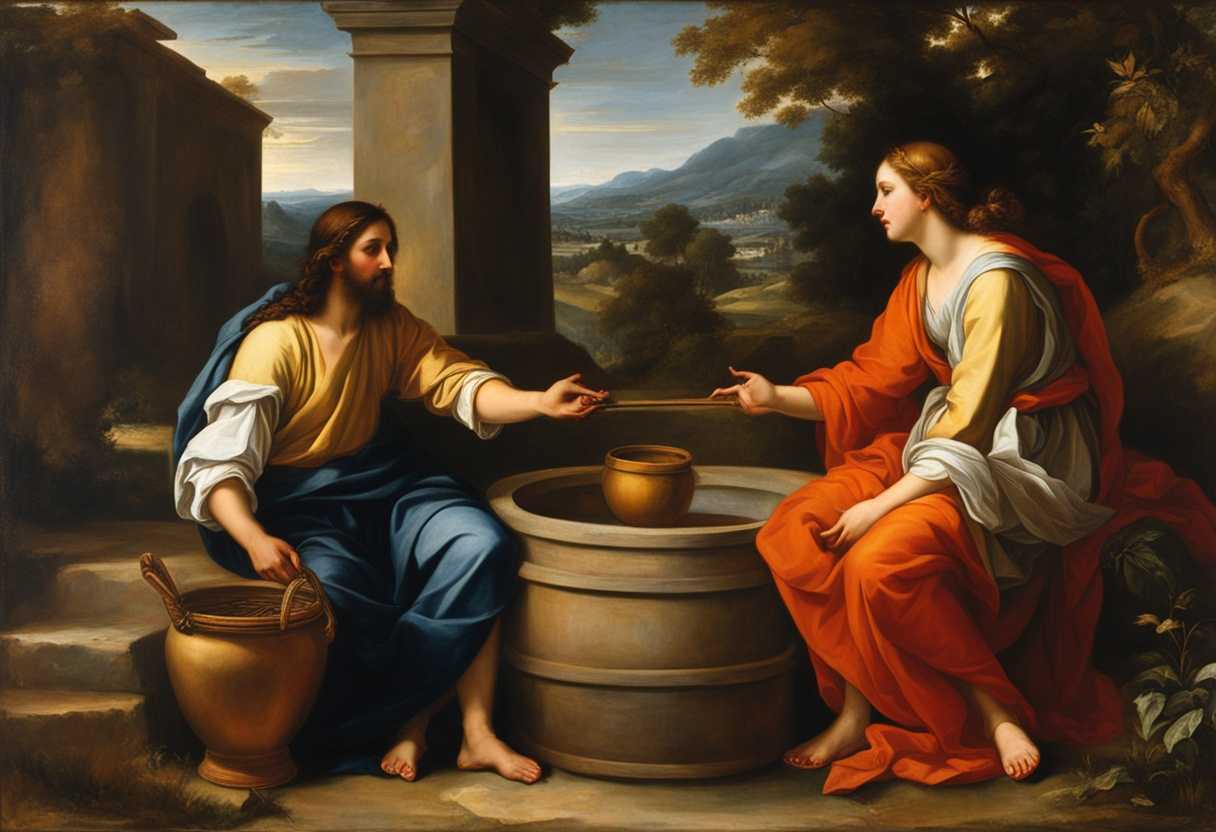
Setting the Scene for John 4:1-26
In John chapter 4, we find Jesus traveling from Judea to Galilee. Along the way, he passes through Samaria, a region where Jews and Samaritans had a long history of animosity and division. Tired from his journey, Jesus stops at a well in the Samaritan town of Sychar while his disciples go into the town to buy food.
At the well, Jesus encounters a Samaritan woman who has come to draw water. This woman, traditionally known as the Samaritan woman or the woman at the well, is surprised when Jesus asks her for a drink of water. Their conversation unfolds, with Jesus revealing his knowledge of her past and offering her living water, a metaphor for eternal life. The woman is intrigued and engages in a deep theological discussion with Jesus, ultimately recognizing him as the Messiah.
The scene at the well is a powerful and transformative encounter between Jesus and the Samaritan woman, breaking down cultural barriers and revealing the universal nature of Jesus’ message. The setting is a simple well in a small Samaritan town, with the dusty road nearby and the midday sun beating down. The conversation between Jesus and the woman is intimate and profound, leading to her belief in him as the Savior.
What is John 4:1-26 about?
Jesus uses the metaphor of “living water” in this powerful moment to convey profound spiritual truths to the Samaritan woman. Water, a vital element for physical life, is used symbolically here to represent the life-giving and cleansing nature of Jesus and His teachings. The living water offered by Jesus satisfies the deepest longings of our souls and brings true fulfillment, just as physical water quenches thirst and sustains life.
Through this encounter, Jesus not only reveals Himself as the Messiah but also breaks down societal barriers and cultural norms by engaging with a Samaritan woman. This interaction showcases Jesus’ radical inclusivity and unconditional love for all people, regardless of their background or circumstances. It serves as a powerful reminder that Jesus came to offer salvation and eternal life to everyone, breaking down barriers and inviting all to partake in the living water of His grace and truth. Let us reflect on this verse and consider the depths of Jesus’ love and the transformative power of His living water in our own lives. How does this encounter challenge us to break down barriers and share the life-giving message of Jesus with all people? How can we allow the living water of Christ to quench our spiritual thirst and sustain us on our journey of faith? Let us seek to embody Jesus’ message of grace and truth in our interactions with others, inspired by His example of love and inclusivity.
Understanding what John 4:1-26 really means
In the Gospel of John, we encounter a powerful and transformative interaction between Jesus and a Samaritan woman at a well. This encounter is significant in the broader narrative as it challenges social norms and reveals the universal nature of Jesus’ message of salvation.
Historically, Jews and Samaritans had deep-rooted animosity and rarely interacted. By engaging in conversation with a Samaritan woman, Jesus defied societal expectations and demonstrated the inclusivity of His ministry. This act of reaching out across cultural divides emphasizes the radical nature of Jesus’ teachings.
One of the key themes in this passage is the metaphor of “living water,” symbolizing eternal life and spiritual fulfillment. Jesus contrasts physical thirst with the everlasting satisfaction that comes from partaking in the water He provides. This metaphor underscores the deeper spiritual needs that Jesus seeks to address in all individuals.
The phrase “True worshipers will worship the Father in the Spirit and in truth” signifies a shift from external rituals to a personal and authentic connection with God. Jesus emphasizes the importance of genuine worship that transcends traditional practices, highlighting the essence of a heartfelt relationship with the Father.
Drawing from related Bible passages such as Isaiah 55:1 and Revelation 22:17, we see a consistent invitation to receive spiritual nourishment and the promise of abundant life through Christ. The imagery of “rivers of living water” flowing from believers further reinforces the idea of spiritual abundance that comes from a deep connection with Jesus.
Today, the message of this encounter remains relevant as people continue to seek fulfillment beyond material needs. Jesus offers a solution that addresses the core longing for spiritual nourishment, inviting all to partake in the eternal satisfaction He provides. Just as Jesus broke down social barriers, we are called to transcend prejudices and embrace the inclusive love that characterizes His ministry.
Consider the story of a person who found profound spiritual fulfillment through faith in Christ, experiencing a transformation akin to drinking from the “living water.” This anecdote illustrates the life-changing power of encountering Jesus and the deep satisfaction that comes from a relationship with Him. Reflecting on personal experiences or testimonies that resonate with the themes of this passage can further illuminate the transformative impact of encountering Jesus.
In conclusion, the encounter at the well with the Samaritan woman reveals Jesus’ offer of eternal life, His call to break down social barriers, and His invitation to worship in spirit and truth. As we contemplate this passage, may we be inspired to seek a deeper relationship with God, to embrace the inclusive message of Jesus, and to find true fulfillment in the living water He freely offers to all who thirst.
How can we truly worship God in Spirit and truth?
We can truly worship God in Spirit and truth by having a genuine, sincere connection with Him from our hearts. This goes beyond just outward rituals or routines, but involves a deep, personal relationship with God. When we worship in Spirit, we engage with God through the Holy Spirit, allowing Him to lead and guide our worship. This means being open to His presence and allowing Him to work in and through us as we worship.
Worshipping in truth involves being authentic and sincere in our worship, without pretense or falsehood. It means aligning our worship with the truth of who God is, His character, His Word, and His will. Worshiping in truth means acknowledging God for who He truly is, without any falsehood or deception. It involves a genuine desire to honor and glorify God in a way that is truthful and reflective of His nature.
Therefore, when we worship God in Spirit and truth, we come before Him with hearts open, sincere, and aligned with His truth. Our worship is not just based on external actions or words, but on a deep, genuine connection with God that is guided by the Holy Spirit and grounded in the truth of who He is.
Application
Think of your life as a bustling city. Each connection you make is like building a bridge. Jesus crossed barriers to reach the Samaritan woman; you can do the same. Engage deeply with those around you, tearing down walls and sharing the love that transforms. Are you ready to build that bridge today?

Reverend Michael Johnson is an experienced Church Minister with a profound expertise in spirituality and guidance. With a serene presence and a compassionate heart, he has faithfully served his congregation for over 20 years, leading them on a spiritual journey towards inner peace and enlightenment. Reverend Johnson’s extensive knowledge of religious philosophies and profound understanding of human nature have made him a trusted confidant and mentor to many, as he seamlessly weaves his profound wisdom into life teachings. Reverend Johnson’s calming demeanor and empathetic nature continue to uplift and heal souls, nurturing a sense of unity and tranquility within his community.