
John 4:1-9 is about Jesus breaking social and cultural norms by engaging in a conversation with a Samaritan woman at the well, demonstrating his mission to reach out to all people regardless of their background or status.
4 Now when Jesus learned that the Pharisees had heard that Jesus was making and baptizing more disciples than John
2 (though Jesus himself did not baptize, but only his disciples),
3 he left Judea and departed again for Galilee.
4 And he had to pass through Samaria.
5 So he came to a town of Samaria called Sychar, near the field that Jacob had given to his son Joseph.
6 Jacob’s well was there; so Jesus, wearied as he was from his journey, was sitting beside the well. It was about the sixth hour.
7 A woman from Samaria came to draw water. Jesus said to her, “Give me a drink.”
8 For his disciples had gone away into the city to buy food.
9 The Samaritan woman said to him, “How is it that you, a Jew, ask for a drink from me, a woman of Samaria?” (For Jews have no dealings with Samaritans.)
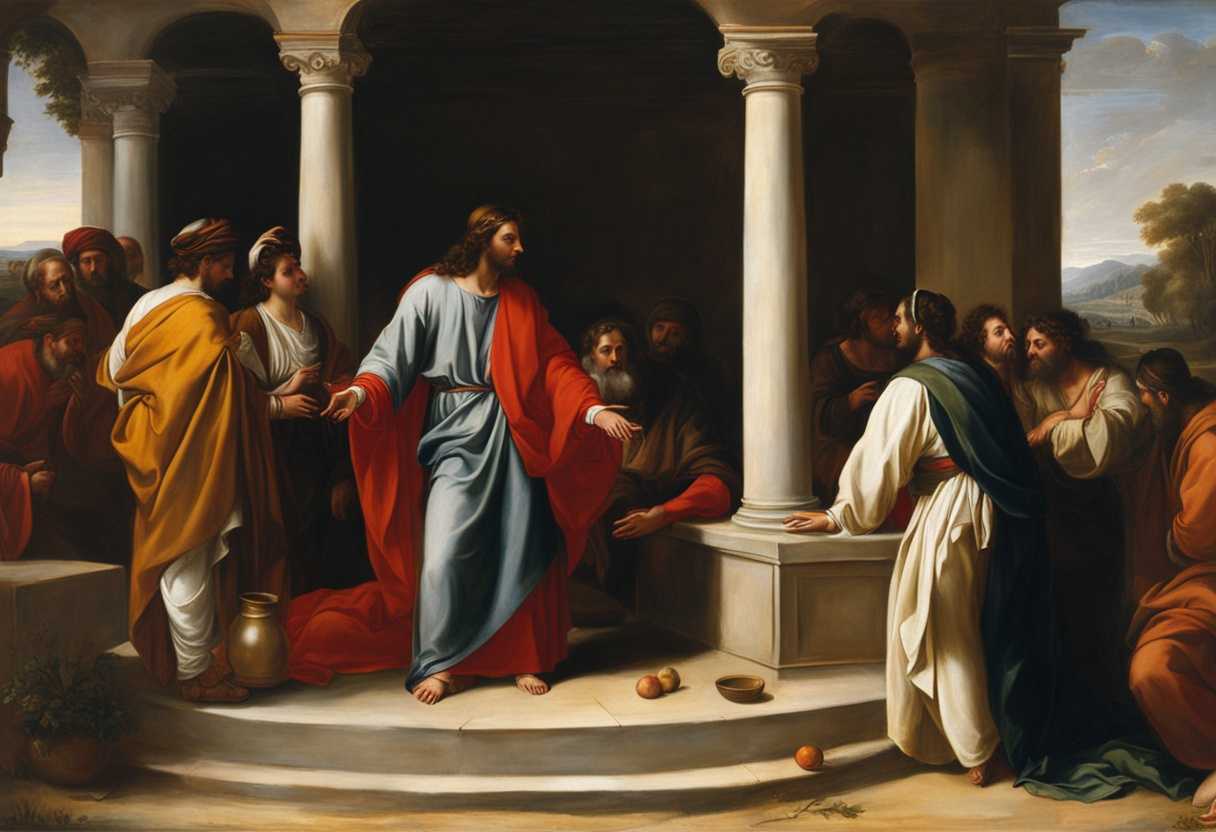
Setting the Scene for John 4:1-9
In John chapter 4, we find Jesus traveling from Judea to Galilee. Along the way, he passes through Samaria, a region where Jews and Samaritans had a long history of animosity and division. Tired from his journey, Jesus stops at a well in the Samaritan town of Sychar while his disciples go into the town to buy food.
At the well, Jesus encounters a Samaritan woman who has come to draw water. This woman, traditionally known as the Samaritan woman or the woman at the well, is surprised when Jesus asks her for a drink of water. This interaction is significant because Jews typically did not associate with Samaritans, let alone speak to Samaritan women in public. Despite the cultural and religious barriers between them, Jesus engages the woman in conversation, revealing his identity as the Messiah and offering her living water.
The scene is set at a well in the heat of the day, with the sun beating down on the dusty ground. The Samaritan woman, unnamed in the text, is portrayed as a marginalized figure, coming to draw water alone, possibly to avoid the judgment of others in the town. Jesus, weary from his journey, sits by the well, initiating a conversation that will ultimately lead to a profound revelation for the Samaritan woman and a demonstration of Jesus’ inclusive love and grace.
What is John 4:1-9 about?
Jesus breaks societal and cultural norms by engaging with a Samaritan woman, who was considered an outcast in this verse. Jesus is not talking about physical water from the well when he offers living water, but rather spiritual nourishment and salvation. He is offering her a new way of life, a fulfilling and eternal life that only He can provide. This encounter also highlights Jesus’ inclusivity and his willingness to reach out to those who are marginalized or deemed unworthy by society.
Just imagine the impact of this interaction on the Samaritan woman – someone who may have felt isolated and unvalued, is now being offered a life-changing gift by Jesus. It challenges us to reflect on our own biases and preconceptions, and reminds us of the transformative power of God’s love and grace. It prompts us to consider how we can follow Jesus’ example by reaching out to those who are often overlooked or marginalized in our own communities. Jesus’ encounter with the Samaritan woman at the well is a powerful reminder of the boundless love and compassion that he offers to all, regardless of their background or circumstances.
Understanding what John 4:1-9 really means
Jesus’ journey from Judea to Galilee, passing through Samaria, sets the stage for a profound encounter at Jacob’s well. The significance of Jesus’ route is not merely geographical but carries a spiritual purpose, emphasizing the divine necessity guiding His steps. As Jesus, weary and thirsty, engages with a Samaritan woman, societal norms are shattered. The cultural divide between Jews and Samaritans, as well as the gender roles of the time, are boldly challenged in this interaction.
In the simple request, “Give me a drink,” Jesus demonstrates His willingness to bridge social barriers and engage with those considered outsiders. The phrase, “For Jews do not associate with Samaritans,” underscores the deep-seated prejudices of the era that Jesus seeks to overcome through His actions. This encounter serves as a powerful example of breaking down barriers and extending grace to all, regardless of societal expectations.
The Parable of the Good Samaritan in Luke 10:25-37 further reinforces Jesus’ teaching on loving one’s neighbor without regard for social or ethnic boundaries. Galatians 3:28 echoes this sentiment, emphasizing the unity and equality found in Christ, transcending societal divisions. These passages highlight the timeless message of inclusivity and love that Jesus embodied in His interactions.
Today, the story of Jesus and the Samaritan woman challenges us to reach out to those different from us, breaking down barriers and fostering understanding. It prompts reflection on our own prejudices and biases, urging us to confront and overcome them in the spirit of Christ’s love. Just as Jesus offered the Samaritan woman “living water,” symbolizing spiritual fulfillment, we are reminded of our need for spiritual nourishment and the call to share this life-giving message with others.
Consider a modern-day parallel where someone from a marginalized community is approached by a person of influence, breaking societal norms with humility and respect. This scenario mirrors Jesus’ interaction, leading to meaningful conversations and deeper connections. It illustrates the transformative power of breaking down barriers and extending grace, echoing the timeless message of love and acceptance exemplified by Jesus.
In conclusion, Jesus’ encounter with the Samaritan woman at the well serves as a poignant reminder of the transformative power of love and grace. It challenges us to emulate His example by looking beyond societal divides, recognizing the worth of every individual, and offering the life-giving message of Christ’s love and salvation to all.
How can we overcome cultural barriers to share God’s love?
To overcome cultural barriers and effectively share God’s love, we can follow the example set by Jesus in the encounter mentioned in John 4:1-9. Jesus reaches out to a Samaritan woman in this story, breaking social norms and cultural prejudices of the time. Similarly, we can show love and respect to people from different backgrounds, acknowledging their value and worth as individuals created by God. We can bridge the gap and build relationships based on mutual understanding and respect by being willing to engage in conversations and interactions with those from different cultures. We can approach others with humility and a genuine desire to connect, listen, and learn from their perspectives, just as Jesus showed empathy and compassion towards the Samaritan woman.
Furthermore, we can overcome cultural barriers by demonstrating Christ’s love through our actions and attitudes. Our lives can be a testimony to the transformative power of God’s love, breaking down walls of division and prejudice. We can break free from cultural stereotypes and biases, paving the way for open and authentic communication that reflects the inclusive nature of God’s kingdom as we embody God’s love in our interactions with others.
Application
Imagine your workplace and family life—where differences often create distance. Like Jesus with the Samaritan woman, we must break down barriers and reach out to others with compassion. Step out of your comfort zone and engage with those who are different. By doing so, you’ll build stronger, more inclusive communities. Will you take this step today and spread kindness beyond your circle?

Reverend Michael Johnson is an experienced Church Minister with a profound expertise in spirituality and guidance. With a serene presence and a compassionate heart, he has faithfully served his congregation for over 20 years, leading them on a spiritual journey towards inner peace and enlightenment. Reverend Johnson’s extensive knowledge of religious philosophies and profound understanding of human nature have made him a trusted confidant and mentor to many, as he seamlessly weaves his profound wisdom into life teachings. Reverend Johnson’s calming demeanor and empathetic nature continue to uplift and heal souls, nurturing a sense of unity and tranquility within his community.