
John 4:4-30 is about the encounter between Jesus and the Samaritan woman at the well, illustrating the transformative power of Jesus’ love and acceptance regardless of social boundaries, leading to the woman’s recognition of Jesus as the Messiah and her proclamation of his message to her community.
4 And he had to pass through Samaria.
5 So he came to a town of Samaria called Sychar, near the field that Jacob had given to his son Joseph.
6 Jacob’s well was there; so Jesus, wearied as he was from his journey, was sitting beside the well. It was about the sixth hour.
7 A woman from Samaria came to draw water. Jesus said to her, “Give me a drink.”
8 For his disciples had gone away into the city to buy food.
9 The Samaritan woman said to him, “How is it that you, a Jew, ask for a drink from me, a woman of Samaria?” (For Jews have no dealings with Samaritans.)
10 Jesus answered her, “If you knew the gift of God, and who it is that is saying to you, ‘Give me a drink,’ you would have asked him, and he would have given you living water.”
11 The woman said to him, “Sir, you have nothing to draw water with, and the well is deep. Where do you get that living water?
12 Are you greater than our father Jacob? He gave us the well and drank from it himself, as did his sons and his livestock.
13 Jesus said to her, “Everyone who drinks of this water will be thirsty again,
14 but whoever drinks of the water that I will give him will never be thirsty again. The water that I will give him will become in him a spring of water welling up to eternal life.”
15 The woman said to him, “Sir, give me this water, so that I will not be thirsty or have to come here to draw water.”
16 So Jesus said to her, “Go, call your husband, and come here.”
17 The woman answered him, “I have no husband.” Jesus said to her, “You are right in saying, ‘I have no husband’;
18 There is no fear in love, but perfect love casts out fear. For fear has to do with punishment, and whoever fears has not been perfected in love.
19 The woman said to him, “Sir, I perceive that you are a prophet.
20 Our fathers worshiped on this mountain, but you say that in Jerusalem is the place where people ought to worship.”
21 Jesus said to her, “Woman, believe me, the hour is coming when neither on this mountain nor in Jerusalem will you worship the Father.”
22 You worship what you do not know; we worship what we know, for salvation is from the Jews.
23 But the hour is coming, and is now here, when the true worshipers will worship the Father in spirit and truth, for the Father is seeking such people to worship him.
24 God is spirit, and those who worship him must worship in spirit and truth.
25 The woman said to him, “I know that Messiah is coming (he who is called Christ). When he comes, he will tell us all things.”
26 Jesus said to her, “I who speak to you am he.”
27 Just then his disciples came back. They marveled that he was talking with a woman, but no one said, “What do you seek?” or, “Why are you talking with her?”
28 So the woman left her water jar and went away into town and said to the people,
29 “Come, see a man who told me all that I ever did. Can this be the Christ?”
30 They went out of the town and were coming to him.
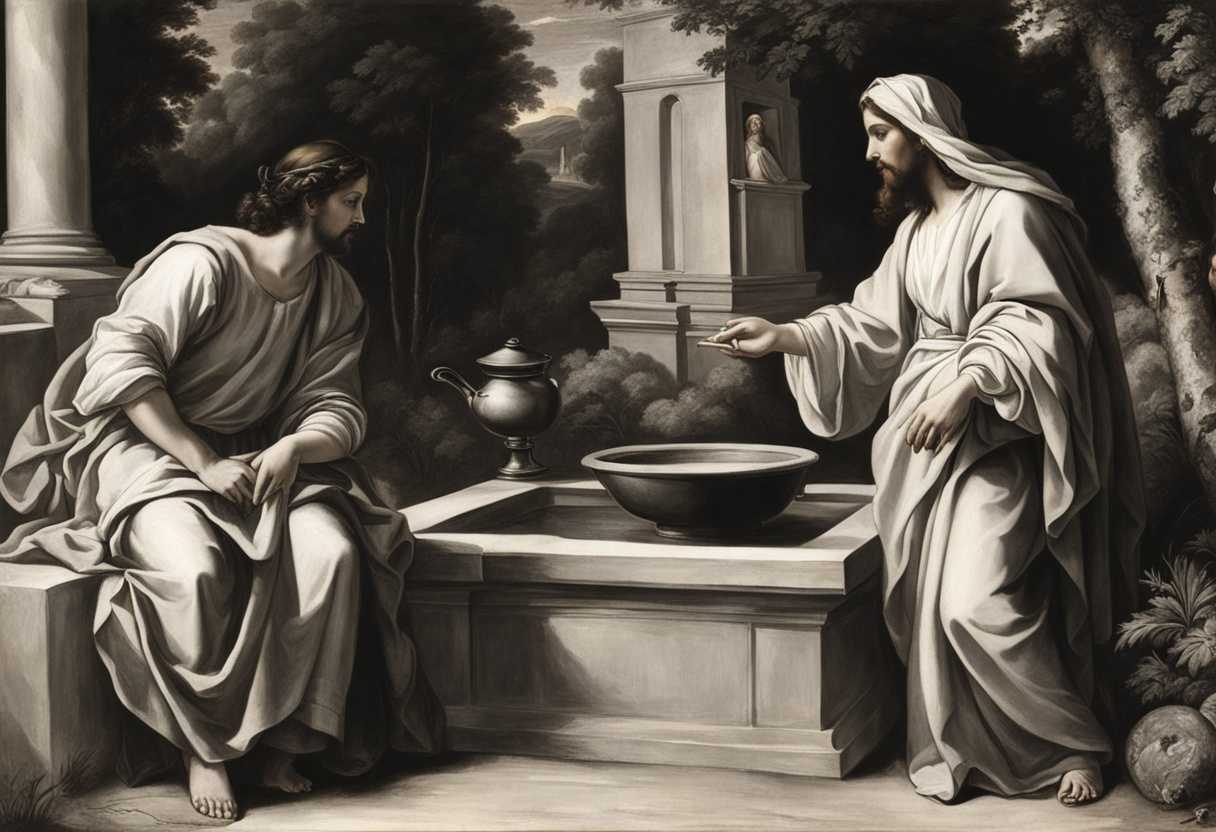
Setting the Scene for John 4:4-30
In John chapter 4, we find Jesus traveling through Samaria on his way to Galilee. Tired from his journey, he stops at a well in the Samaritan town of Sychar while his disciples go into the town to buy food. It is midday, and the sun beats down on the dusty ground as Jesus sits alone by the well, weary and thirsty.
As he rests, a Samaritan woman approaches the well to draw water. This woman, unnamed in the text, is surprised when Jesus asks her for a drink of water. A conversation ensues between them, where Jesus reveals his knowledge of her past and offers her the living water of eternal life. The woman is intrigued and engages in a deep discussion with Jesus about worship and the coming Messiah.
The scene is set against the backdrop of the well, with the ancient stones and the clear water providing a serene setting for this profound encounter between Jesus and the Samaritan woman. The tension between Jews and Samaritans adds depth to the interaction, as Jesus challenges societal norms by engaging with this woman and offering her spiritual truths. The dialogue that unfolds at the well in Sychar is a powerful example of Jesus’ compassion, wisdom, and willingness to reach out to all people, regardless of their background or circumstances.
What is John 4:4-30 about?
Jesus reveals His divine identity to a Samaritan woman by offering her living water in this verse. The symbolism of living water is profound, representing not just physical sustenance but also spiritual renewal and eternal life. Jesus offers this living water to the woman, inviting her to a deeper relationship with Him that transcends societal boundaries and personal circumstances.
Imagine the significance of this encounter – a Jewish man speaking openly to a Samaritan woman, breaking down barriers of culture, tradition, and prejudice. Through this simple gesture of offering living water, Jesus shows us that His message is for all people, regardless of background or identity. He demonstrates His love, compassion, and grace in a way that is inclusive and transformative.
So, as we reflect on this verse, let us consider the universal message of Jesus’ offer of living water. How does this invitation resonate with us personally? Are there barriers in our own lives that need to be broken down in order to fully accept the living water that Jesus freely offers? Let us open our hearts to receive this gift of spiritual nourishment and eternal life, just as the Samaritan woman did on that day by the well.
Understanding what John 4:4-30 really means
The encounter between Jesus and the Samaritan woman at the well is a profound narrative that transcends mere historical events. It unfolds in Samaria, a region marked by deep-seated animosity between Jews and Samaritans, yet Jesus deliberately engages with this woman, defying societal norms. This interaction underscores His overarching mission to reach all people, regardless of their background or social status. It serves as a poignant reminder of the inclusive nature of Jesus’ love and His desire to bridge divides that separate individuals.
In this passage, Jesus offers the Samaritan woman “living water,” a symbolic representation of eternal life and the presence of the Holy Spirit within believers. The concept of “living water” contrasts the fleeting satisfaction derived from earthly sources with the enduring fulfillment that Jesus provides. It beckons individuals to look beyond temporary gratification and embrace the everlasting nourishment that only Christ can offer. Moreover, Jesus emphasizes the significance of authentic worship, highlighting the essence of genuine, heartfelt devotion over superficial religious practices.
Drawing parallels with other biblical passages enriches our understanding of Jesus’ message. The invitation in Isaiah 55:1 to come and partake of the waters mirrors Jesus’ offer of living water, symbolizing a call to spiritual renewal and sustenance. Similarly, Revelation 22:17 reinforces the theme of eternal life through Jesus, inviting all who thirst to receive the free gift of the water of life. These passages collectively underscore the timeless truth of Christ’s redemptive work and His invitation to partake in the eternal blessings He bestows.
The relevance of this narrative extends to contemporary society, urging individuals to emulate Jesus’ example by breaking down barriers that segregate communities. Just as Jesus transcended social, racial, and gender divides in His interaction with the Samaritan woman, we are called to foster inclusivity and unity in our interactions with others. Furthermore, the pursuit of spiritual fulfillment in a world consumed by materialism and transient pleasures remains a pressing challenge. Jesus’ offer of “living water” serves as a poignant reminder of the enduring satisfaction found in a personal relationship with Him.
Consider a scenario where a person, despite achieving worldly success, grapples with a profound sense of emptiness. Their relentless pursuit of fulfillment through external pursuits proves futile, leaving them disillusioned and restless. However, upon encountering the message of Jesus’ “living water,” they experience a transformative awakening. This newfound spiritual connection with God fills the void within them, imparting a profound sense of peace and purpose previously unknown. The Samaritan woman’s encounter with Jesus thus finds resonance in the lives of individuals seeking lasting fulfillment amidst life’s transient offerings.
In conclusion, the narrative of the Samaritan woman at the well serves as a compelling testament to Jesus’ boundless love and the eternal satisfaction He offers to all who seek Him. It beckons us to embrace a deeper spiritual connection with Christ, transcending societal barriers and embracing genuine worship. As we reflect on this encounter, may we be inspired to embody Jesus’ inclusive love and to seek lasting fulfillment in Him, breaking down barriers that divide us and embracing the transformative power of His living water.
How can we share the message of Jesus effectively?
We can share the message of Jesus effectively by being open and approachable to those around us, just as Jesus was with the Samaritan woman at the well in the passage mentioned. Engaging in meaningful conversations and showing genuine care and compassion towards others can create opportunities to share the love and truth of Jesus in a relatable and understandable way.
Additionally, we can learn from Jesus in this passage to meet people where they are at, regardless of their background or past. We can also extend grace and acceptance to those we interact with, showing them that Jesus’s message is for everyone and that His love knows no bounds, just as Jesus did not discriminate against the Samaritan woman but instead offered her living water.
It is important to remember that sharing the message of Jesus is not about forcing beliefs onto others, but rather about showing them through our actions and words the transformative power of His love and grace. We can effectively communicate His message to those around us by living out the principles of kindness, forgiveness, and humility that Jesus exemplified.
Application
Picture yourself, busy with work and family, always on the move. Yet, there’s incredible power in pausing to truly engage with those around us, just as Jesus did with the Samaritan woman. Imagine bridging the gap with someone who’s different from you—offering them acceptance and compassion. This simple act can transform lives, including yours. Ready to make a difference today? What’s stopping you from being a beacon of hope?

Reverend Michael Johnson is an experienced Church Minister with a profound expertise in spirituality and guidance. With a serene presence and a compassionate heart, he has faithfully served his congregation for over 20 years, leading them on a spiritual journey towards inner peace and enlightenment. Reverend Johnson’s extensive knowledge of religious philosophies and profound understanding of human nature have made him a trusted confidant and mentor to many, as he seamlessly weaves his profound wisdom into life teachings. Reverend Johnson’s calming demeanor and empathetic nature continue to uplift and heal souls, nurturing a sense of unity and tranquility within his community.