
John 4:5-29 is about Jesus breaking societal and cultural norms by engaging with a Samaritan woman at the well, showing that he offers spiritual nourishment and living water to all people regardless of their background or status.
5 So he came to a town of Samaria called Sychar, near the field that Jacob had given to his son Joseph.
6 Jacob’s well was there; so Jesus, wearied as he was from his journey, was sitting beside the well. It was about the sixth hour.
7 A woman from Samaria came to draw water. Jesus said to her, “Give me a drink.”
8 For his disciples had gone away into the city to buy food.
9 The Samaritan woman said to him, “How is it that you, a Jew, ask for a drink from me, a woman of Samaria?” (For Jews have no dealings with Samaritans.)
10 Jesus answered her, “If you knew the gift of God, and who it is that is saying to you, ‘Give me a drink,’ you would have asked him, and he would have given you living water.”
11 The woman said to him, “Sir, you have nothing to draw water with, and the well is deep. Where do you get that living water?
12 Are you greater than our father Jacob? He gave us the well and drank from it himself, as did his sons and his livestock.
13 Jesus said to her, “Everyone who drinks of this water will be thirsty again,
14 but whoever drinks of the water that I will give him will never be thirsty again. The water that I will give him will become in him a spring of water welling up to eternal life.”
15 The woman said to him, “Sir, give me this water, so that I will not be thirsty or have to come here to draw water.”
16 So Jesus said to her, “Go, call your husband, and come here.”
17 The woman answered him, “I have no husband.” Jesus said to her, “You are right in saying, ‘I have no husband’;
18 There is no fear in love, but perfect love casts out fear. For fear has to do with punishment, and whoever fears has not been perfected in love.
19 The woman said to him, “Sir, I perceive that you are a prophet.
20 Our fathers worshiped on this mountain, but you say that in Jerusalem is the place where people ought to worship.”
21 Jesus said to her, “Woman, believe me, the hour is coming when neither on this mountain nor in Jerusalem will you worship the Father.”
22 You worship what you do not know; we worship what we know, for salvation is from the Jews.
23 But the hour is coming, and is now here, when the true worshipers will worship the Father in spirit and truth, for the Father is seeking such people to worship him.
24 God is spirit, and those who worship him must worship in spirit and truth.
25 The woman said to him, “I know that Messiah is coming (he who is called Christ). When he comes, he will tell us all things.”
26 Jesus said to her, “I who speak to you am he.”
27 Just then his disciples came back. They marveled that he was talking with a woman, but no one said, “What do you seek?” or, “Why are you talking with her?”
28 So the woman left her water jar and went away into town and said to the people,
29 “Come, see a man who told me all that I ever did. Can this be the Christ?”
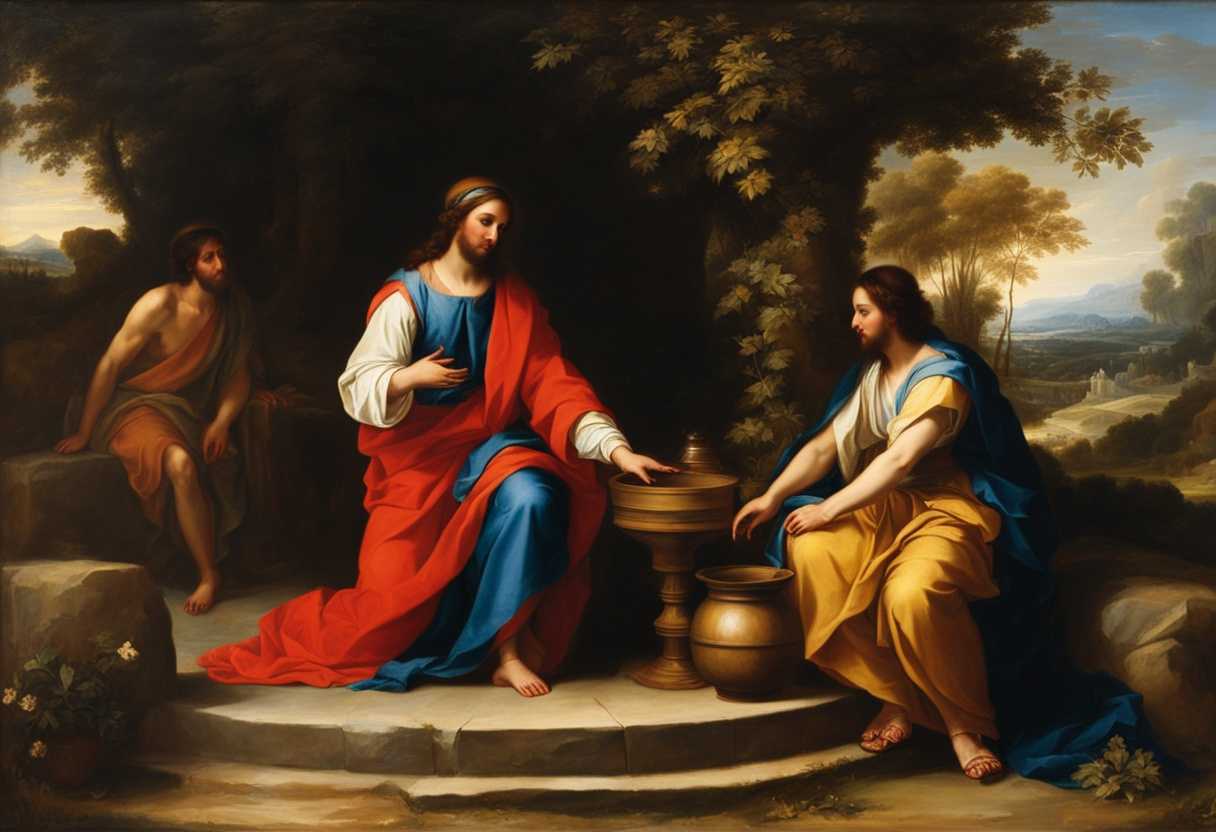
Setting the Scene for John 4:5-29
In John chapter 4, we find Jesus traveling through Samaria on his way to Galilee. Tired from his journey, he stops at a well in the Samaritan town of Sychar while his disciples go into the town to buy food. It is midday, and the sun beats down on the dusty ground as Jesus sits alone by the well.
Soon, a Samaritan woman approaches the well to draw water. This woman, unnamed in the text, is surprised when Jesus asks her for a drink. A conversation ensues between them, where Jesus reveals his knowledge of her past and offers her living water. The woman is intrigued and engages in a deep discussion with Jesus about worship and the Messiah. As their conversation unfolds, the woman begins to realize that Jesus is more than just a weary traveler – he is a prophet, and possibly even the long-awaited Messiah. The encounter at the well becomes a pivotal moment of revelation and transformation for the Samaritan woman, as she comes to believe in Jesus and rushes back to her town to share the good news with others.
What is John 4:5-29 about?
Jesus breaks societal norms by engaging with a Samaritan woman and offering her living water in this powerful verse. Through this interaction, Jesus not only demonstrates his compassion and willingness to reach out to those considered outcasts in society but also reveals his true identity as the Messiah. Just like the physical water that quenches our thirst, Jesus offers us the living water of spiritual renewal and eternal life. We reflect on this verse, considering the significance of Jesus’ offer of living water. What does it mean for Jesus to be the source of this living water that brings forth spiritual nourishment and renewal to our lives? How does this encounter with the Samaritan woman challenge our own perceptions of who is deserving of God’s grace and compassion? Jesus invites us all to partake in the life-giving water that only He can provide, regardless of our background or circumstances.
Understanding what John 4:5-29 really means
Jesus’ journey through Samaria, stopping at Jacob’s well, sets the stage for a remarkable encounter with a Samaritan woman, challenging societal norms by engaging her in conversation. This interaction unfolds into a profound dialogue about “living water,” symbolizing the eternal life and spiritual fulfillment that Jesus provides. The contrast between earthly water, which leaves one thirsty again, and the water Jesus offers, which brings everlasting satisfaction, underscores the transient nature of worldly desires against the enduring fulfillment found in Christ. The concept of true worship, centered on genuine devotion in spirit and truth, is emphasized, highlighting the significance of heartfelt connection with God over mere ritualistic practices.
Drawing parallels from related Bible passages, such as Isaiah 55:1’s invitation to spiritual nourishment and Revelation 22:17’s promise of the water of life, reinforces the timeless message of seeking fulfillment in Christ. Psalm 42:1’s imagery of thirst for God mirrors the deep spiritual longing inherent in humanity, resonating with the Samaritan woman’s search for meaning and satisfaction. In today’s context, where fleeting pleasures often mask deeper needs, the metaphor of “living water” offers a profound invitation to a lasting and profound fulfillment beyond temporary distractions.
The narrative challenges contemporary societal divisions and exclusions, advocating for inclusivity and compassion in the spirit of Christ’s teachings. The call to true worship, characterized by authenticity and sincerity in our relationship with God, transcends mere outward practices, urging a deeper connection with the divine. Consider a scenario where material success fails to quench an inner emptiness, echoing the Samaritan woman’s quest for true fulfillment. This anecdote illustrates the universal human yearning for purpose and contentment, ultimately pointing towards the transformative power of encountering Christ’s love.
In conclusion, the encounter between Jesus and the Samaritan woman serves as a poignant reminder of the profound impact of Christ’s love and the enduring satisfaction He offers. It prompts us to delve into deeper spiritual truths, break down barriers that divide us, and cultivate a community of authentic worship and inclusivity. As we reflect on this narrative, may we be inspired to seek the “living water” that brings eternal fulfillment and to embody the essence of true worship in our daily lives.
How can we overcome cultural barriers to share God’s love?
One way to overcome cultural barriers to share God’s love is by demonstrating respect and understanding towards those from different backgrounds. We can build bridges that lead to meaningful conversations and relationships by acknowledging and valuing the cultural differences of others. We can approach others with a humble and open heart, seeking to understand their perspective while also sharing the message of God’s love, just as Jesus engaged with the Samaritan woman at the well, showing genuine interest in her life and beliefs.
Additionally, it is important to be sensitive to cultural nuances and customs when sharing the gospel. Being aware of how certain words or actions may be perceived in different cultural contexts can help prevent misunderstandings and create a space for fruitful communication. We can break down barriers and create opportunities for God’s love to shine through by adapting our approach to meet people where they are and by showing cultural humility. Cultivating a spirit of humility, empathy, and genuine love for others is ultimately the key to overcoming cultural barriers in sharing God’s love. We too can reach out to those from diverse backgrounds with a posture of grace and understanding, just as Jesus met the Samaritan woman in her cultural context and spoke directly to her heart. We can transcend cultural differences and make God’s love known to all by demonstrating Christ’s love in both our words and actions.
Application
Think of your hectic day, juggling work and family responsibilities—now imagine a pause, a moment to recharge your spirit. Meeting Jesus is like that vital break, transforming everything. Don’t let your past or doubts chain you; step forward, as you are, ready to embrace His love and truth. Will you take that step today and let Him refresh your weary soul?

Reverend Michael Johnson is an experienced Church Minister with a profound expertise in spirituality and guidance. With a serene presence and a compassionate heart, he has faithfully served his congregation for over 20 years, leading them on a spiritual journey towards inner peace and enlightenment. Reverend Johnson’s extensive knowledge of religious philosophies and profound understanding of human nature have made him a trusted confidant and mentor to many, as he seamlessly weaves his profound wisdom into life teachings. Reverend Johnson’s calming demeanor and empathetic nature continue to uplift and heal souls, nurturing a sense of unity and tranquility within his community.