
John 4:7-8 is about Jesus engaging in a conversation with a Samaritan woman at the well, illustrating his radical inclusivity by breaking social norms and barriers through welcoming dialogue and offering living water to all.
7 A woman from Samaria came to draw water. Jesus said to her, “Give me a drink.”
8 For his disciples had gone away into the city to buy food.
Setting the Scene for John 4:7-8
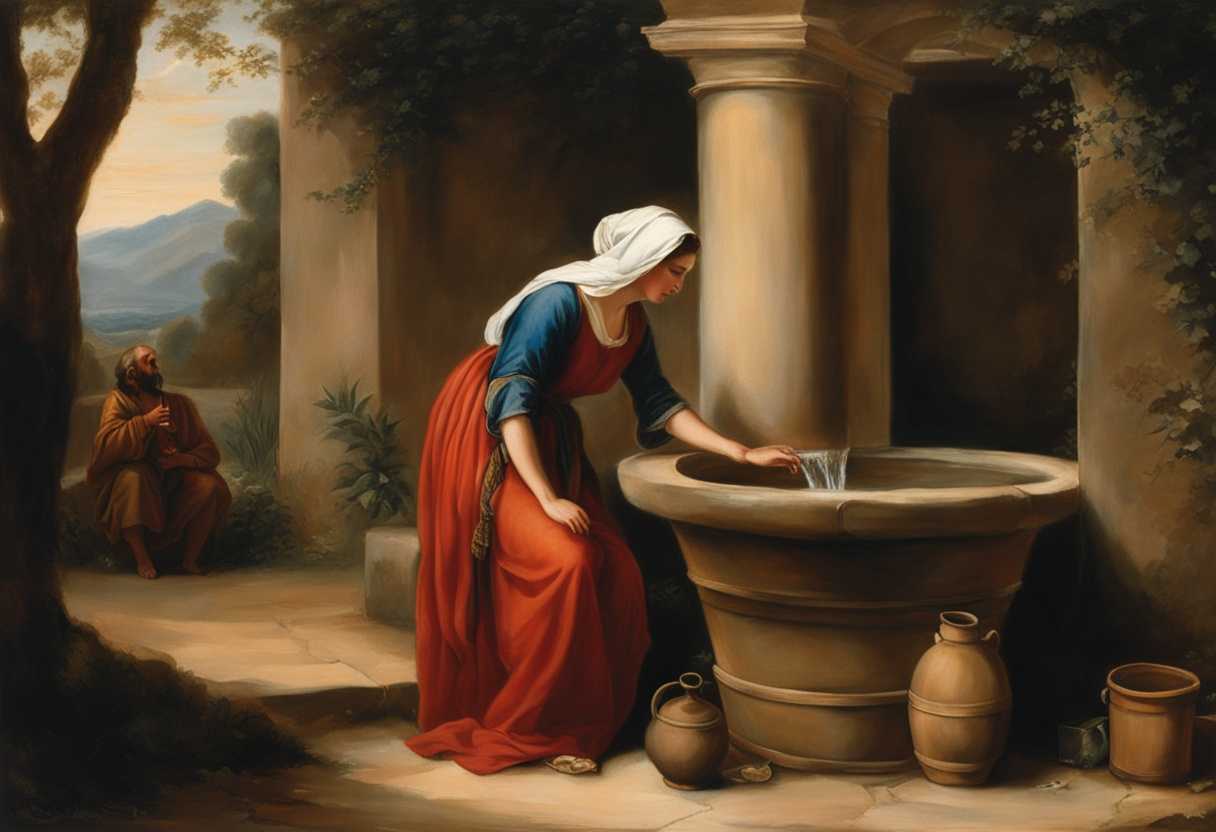
In John chapter 4, we find Jesus traveling through Samaria on his way to Galilee. Tired from his journey, he stops at a well in the Samaritan town of Sychar while his disciples go into the town to buy food. It is midday, and the sun beats down on the dusty ground as Jesus sits alone by the well, seeking respite from the heat.
As Jesus rests, a Samaritan woman approaches the well to draw water. Her name is not mentioned in the passage, but we learn that she is surprised when Jesus, a Jewish man, speaks to her and asks for a drink of water. The interaction between Jesus and the Samaritan woman is significant because of the cultural and religious divide between Jews and Samaritans at that time. Despite this, Jesus engages her in conversation, revealing his identity as the Messiah and offering her living water.
The scene at the well is a poignant moment of connection and revelation, where Jesus breaks down barriers of prejudice and offers the gift of salvation to a woman who is seen as an outcast. The dusty surroundings of the well, the heat of the day, and the unexpected encounter between Jesus and the Samaritan woman all contribute to the powerful message of love and inclusion that is central to this passage in John chapter 4.
What is John 4:7-8 about?
This verse encapsulates the core message of Jesus’ ministry – love, acceptance, and breaking down barriers. Jesus’ act of asking a Samaritan woman for water was radical in a time when many Jews looked down upon Samaritans. It symbolizes his willingness to engage with and show kindness to all people, regardless of societal norms or prejudices. It shows that Jesus sees beyond cultural, racial, or social boundaries, emphasizing the importance of love and compassion for all.
This encounter also highlights the universal nature of Jesus’ message – that it is not limited to a particular group or ethnicity. Jesus demonstrates that his love and salvation are available to everyone, not just to a select few, by reaching out to the Samaritan woman. He invites us to look beyond surface differences and see the inherent worth and dignity of every individual. We are called to embrace and show kindness to all people, recognizing the value and beauty in diversity, just as Jesus welcomed the Samaritan woman.
Understanding what John 4:7-8 really means
In the Gospel of John, we come across a poignant moment where Jesus defies societal norms by engaging in a conversation with a Samaritan woman at a well. This encounter is significant not only for its cultural implications but also for the profound spiritual truths it unveils. The simplicity of the scene, with a woman coming to draw water, belies the depth of the dialogue that follows. Jesus’ request for a drink serves as a catalyst for a discussion that transcends physical thirst, delving into the realm of spiritual longing and the promise of living water.
The phrase “Give me a drink” uttered by Jesus carries layers of meaning beyond a mere request for water. It symbolizes his willingness to bridge divides and initiate a dialogue that goes beyond the surface. In a world marked by divisions and prejudices, this simple act of asking for a drink becomes a powerful metaphor for breaking down barriers and fostering understanding. Just as Jesus sought water from a Samaritan woman, we are called to engage with those who may be different from us, recognizing the shared humanity that unites us all.
The concept of living water, introduced by Jesus in this encounter, resonates throughout the Bible as a symbol of spiritual sustenance and eternal life. In John 4:13-14, Jesus contrasts the temporary satisfaction of physical water with the everlasting fulfillment found in the living water he offers. This imagery is echoed in John 7:37-38, where Jesus extends an invitation to all who are thirsty to come to him and partake of the rivers of living water. The Old Testament also foreshadows this promise in Isaiah 55:1, inviting all to drink freely from the well of God’s provision and salvation.
The relevance of this narrative extends to contemporary society, where the themes of breaking barriers, addressing spiritual thirst, and embracing inclusivity remain as vital as ever. Just as Jesus crossed cultural boundaries to reach the Samaritan woman, we are called to transcend our own prejudices and preconceptions to connect with others authentically. The story serves as a reminder that God’s love and salvation are not limited by human constructs but are freely available to all who seek them.
In practical terms, this narrative challenges us to emulate Jesus’ example by reaching out to those on the margins, listening to their voices, and recognizing their inherent worth. Imagine a scenario where a person from a marginalized community is approached with humility and respect, sparking a dialogue that leads to mutual understanding and respect. Whether it be a community leader seeking advice from the marginalized or a gesture of kindness extended across social divides, the essence of this encounter lies in recognizing the dignity of every individual and the transformative power of genuine connection.
In conclusion, the encounter between Jesus and the Samaritan woman serves as a timeless lesson in compassion, inclusivity, and spiritual fulfillment. Through a simple request for water, Jesus opens the door to a deeper conversation about our deepest longings and the eternal satisfaction found in him. As we reflect on this narrative, may we be inspired to break down barriers, quench our spiritual thirst with the living water of Christ, and extend the same grace and love to all those we encounter in our journey of faith.
What impact does love have on our relationships?
Love has a profound impact on our relationships. It allows us to truly see and understand others, and vice versa. When we love one another, we are able to see past external appearances and societal labels, and truly connect on a deeper level. Love fosters compassion, empathy, and understanding, which are essential for building strong and meaningful relationships.
Furthermore, love also helps us to be more vulnerable and authentic with one another. It creates a safe space where we can be our true selves without fear of judgment or rejection. This vulnerability fosters intimacy and trust between individuals, strengthening the bond in the relationship. Love, therefore, plays a crucial role in nurturing and maintaining healthy, fulfilling relationships.
Application
Think about Jesus at the well, engaging with the woman despite their differences. Just like balancing work deadlines and family responsibilities, He showed love and compassion effortlessly. Can you do the same with those in your life? Reach out with empathy and kindness. Embrace others with the same grace. How will you make this change today?

Reverend Michael Johnson is an experienced Church Minister with a profound expertise in spirituality and guidance. With a serene presence and a compassionate heart, he has faithfully served his congregation for over 20 years, leading them on a spiritual journey towards inner peace and enlightenment. Reverend Johnson’s extensive knowledge of religious philosophies and profound understanding of human nature have made him a trusted confidant and mentor to many, as he seamlessly weaves his profound wisdom into life teachings. Reverend Johnson’s calming demeanor and empathetic nature continue to uplift and heal souls, nurturing a sense of unity and tranquility within his community.