
7 A woman from Samaria came to draw water. Jesus said to her, “Give me a drink.”
Setting the Scene for John 4:7
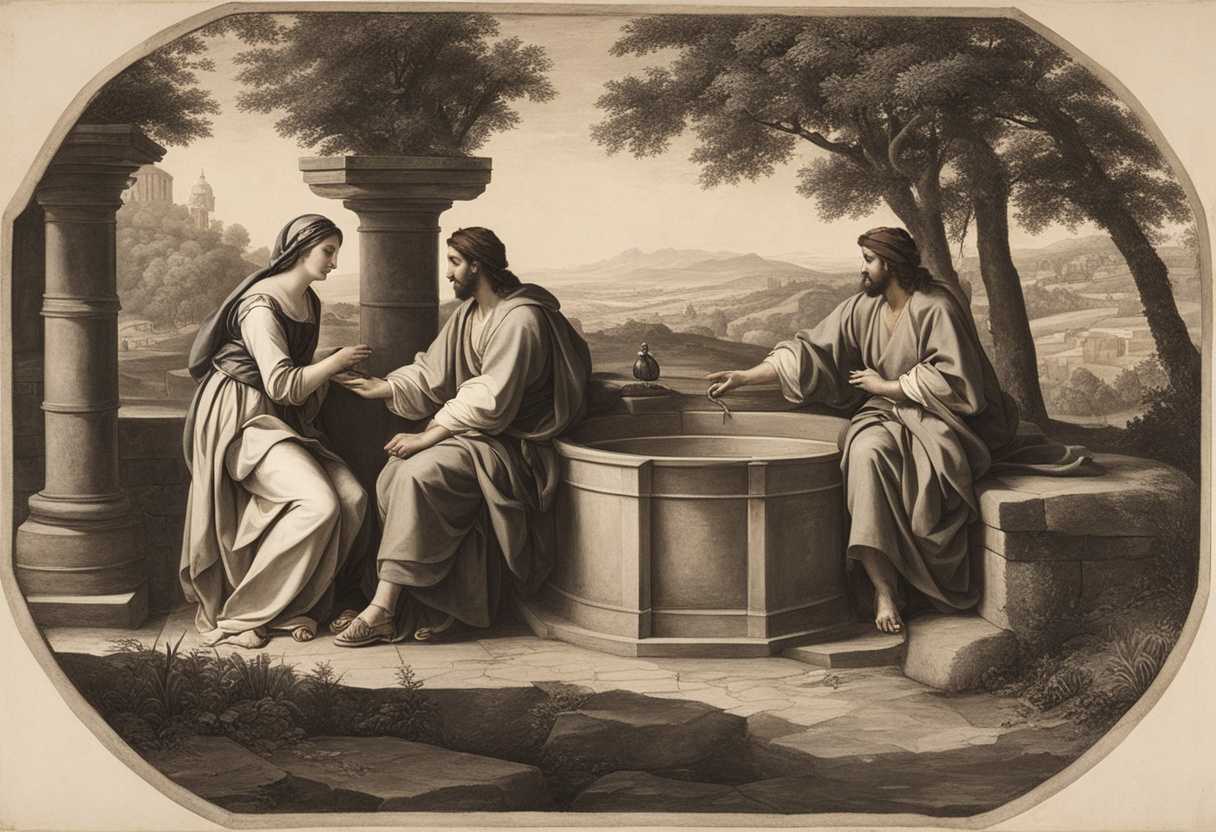
In John chapter 4, we find Jesus traveling through Samaria on his way to Galilee. Tired from his journey, he stops at a well in the Samaritan town of Sychar while his disciples go into the town to buy food. It is midday, and the sun beats down on the dusty ground as Jesus sits alone by the well, seeking respite from the heat.
As he rests, a Samaritan woman approaches the well to draw water. Her name is not mentioned in the passage, but we learn that she has had five husbands and is currently living with a man who is not her husband. This woman, a social outcast in her community, is surprised when Jesus asks her for a drink of water. A conversation ensues between them, where Jesus reveals his knowledge of her past and offers her the living water of eternal life.
The scene is set against the backdrop of the well, with the ancient stones and the clear water providing a tranquil setting for this profound encounter between Jesus and the Samaritan woman. The tension between their different backgrounds and beliefs is palpable as they discuss matters of faith and salvation, leading to a transformative moment for the woman as she recognizes Jesus as the Messiah.
What is John 4:7 about?
Jesus’ interaction with the Samaritan woman in this verse holds deep significance. At that time, Jews and Samaritans had a history of conflict and animosity. Jesus challenges societal norms and breaks down barriers of prejudice and discrimination by asking the Samaritan woman for water. This simple act conveys a powerful message of inclusivity and love, showing that Jesus’ message is for everyone, regardless of their background or social status.
The mention of “living water” in this conversation symbolizes the spiritual nourishment and fulfillment that Jesus offers to all who believe in him. It is a metaphor for the eternal life and satisfaction that can only come from a relationship with God. Jesus, by engaging in this dialogue with the Samaritan woman, is not only offering her physical water but also inviting her to partake in the spiritual abundance that he provides. This encounter teaches us about the transformative power of Jesus’ love and the universality of his message, reaching out to all people, regardless of their past or circumstances.
Reflecting on this verse prompts us to consider how we interact with others. Are we willing to engage with those who are different from us, to break down barriers and show love and compassion? Just as Jesus did with the Samaritan woman, we are called to reach out to all people, offering them not just physical refreshment but also the life-changing message of salvation and grace. This verse challenges us to see beyond societal divisions and to embrace the opportunity to share God’s love with everyone we encounter.
Understanding what John 4:7 really means
Structure for Commentary
1. Introduction to the Verse
2. Contextual Background
3. Detailed Phrase Analysis
4. Related Biblical Passages
5. Contemporary Relevance
6. Anecdotal Illustration
7. Concluding Thoughts
Commentary on John 4:7
Introduction to the Verse
John 4:7 introduces a pivotal moment in the Gospel of John where Jesus encounters a Samaritan woman at the well. This meeting is not just a simple conversation but a profound interaction that breaks social, cultural, and religious barriers. Let’s explore its deeper meaning.
Contextual Background
To understand this verse fully, we need to look at the context. Jesus was traveling from Judea to Galilee and decided to pass through Samaria, a region Jews typically avoided due to longstanding hostilities. He stops at Jacob’s well, tired and thirsty. It is here that a Samaritan woman comes to draw water. This setting is crucial because it highlights the radical nature of Jesus’ actions. Jews and Samaritans did not associate with each other in that era, and men rarely spoke to women in public.
Detailed Phrase Analysis
When the verse says, “A woman of Samaria came to draw water,” it sets up an encounter that defies societal norms. The phrase “came to draw water” on the surface seems mundane, but in the biblical context, wells were often places of significant social and spiritual encounters. The act of drawing water symbolizes the woman’s daily sustenance needs but also foreshadows the spiritual nourishment she is about to receive.
Related Biblical Passages
This encounter echoes other significant biblical moments. For instance, Genesis 24 recounts how Rebekah was chosen as Isaac’s bride at a well. Additionally, the encounter at the well parallels Jesus’ later declaration in John 7:37-38, where He speaks of offering “living water” to those who thirst. These connections underscore the transformative power of divine encounters at wells.
Contemporary Relevance
Why is this relevant today? We live in a world often divided by social, cultural, and religious barriers. This verse reminds us that Jesus transcends these divisions. He reaches out to those on the margins of society, offering them not just physical sustenance but spiritual wholeness. It challenges us to break down our own barriers and extend grace and kindness to everyone, regardless of their background. John, despite his busy schedule, decided to volunteer at a local homeless shelter. One day, he struck up a conversation with a woman named Maria. Like the woman at the well, Maria felt ostracized and judged. Through their conversations, John realized that meeting Maria’s physical needs was important, but offering her dignity and respect was transformative. This modern-day example reflects the essence of Jesus’ encounter at the well. John 4:7 is a verse rich with meaning, in summary. It teaches us about breaking barriers, offering grace, and recognizing the profound in the mundane. We should remember that every interaction holds the potential for spiritual significance as we go about our daily lives. Who knows? The next time you extend kindness to a stranger, you might just be participating in a divine encounter.
This commentary encourages us to reflect on how we interact with others, urging us to see beyond societal norms and embrace the deeper, spiritual connections in our everyday lives.
How can we show love and compassion to others?
We can show love and compassion to others by reaching out to them and building relationships, just as Jesus did with the woman at the well. We can take the time to engage in conversations, listen attentively to their stories, and show genuine interest in their well-being. We can demonstrate care and understanding for others, ultimately fostering a sense of love and compassion in our interactions by being present and empathetic.
Additionally, we can offer grace and forgiveness to those around us, recognizing that everyone has their own struggles and shortcomings. Just as Jesus showed understanding and acceptance towards the woman at the well despite societal norms, we can also extend grace and compassion to others, knowing that we all fall short at times. We can create an environment of love and compassion that transcends judgment and condemnation by practicing forgiveness and showing understanding.
Furthermore, we can show love and compassion through acts of service and kindness. Whether it’s offering a helping hand to someone in need, sharing resources with those less fortunate, or simply being a source of support and encouragement, our actions can speak volumes about our care for others. We can embody the spirit of compassion that Jesus exemplified during his ministry on Earth by demonstrating love through tangible gestures of kindness and generosity.
Application
Think about John 4:7 for a moment. Just like balancing work and family, this verse reminds us to connect with people who might be on a different path. Imagine the impact of inviting someone new into your circle, someone who might believe differently or look different. It’s not about grand gestures but simple acts of compassion and understanding. How will you extend a hand today?

Reverend Michael Johnson is an experienced Church Minister with a profound expertise in spirituality and guidance. With a serene presence and a compassionate heart, he has faithfully served his congregation for over 20 years, leading them on a spiritual journey towards inner peace and enlightenment. Reverend Johnson’s extensive knowledge of religious philosophies and profound understanding of human nature have made him a trusted confidant and mentor to many, as he seamlessly weaves his profound wisdom into life teachings. Reverend Johnson’s calming demeanor and empathetic nature continue to uplift and heal souls, nurturing a sense of unity and tranquility within his community.