
John 4:9-10 is about Jesus breaking social norms by engaging in conversation with a Samaritan woman at the well and offering her living water, symbolizing spiritual nourishment and eternal life that transcends cultural divides and societal boundaries.
9 The Samaritan woman said to him, “How is it that you, a Jew, ask for a drink from me, a woman of Samaria?” (For Jews have no dealings with Samaritans.)
10 Jesus answered her, “If you knew the gift of God, and who it is that is saying to you, ‘Give me a drink,’ you would have asked him, and he would have given you living water.”
Setting the Scene for John 4:9-10
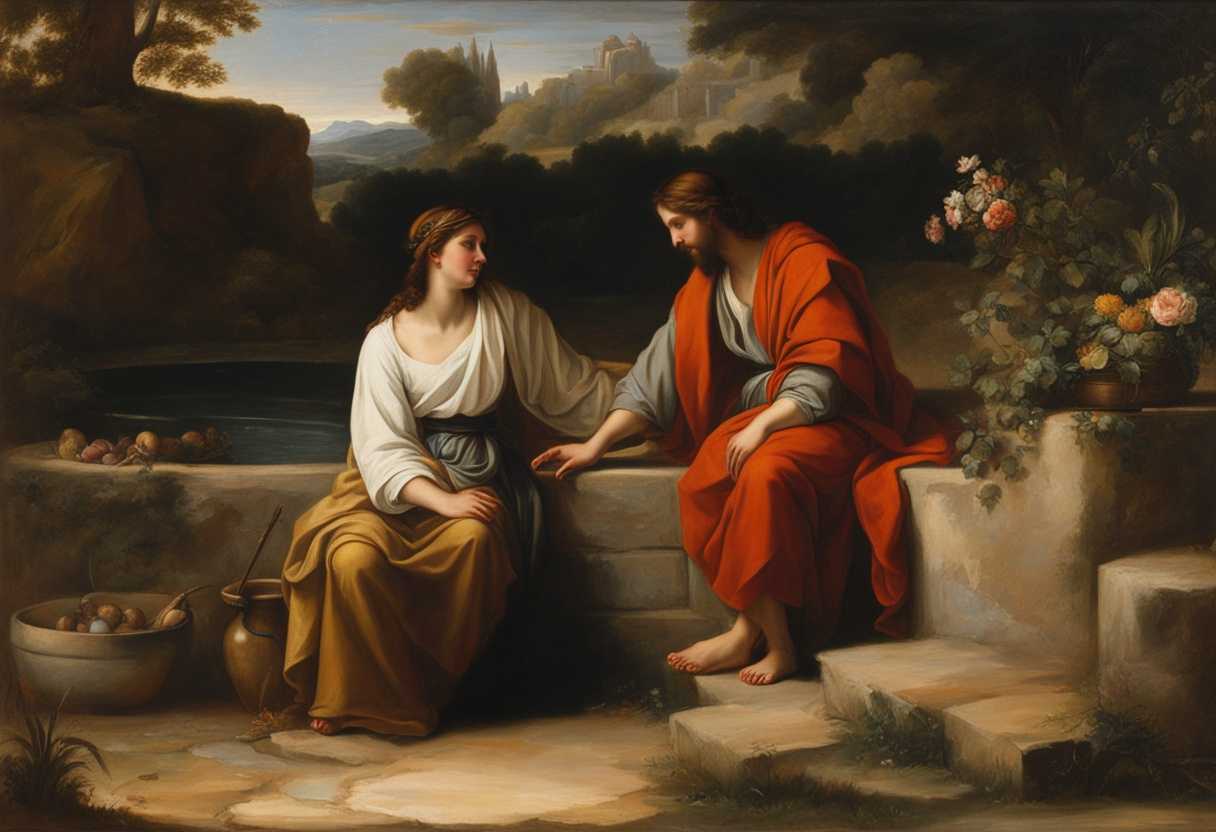
In John chapter 4, we find Jesus traveling through Samaria on his way to Galilee. Tired from his journey, he stops at a well in the Samaritan town of Sychar while his disciples go into the town to buy food. It is midday, and the sun beats down on the dusty ground as Jesus sits alone by the well, seeking respite from the heat.
As he rests, a Samaritan woman approaches the well to draw water. This woman, unnamed in the text, is surprised when Jesus asks her for a drink of water. The Samaritans and Jews had a long history of animosity towards each other, so her astonishment at Jesus, a Jewish man, speaking to her is understandable. Their interaction at the well is a significant moment, as Jesus breaks down social and cultural barriers by engaging in conversation with this Samaritan woman.
The scene is set against the backdrop of a simple well, surrounded by fields and the humble dwellings of the Samaritan town. The encounter between Jesus and the Samaritan woman at the well becomes a powerful example of Jesus’ willingness to reach out to all people, regardless of their background or social status.
What is John 4:9-10 about?
This verse highlights the profound message of breaking down cultural barriers and defying societal norms by depicting Jesus engaging with a Samaritan woman. A deep-seated animosity between Jews and Samaritans in ancient Palestine stemmed from religious and ethnic differences. Jesus challenges the prevalent prejudices and social hierarchies of the time by engaging in conversation with a Samaritan woman and treating her with respect. He exemplifies the value of seeing beyond cultural divides and recognizing the inherent dignity and worth of every individual, regardless of their background or ethnicity.
Through this act of compassion and inclusion, Jesus teaches us about the transformative power of love and acceptance. He shows us that true spiritual growth and connection can only be achieved when we embrace all people with open hearts and minds, transcending the limitations of cultural biases and stereotypes. Jesus sets a powerful example of how we can create a more just and equitable society by reaching out to the marginalized and disenfranchised, breaking down barriers, and fostering understanding and empathy among all people. This verse ultimately challenges us to reflect on our own attitudes and prejudices, inspiring us to follow Jesus’ lead in building bridges across cultural divides and cultivating a more inclusive and compassionate world.
Understanding what John 4:9-10 really means
In the Gospel of John, we encounter a poignant moment where Jesus defies cultural norms by engaging in a conversation with a Samaritan woman at a well. The tension between Jews and Samaritans adds depth to this interaction, highlighting the societal barriers that Jesus transcends through His actions. When the Samaritan woman questions Jesus’ request for water, she unwittingly sets the stage for a profound spiritual dialogue, showcasing the transformative power of breaking down social and religious divides.
The Samaritan woman’s incredulous response, “You are a Jew and I am a Samaritan woman. How can you ask me for a drink?” underscores the deep-seated animosity between their communities. Jesus’ willingness to engage with her despite these divisions challenges us to reflect on our own prejudices and biases. It prompts us to consider how we can emulate His example by reaching out to those different from us, fostering unity and understanding in a world often marked by division.
Jesus’ cryptic statement, “If you knew the gift of God and who it is that asks you for a drink,” hints at the spiritual depth of His message. By alluding to the gift of salvation and eternal life, Jesus invites the Samaritan woman—and us—to look beyond the physical realm and seek spiritual nourishment. This call to transcend earthly concerns resonates with a timeless truth: true fulfillment comes not from material possessions but from a relationship with the divine.
The imagery of “living water” that Jesus offers the Samaritan woman symbolizes the Holy Spirit and the eternal life found in Him. This metaphorical language points to a spiritual sustenance that quenches a deeper thirst within us—a thirst for meaning, purpose, and connection with God. Just as physical water sustains our bodies, the living water Jesus provides nourishes our souls, offering a source of eternal satisfaction that transcends temporal desires.
In our contemporary context, the story of Jesus and the Samaritan woman serves as a powerful reminder to break down barriers that separate us from one another. Whether those barriers are social, racial, or religious, Jesus’ example calls us to bridge divides and extend love and grace to all. By recognizing Jesus’ true identity as the source of living water, we open ourselves to a transformative experience that leads to eternal life and genuine fulfillment.
As we ponder this encounter at the well, let us reflect on how we can embody Jesus’ radical love in our interactions with others. May we seek to understand and appreciate the differences that make each individual unique, recognizing that in Christ, we find unity that transcends all earthly distinctions. Just as Jesus offered the Samaritan woman living water, may we too share the life-giving message of hope and salvation with those around us, breaking down barriers and ushering in a kingdom of love and reconciliation.
What misconceptions do we have about God’s grace?
One misconception we may have about God’s grace is that it is something we have to earn or deserve. Jesus offers the Samaritan woman living water as a gift in the referenced verse, not because of anything she has done to deserve it, but because of God’s grace and love for her. This shows us that God’s grace is freely given and not based on our actions or worthiness.
Another misconception is that God’s grace is limited or restricted only to certain people. Jesus offers living water to a Samaritan woman in this verse, showing that God’s grace is available to all, regardless of background, ethnicity, or social standing. God’s grace is inclusive and available to everyone who is willing to receive it.
Lastly, we may also wrongly think that God’s grace is something we can manipulate or control. The Samaritan woman did not do anything to earn the living water; it was given to her simply because of God’s grace. This reminds us that God’s grace is a gift that we cannot earn or manipulate through our actions, but rather something freely given by God out of His love and mercy.
Application
Think of your workplace. It’s like a giant, diverse family. What if you chose to be the one who breaks down the walls we all build up? Be the hand that reaches out, the smile that goes the extra mile. Make today’s task to connect, include, and show kindness, especially to those you don’t usually interact with. How can you be the bridge that brings people together today?

Reverend Michael Johnson is an experienced Church Minister with a profound expertise in spirituality and guidance. With a serene presence and a compassionate heart, he has faithfully served his congregation for over 20 years, leading them on a spiritual journey towards inner peace and enlightenment. Reverend Johnson’s extensive knowledge of religious philosophies and profound understanding of human nature have made him a trusted confidant and mentor to many, as he seamlessly weaves his profound wisdom into life teachings. Reverend Johnson’s calming demeanor and empathetic nature continue to uplift and heal souls, nurturing a sense of unity and tranquility within his community.