
John 5:2-8 is about Jesus healing a man who had been an invalid for 38 years, highlighting the power of faith and divine intervention in bringing about miracles and transformation in one’s life.
2 Now there is in Jerusalem by the Sheep Gate a pool, in Aramaic called Bethesda, which has five roofed colonnades.
3 In these lay a multitude of invalids—blind, lame, and paralyzed.
4 for an angel of the Lord went down at certain seasons into the pool and stirred up the water; whoever stepped in first after the stirring of the water was healed of whatever disease he had.
5 One man was there who had been an invalid for thirty-eight years.
6 When Jesus saw him lying there and knew that he had already been there a long time, he said to him, “Do you want to be healed?”
7 The sick man answered him, “Sir, I have no one to put me into the pool when the water is stirred up, and while I am going another steps down before me.”
8 Jesus said to him, “Get up, take up your bed, and walk.”
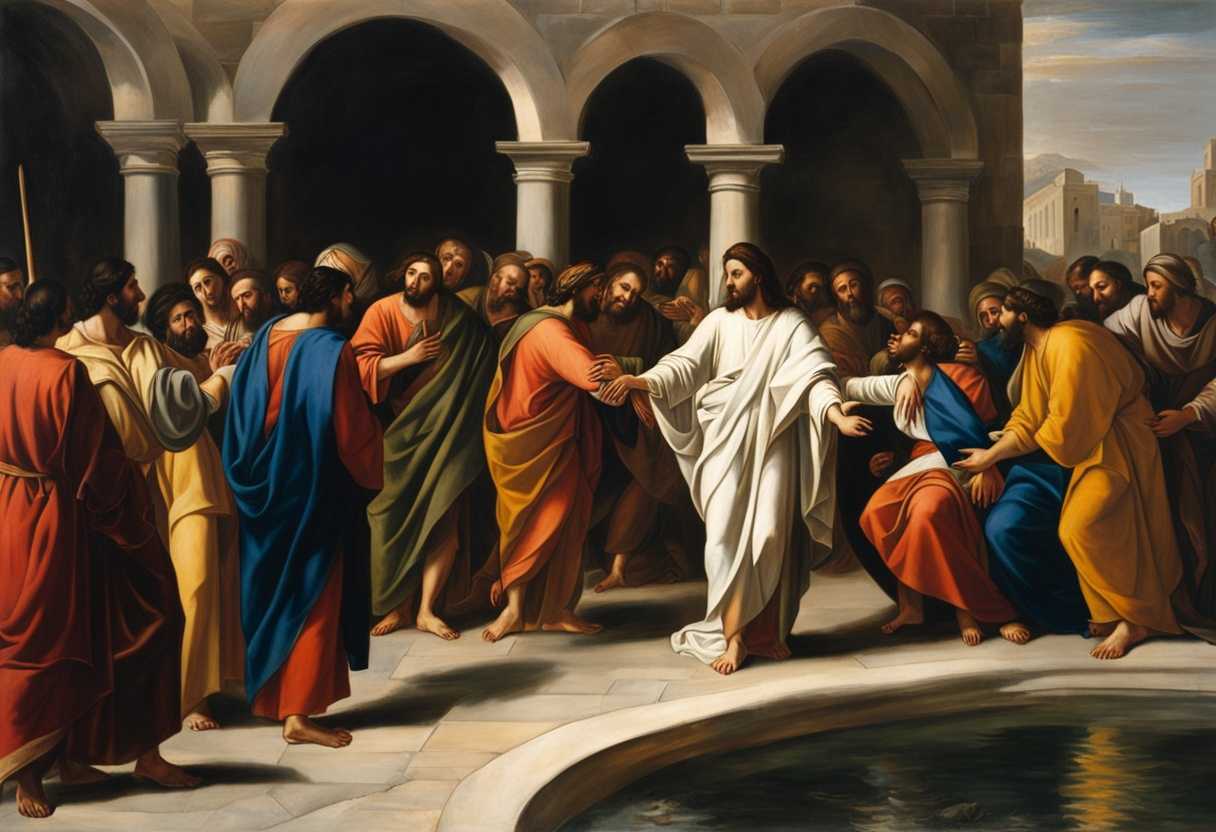
Setting the Scene for John 5:2-8
In John chapter 5, we find Jesus at the Pool of Bethesda in Jerusalem. The scene is bustling with activity as a multitude of people gather around the pool. The pool is surrounded by five covered colonnades, providing shade and shelter for those seeking healing. The atmosphere is filled with anticipation and hope as the sick, blind, lame, and paralyzed wait for the stirring of the waters, believed to have healing powers when an angel troubled the water.
Among the crowd is a man who has been paralyzed for thirty-eight years. His name is not mentioned, but his desperation for healing is evident. Jesus approaches him and asks a simple yet profound question, “Do you want to get well?” The man explains his situation, expressing his inability to reach the water in time due to his condition. Jesus then commands him to rise, take up his mat, and walk. In an instant, the man is healed, picks up his mat, and walks away, experiencing the miraculous power of Jesus firsthand. The encounter leaves the man and the onlookers in awe of the incredible healing that has taken place.
What is John 5:2-8 about?
We witness a powerful example of Jesus’ compassion and authority in this verse. Despite the strict religious rules about not working on the Sabbath, Jesus does not hesitate to show love and mercy by healing a man in need. This act challenges the traditional norms and beliefs of the time, emphasizing the importance of human well-being and kindness above rigid laws. It demonstrates Jesus’ mission to bring healing and restoration to all, regardless of the day or circumstances.
Reflect on the courage and conviction it took for Jesus to defy societal expectations and religious customs in order to help someone in need. This story calls us to prioritize compassion and empathy in our own lives, even if it means going against the norms or rules of our society. How can we follow Jesus’ example by showing love and care for others, even when it may be uncomfortable or challenging? Let this verse inspire us to act with kindness and grace towards those who are suffering or marginalized, following the example of Jesus’ selfless love.
Understanding what John 5:2-8 really means
The scene unfolds at the Pool of Bethesda in Jerusalem, a place renowned for its healing properties, surrounded by a multitude of sick individuals seeking restoration. The presence of the blind, the lame, and the paralyzed paints a vivid picture of the brokenness and suffering prevalent in society, emphasizing the deep need for healing and wholeness.
In the midst of this sea of affliction, Jesus approaches a man who had been an invalid for thirty-eight years and poses a profound question, “Do you want to get well?” This inquiry cuts to the core of the healing process, highlighting the necessity of a genuine desire and openness to receive healing, both physically and spiritually.
With a simple command, “Get up! Pick up your mat and walk,” Jesus demonstrates His divine authority and the transformative power of His word. The immediate response of the invalid man, who rises, takes up his mat, and walks, showcases the instantaneous change that occurs when one surrenders to the will of Christ.
This narrative resonates with other biblical accounts, such as Mark 2:9-12, where Jesus heals a paralyzed man, showcasing His ability to forgive sins and restore physical health. Additionally, Isaiah 35:5-6 prophesies about the Messiah’s coming, foretelling His miraculous works of opening blind eyes and enabling the lame to leap like deer, further affirming Jesus’ identity as the promised Savior.
The relevance of this passage extends to contemporary society, where many individuals grapple with various forms of brokenness and seek healing. It prompts readers to turn to Jesus with faith, acknowledging His power to bring about transformation in every aspect of their lives. Just as the invalid man had to respond to Jesus’ command with faith and action, individuals today are challenged to examine their willingness to be made whole and to step out in faith towards their own healing journey.
Consider a person battling addiction, akin to the invalid man lingering by the pool. The pivotal moment arrives when they earnestly desire freedom and take steps towards recovery, mirroring the man’s obedience to Jesus’ directive to “Get up.” This analogy underscores the importance of personal agency and faith in the process of healing and restoration.
In conclusion, the account of the invalid man at the Pool of Bethesda serves as a poignant reminder of Jesus’ compassion, authority, and willingness to bring about profound transformation in the lives of those who seek Him. It beckons readers to introspection, urging them to trust in Jesus’ ability to heal their deepest wounds and to believe that no situation is beyond His redemptive touch.
How can we seek healing despite our limitations?
The story in John 5:2-8 shows us that healing is not limited by our abilities or resources. A man who had been unable to walk for 38 years approached Jesus for healing in the passage. Despite his physical limitations, he did not let his inability to move quickly prevent him from seeking out Jesus. This teaches us that we should not allow our limitations to hinder us from seeking healing or help. Instead, we should be persistent and proactive in seeking out the support and restoration we need.
Furthermore, the passage reveals that healing often requires a combination of faith and action. When Jesus asked the man if he wanted to get well, the man responded by listing the obstacles he faced in reaching the healing pool. Jesus simply told him to pick up his mat and walk, and the man was instantly healed. This demonstrates that sometimes healing comes when we take a step of faith and act upon it, trusting that God will meet us in our efforts. Even when we feel limited or powerless, we can still take steps towards healing by believing in the possibility of restoration and actively seeking it out. The passage teaches us that healing is possible despite our limitations when we have faith, take action, and persistently seek out the help we need. We should not allow our weaknesses or constraints to deter us from seeking healing and restoration. We can experience healing in our lives by trusting in God, being proactive in seeking support, and taking steps towards recovery.
Application
Think of your life as a marathon. Just as Jesus healed the man who had been struggling for 38 years, He can heal your struggles too. Don’t let the weight of your daily challenges wear you down. Approach Jesus with the same faith, knowing He can work miracles in your life. Are you ready to hand over your burdens and trust Him to transform your situation today?

Reverend Michael Johnson is an experienced Church Minister with a profound expertise in spirituality and guidance. With a serene presence and a compassionate heart, he has faithfully served his congregation for over 20 years, leading them on a spiritual journey towards inner peace and enlightenment. Reverend Johnson’s extensive knowledge of religious philosophies and profound understanding of human nature have made him a trusted confidant and mentor to many, as he seamlessly weaves his profound wisdom into life teachings. Reverend Johnson’s calming demeanor and empathetic nature continue to uplift and heal souls, nurturing a sense of unity and tranquility within his community.