
Joshua 13:24-28 is about the division of land among the tribes of Israel, illustrating God’s faithfulness in fulfilling His promise to give the Israelites their inheritance.
24 Moses gave an inheritance also to the tribe of Gad, to the people of Gad, according to their clans.
25 Their territory was Jazer, and all the cities of Gilead, and half the land of the Ammonites, to Aroer, which is east of Rabbah,
26 and from Heshbon to Ramath-mizpeh and Betonim, and from Mahanaim to the territory of Debir,
27 and in the valley Beth-haram, Beth-nimrah, Succoth, and Zaphon, the rest of the kingdom of Sihon king of Heshbon, having the Jordan as a boundary, to the lower end of the Sea of Chinnereth, eastward beyond the Jordan.
28 This is the inheritance of the people of Gad according to their clans, with their cities and villages.
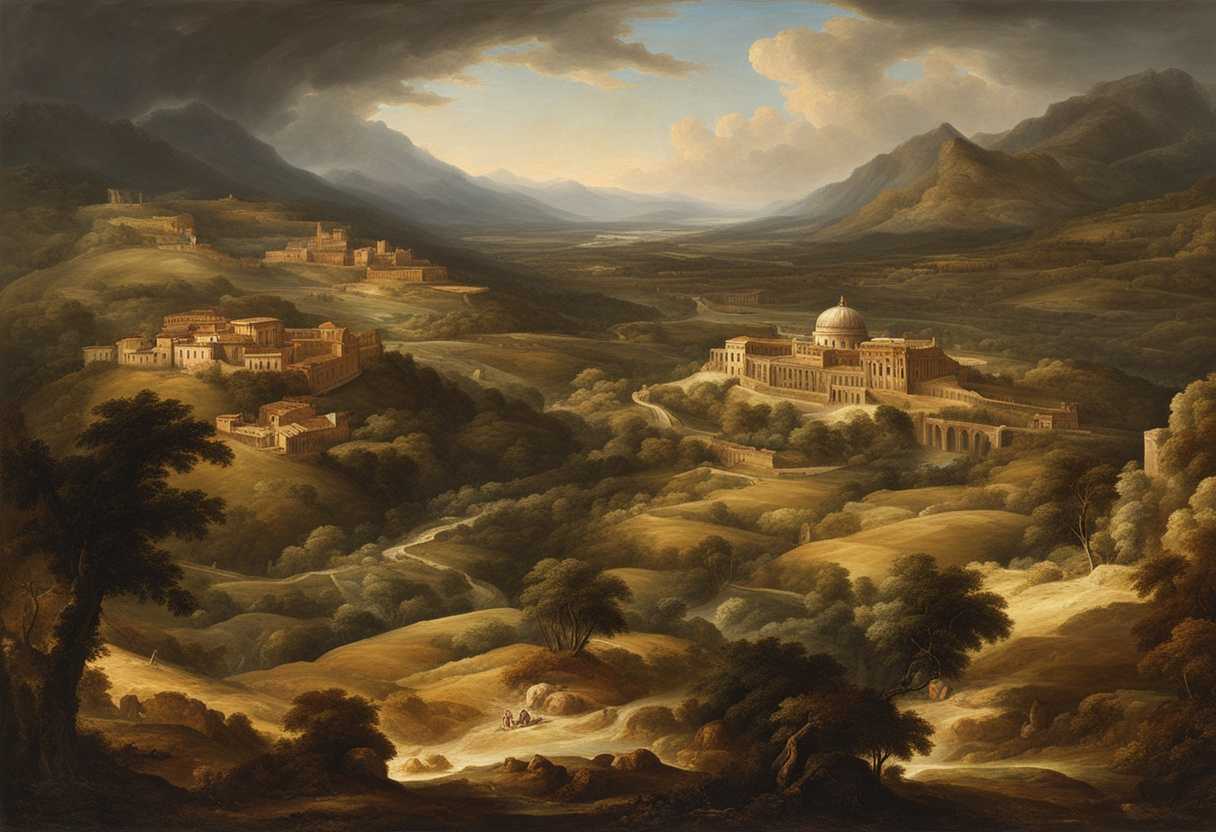
Setting the Scene for Joshua 13:24-28
In Joshua chapter 13, we find the scene set in the land of Canaan, shortly after the Israelites have conquered and divided the land among the tribes. The focus is on the tribe of Gad, one of the tribes that received their inheritance on the eastern side of the Jordan River. The leaders of Gad, including their chief, were present in this scene.
The leaders of Gad had come before Joshua, Eleazar the priest, and the tribal leaders to discuss the land they had received. They were recounting the cities and territories that had been allotted to them as their inheritance. The atmosphere was one of solemnity and gratitude as they acknowledged the fulfillment of God’s promise to give them the land.
The setting was likely in a large tent or meeting place, with maps or scrolls spread out detailing the division of the land. The leaders of Gad, along with Joshua and the other tribal leaders, were seated in a circle, discussing the boundaries and cities that were now under their control. The scene depicted a moment of reflection on the journey thus far and a reminder of the faithfulness of God in fulfilling His promises to His people.
What is Joshua 13:24-28 about?
The passage in Joshua 13:24-28 offers a glimpse into how the land was divided among the twelve tribes of Israel. The passage highlights the specific portion allocated to the tribe of Gad, illustrating the meticulous planning and distribution carried out by Joshua under the guidance of God. As we delve into the details of the land assigned to Gad, we witness the fulfillment of God’s promise to provide a homeland for each tribe, showcasing His faithfulness and commitment to His people.
The intricate delineation of territories within the Promised Land serves as a reminder of the importance of order, organization, and careful stewardship of resources. Examining the allocation to the tribe of Gad helps us appreciate the significance of honoring commitments, respecting boundaries, and embracing diversity within a community. This passage invites us to reflect on how we can apply the principles of equity, fairness, and cooperation in our own lives and relationships, fostering a sense of unity and harmony amongst ourselves. As we explore the distribution of land to the tribe of Gad in Joshua 13:24-28, let us ponder the deeper significance behind God’s provision and guidance. How can we learn from the meticulous planning and allocation demonstrated here to cultivate a spirit of gratitude, responsibility, and unity in our own communities? We can work towards creating a more harmonious and equitable society by recognizing the value of honoring commitments, respecting boundaries, and embracing diversity, reflecting the principles of justice and stewardship exemplified in this passage.
Understanding what Joshua 13:24-28 really means
The Book of Joshua recounts the conquest of Canaan by the Israelites, led by Joshua, and Chapter 13 delves into the division of the land among the tribes of Israel. Specifically, verses 24-28 shed light on the allocation of land to the tribe of Gad. In these verses, we see the tangible fulfillment of God’s promise as Moses gives an inheritance to the tribe of Gad, underscoring the faithfulness of God to His word. The territory assigned to Gad, including Jazer, the cities of Gilead, and half the land of the Ammonites, showcases God’s specific provision and care for His people.
In Numbers 32:1-5, we witness the tribe of Gad making a practical request for land suitable for their livestock, demonstrating God’s willingness to meet their needs. Deuteronomy 3:12-17 further reinforces the idea of God fulfilling His promises as Moses recounts the allocation of land to various tribes. Psalm 16:5-6 echoes this theme of God providing a beautiful inheritance to His chosen people, emphasizing His faithfulness and generosity.
The relevance of this passage to us today lies in its reflection of God’s faithfulness, provision, and care. Just as God ensured the tribe of Gad received their inheritance, He continues to fulfill His promises to us. The detailed allocation of land highlights God’s attentiveness to the specific needs of His people, reminding us of His care in our individual circumstances. Moreover, the emphasis on community and shared inheritance in the passage encourages us to support and care for one another within our faith communities.
Consider a family facing financial struggles who, through prayer and hard work, unexpectedly receive a substantial inheritance. This windfall enables them to settle debts, secure a home, and provide for their children’s education. Similarly, God’s provision for the tribe of Gad showcases His ability to meet our needs in unexpected ways, illustrating His faithfulness and care for His people. Reflecting on Joshua 13:24-28 serves as a reminder of God’s unwavering commitment to His promises and His constant provision for His children.
How can we faithfully obey God’s call today?
We can faithfully obey God’s call today by diligently carrying out the tasks He has assigned to us, just as the tribes of Israel were given specific territories to conquer and govern in ancient times. We should be attentive to the unique responsibilities and opportunities that God has placed in front of us, whether it be in our families, communities, workplaces, or churches. We demonstrate our trust and faith in His guidance and provision by committing ourselves wholeheartedly to the work God has called us to do.
Furthermore, we can honor God by being good stewards of the resources and blessings He has given us, just as the Israelites were instructed to manage the lands they had conquered. We can bring glory to His name and further His kingdom on earth by using our time, talents, and resources wisely and in accordance with God’s principles. It is important to remember that everything we have ultimately belongs to God, and we are accountable for how we use what He has entrusted to us.
Lastly, we can faithfully obey God’s call by standing firm in the face of opposition and remaining obedient to His commands, even when faced with challenges or temptations. We may encounter obstacles and adversaries in our own lives, just as the tribes of Israel faced resistance from the inhabitants of the lands they were to possess. We can overcome any opposition and continue to walk in obedience to His will by relying on God’s strength and remaining steadfast in our faith.
Application
Just as the tribes had unique tasks in the promised land, each of us has a special role to play in God’s kingdom today. What is God calling you to do in your community? It’s time to step up, have faith, and act with obedience. Your purpose is waiting for you to fulfill it. How will you answer God’s call in your life?

Reverend Michael Johnson is an experienced Church Minister with a profound expertise in spirituality and guidance. With a serene presence and a compassionate heart, he has faithfully served his congregation for over 20 years, leading them on a spiritual journey towards inner peace and enlightenment. Reverend Johnson’s extensive knowledge of religious philosophies and profound understanding of human nature have made him a trusted confidant and mentor to many, as he seamlessly weaves his profound wisdom into life teachings. Reverend Johnson’s calming demeanor and empathetic nature continue to uplift and heal souls, nurturing a sense of unity and tranquility within his community.