
Joshua 24:1-28 is about Joshua reminding the Israelites of their history with the Lord, urging them to choose to serve and worship Him alone, and making a covenant to do so.
1 Joshua gathered all the tribes of Israel to Shechem and summoned the elders, the heads, the judges, and the officers of Israel. And they presented themselves before God.
2 And Joshua said to all the people, “Thus says the Lord, the God of Israel: Long ago, your fathers lived beyond the Euphrates, Terah, the father of Abraham and of Nahor; and they served other gods.
3 Then I took your father Abraham from beyond the River and led him through all the land of Canaan, and made his offspring many.
4 And to Isaac I gave Jacob and Esau. And I gave Esau the hill country of Seir to possess, but Jacob and his children went down to Egypt.
5 And I sent Moses and Aaron, and I plagued Egypt with what I did in the midst of it, and afterward I brought you out.
6 And I brought your fathers out of Egypt, and you came to the sea. And the Egyptians pursued your fathers with chariots and horsemen to the Red Sea.
7 And they cried to the Lord, he put darkness between you and the Egyptians and made the sea come upon them and cover them; and your eyes saw what I did in Egypt. And you lived in the wilderness a long time.
8 Then I brought you to the land of the Amorites, who lived on the other side of the Jordan. They fought with you, and I gave them into your hand, and you took possession of their land, and I destroyed them before you.
9 Then Balak the son of Zippor, king of Moab, arose and fought against Israel.
10 And I gave you a land on which you had not labored and cities that you had not built, and you dwell in them. You eat the fruit of vineyards and olive orchards that you did not plant.
11 And you went over the Jordan and came to Jericho, and the leaders of Jericho fought against you, and also the Amorites, the Perizzites, the Canaanites, the Hittites, the Girgashites, the Hivites, and the Jebusites.
12 And I sent the hornet before you, which drove them out before you, the two kings of the Amorites; it was not by your sword or by your bow.
13 I gave you a land on which you had not labored and cities that you had not built, and you dwell in them. You eat the fruit of vineyards and olive orchards that you did not plant.’”
14 “Now therefore fear the Lord and serve him in sincerity and in faithfulness. Put away the gods that your fathers served beyond the River and in Egypt, and serve the Lord.”
15 And if it is evil in your eyes to serve the Lord, choose this day whom you will serve, whether the gods your fathers served in the region beyond the River, or the gods of the Amorites in whose land you dwell. But as for me and my house, we will serve the Lord.
16 Then the people answered, “Far be it from us that we should forsake the Lord to serve other gods,
17 for it is the Lord our God who brought us and our fathers up from the land of Egypt, out of the house of slavery, and who did those great signs in our sight and preserved us in all the way that we went, and among all the peoples through whom we passed.
18 And the Lord drove out before us all the peoples, the Amorites who lived in the land. Therefore we also will serve the Lord, for he is our God.”
19 But Joshua said to the people, “You are not able to serve the Lord, for he is a holy God. He is a jealous God; he will not forgive your transgressions or your sins.
20 If you forsake the Lord and serve foreign gods, then he will turn and do you harm and consume you, after having done you good.”
21 And the people said to Joshua, “No, but we will serve the Lord.”
22 Then Joshua said to the people, “You are witnesses against yourselves that you have chosen the Lord, to serve him.” And they said, “We are witnesses.”
23 He said, “Then put away the foreign gods that are among you, and incline your heart to the Lord, the God of Israel.”
24 And the people said to Joshua, “The Lord our God we will serve, and his voice we will obey.”
25 So Joshua made a covenant with the people that day, and put in place statutes and rules for them at Shechem.
26 And Joshua wrote these words in the Book of the Law of God.
27 And Joshua said to all the people, “Behold, this stone shall be a witness against us, for it has heard all the words of the Lord that he spoke to us. Therefore it shall be a witness against you, lest you deal falsely with your God.”
28 So Joshua sent the people away, every man to his inheritance.
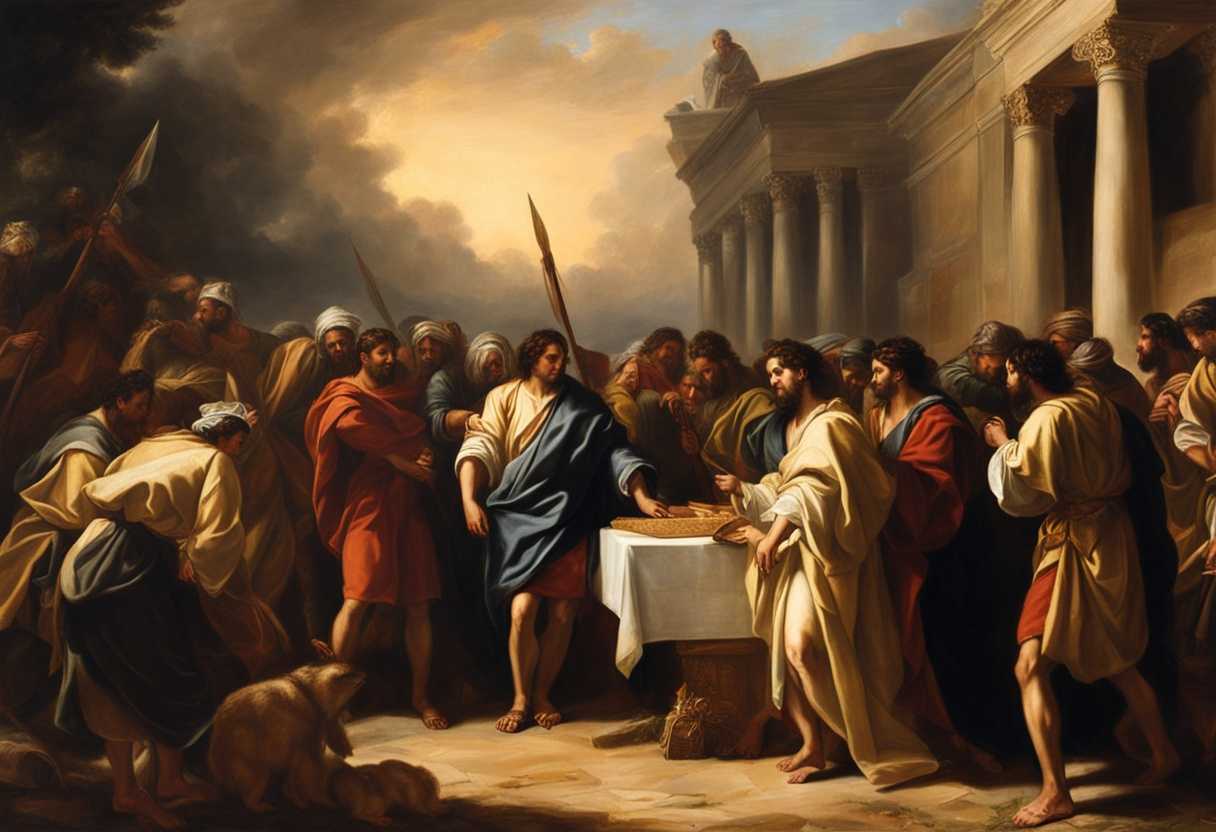
Setting the Scene for Joshua 24:1-28
The scene in Joshua 24:1-28 takes place towards the end of Joshua’s life, as he gathers all the tribes of Israel at Shechem. The setting is significant as Shechem holds historical and religious importance for the Israelites. The location is surrounded by lush greenery, with the ancient city serving as a backdrop to the gathering.
Joshua, the revered leader of the Israelites, stands before the people alongside other prominent figures such as Eleazar the priest and the tribal leaders. The tribes of Israel have come together at Joshua’s summons to renew their covenant with the Lord. The atmosphere is solemn and reverent, as the people listen intently to Joshua’s words, recounting the faithfulness of God throughout their history.
As Joshua speaks, recounting the journey of the Israelites from their ancestors’ time in Mesopotamia to their conquest of the Promised Land, the people are reminded of God’s faithfulness and provision. The scene is filled with emotion as Joshua challenges the people to choose whom they will serve, either the gods of their ancestors or the one true God. The people respond with a resounding affirmation of their commitment to serve the Lord, sealing their covenant with rituals and sacrifices.
What is Joshua 24:1-28 about?
Joshua is urging the people of Israel in this verse to make a conscious and firm decision to serve the Lord faithfully. He presents them with a crucial choice: either they can continue in their ways, serving other gods as their forefathers did, or they can commit to worshiping the one true God wholeheartedly. Joshua is emphasizing the importance of making a deliberate and unwavering choice when it comes to matters of faith and devotion by setting this challenge before them.
Think about the significance of this choice. What does it mean for the Israelites to choose to serve the Lord faithfully? How does this decision impact their relationship with God and their community? Joshua’s words remind us that faith requires action and commitment, and that we have the power to choose our path when it comes to matters of spirituality and belief. Let us reflect on this verse and consider our own choices when it comes to serving the Lord faithfully, and how we can apply Joshua’s challenge to our own lives today.
Understanding what Joshua 24:1-28 really means
Joshua 24:1-28 presents a pivotal moment in the history of Israel, as Joshua, nearing the end of his life, gathers the tribes at Shechem to renew their covenant with God. This passage serves as a culmination of Joshua’s leadership, urging the Israelites to reaffirm their commitment to the Almighty. The phrase “Choose this day whom you will serve” resonates with a call for intentional decision-making in matters of faith. It emphasizes the importance of making a conscious choice about whom to follow and serve, highlighting the significance of personal agency in spiritual matters.
“As for me and my house, we will serve the Lord” stands out as a powerful declaration of faith and leadership by Joshua. This statement underscores the importance of family and household in spiritual commitment, showcasing the influence of individual choices on the collective unit. Joshua’s call to “put away the gods that your fathers served” urges the Israelites to reject idolatry and past influences that hinder their worship of the true God. It serves as a reminder to prioritize the worship of the one true God above all other distractions and false idols.
The assertion that “He is a holy God; He is a jealous God” underscores the nature of God and the seriousness of the covenant relationship with Him. This phrase highlights the purity and exclusivity of God’s love and demands wholehearted devotion from His people. Drawing parallels with related biblical passages such as Deuteronomy 6:5, Exodus 20:3, and Matthew 6:24 reinforces the timeless nature of the call to wholehearted devotion and the rejection of competing allegiances.
In today’s fast-paced and distracted world, the message of Joshua 24:1-28 remains relevant. It challenges individuals to prioritize their faith amidst competing priorities and distractions. The emphasis on family and household in spiritual matters serves as a poignant reminder of the importance of nurturing spiritual foundations within the family unit. By making intentional choices to serve God, individuals and families can strengthen their bond and establish a solid foundation for their lives.
Consider a modern family that consciously prioritizes their faith amidst a busy schedule. By setting aside time for family prayers, Bible study, and attending church together, they emulate Joshua’s declaration and strengthen their spiritual bond. This anecdote illustrates how intentional choices to serve God can positively impact not just individuals but entire households, fostering unity and spiritual growth.
Reflecting on the themes and phrases of Joshua 24:1-28 prompts us to consider the urgency and importance of making deliberate choices in our spiritual lives. The call to choose whom to serve demands immediate action and discernment in a world filled with competing influences. Joshua’s declaration serves as a timeless example of loyalty and dedication to God, inspiring us to follow suit in our own lives and households.
What does it mean to truly serve the Lord?
To truly serve the Lord means to wholeheartedly devote oneself to following His commandments and living in obedience to His will. It involves making a conscious decision to prioritize God above all else, choosing to serve Him faithfully and with sincerity. Serving the Lord in the context of Joshua 24:1-28 involves committing to a lifestyle of worship, reverence, and allegiance to the one true God, not just making empty promises or lip service. Joshua reminds the Israelites of all that the Lord has done for them in Joshua 24:1-28, from delivering them out of Egypt to providing for them in the wilderness. He calls upon them to make a choice to serve the Lord with true sincerity and faithfulness. True service to the Lord involves acknowledging His sovereignty, obeying His commands, and committing to follow Him wholeheartedly. It is a lifelong dedication to living in alignment with God’s principles and seeking His guidance in all aspects of life. To truly serve the Lord ultimately involves surrendering one’s will to His, seeking His guidance and direction in all things. It requires a heart that is willing to submit to God’s authority, a mind that is focused on His ways, and actions that reflect His love and righteousness. It is a continual process of growing in relationship with God, deepening one’s faith, and striving to live a life that is pleasing to Him.
Application
In the busy intersections of our lives, we stand at a crossroads like Joshua once did. The choice is clear: to wholeheartedly serve the Lord or stray towards false idols. Let’s make that unwavering commitment and put our faith above distractions. Will you take that pivotal step towards serving the Lord, unfaltering in your devotion?

Reverend Michael Johnson is an experienced Church Minister with a profound expertise in spirituality and guidance. With a serene presence and a compassionate heart, he has faithfully served his congregation for over 20 years, leading them on a spiritual journey towards inner peace and enlightenment. Reverend Johnson’s extensive knowledge of religious philosophies and profound understanding of human nature have made him a trusted confidant and mentor to many, as he seamlessly weaves his profound wisdom into life teachings. Reverend Johnson’s calming demeanor and empathetic nature continue to uplift and heal souls, nurturing a sense of unity and tranquility within his community.