
Joshua 3:1-17 is about the Israelites crossing the Jordan River under Joshua’s leadership, symbolizing their transition from the wilderness into the Promised Land with the divine presence of God guiding and protecting them throughout the journey.
1 Then Joshua rose early in the morning and they set out from Shittim. And they came to the Jordan, he and all the people of Israel, and lodged there before they passed over.
2 After three days the officers went through the camp
3 and commanded the people, “As soon as you see the ark of the covenant of the Lord your God being carried by the Levitical priests, then you shall set out from your place and follow it,
4 Yet there shall be a distance between you and it, about 2,000 cubits in length. Do not come near it, in order that you may know the way you shall go, for you have not passed this way before.”
5 Then Joshua said to the people, “Consecrate yourselves, for tomorrow the Lord will do wonders among you.”
6 And Joshua said to the priests, “Take up the ark of the covenant and pass on before the people.” So they took up the ark of the covenant and went before the people.
7 The Lord said to Joshua, “Today I will begin to exalt you in the sight of all Israel, that they may know that, as I was with Moses, so I will be with you.
8 And as for you, command the priests who bear the ark of the covenant, ‘When you come to the brink of the waters of the Jordan, you shall stand still in the Jordan.’”
9 And Joshua said to the people of Israel, “Come here and listen to the words of the Lord your God.”
10 And Joshua said, “Here is how you shall know that the living God is among you and that he will without fail drive out from before you the Canaanites, the Hittites, the Hivites, the Perizzites, the Girgashites, the Amorites, and the Jebusites.
11 Behold, the ark of the covenant of the Lord of all the earth is passing over before you into the Jordan.
12 Now therefore take twelve men from the tribes of Israel, from each tribe a man.
13 And when the soles of the feet of the priests bearing the ark of the Lord, the Lord of all the earth, shall rest in the waters of the Jordan, the waters of the Jordan shall be cut off from flowing, and the waters coming down from above shall stand in one heap.”
14 So when the people set out from their tents to pass over the Jordan with the priests bearing the ark of the covenant before the people,
15 and as soon as those bearing the ark had come as far as the Jordan, and the feet of the priests bearing the ark were dipped in the brink of the water (now the Jordan overflows all its banks throughout the time of harvest),
16 the waters coming down from above stood and rose up in a heap very far away, at Adam, the city that is beside Zarethan, and those flowing down toward the Sea of the Arabah, the Salt Sea, were completely cut off. And the people passed over opposite Jericho.
17 And the priests who bore the ark of the covenant of the Lord stood firmly on dry ground in the midst of the Jordan, and all Israel was passing over on dry ground until all the nation finished passing over the Jordan.
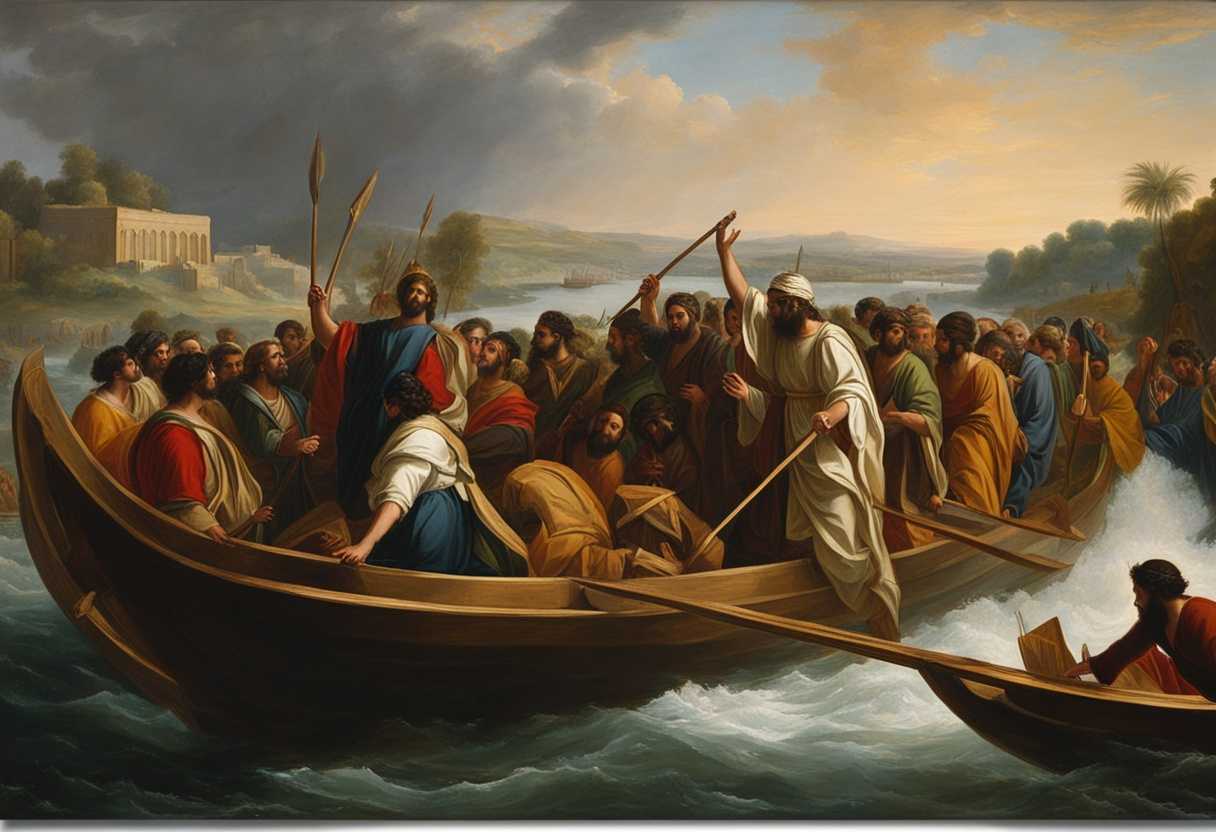
Setting the Scene for Joshua 3:1-17
In Joshua chapter 3, we find the Israelites camped on the banks of the Jordan River, preparing to cross over into the Promised Land. Joshua, the newly appointed leader after Moses’ death, stands among the people, ready to lead them into this significant moment in their history. The atmosphere is charged with anticipation and excitement as the Israelites have been wandering in the wilderness for 40 years, and now they are on the brink of entering the land flowing with milk and honey.
The priests carrying the Ark of the Covenant, a sacred symbol of God’s presence among His people, stand at the water’s edge. They have been instructed to step into the Jordan River first, trusting in God’s promise that the waters will part before them. The rest of the Israelites watch in awe as the miraculous event unfolds before their eyes. The scene is one of faith, obedience, and the fulfillment of God’s covenant with His chosen people. As the priests take that first step into the river, the waters begin to pile up in a heap upstream, allowing the Israelites to cross over on dry ground, just as they had crossed the Red Sea years before. It is a moment of divine intervention and a powerful demonstration of God’s faithfulness to His people.
What is Joshua 3:1-17 about?
Joshua steps into a monumental moment of leadership as he guides the Israelites across the Jordan River in this verse. It symbolizes not just a physical journey, but a spiritual and metaphorical one as well. Joshua showcases God’s power and faithfulness to fulfill His promises by leading the people across the river. Through this act, we see the importance of trusting in God’s plan and following His guidance even when faced with seemingly insurmountable obstacles.
Imagine the feelings of awe and wonder that must have filled the hearts of the Israelites as they witnessed this miraculous event unfold before their eyes. Reflect on your own life journey – what “Jordan Rivers” have you faced, and how have you trusted in God’s power and faithfulness to navigate through them? Let us also trust in God’s guidance and provision in our own lives, knowing that He is always faithful to lead us through our challenges and into His promises, just as Joshua led the Israelites across the Jordan River.
Understanding what Joshua 3:1-17 really means
In Joshua 3:1-17, we witness a pivotal moment in the Israelites’ journey towards the Promised Land. As they stand on the banks of the Jordan River, preparing to cross into the land flowing with milk and honey, Joshua gives them a crucial instruction: to follow the Ark of the Covenant. This sacred object symbolizes God’s presence and guidance among His people, serving as a tangible reminder that they are not alone in their journey. The Ark leads the way, demonstrating that their success lies in following God’s direction.
One key phrase in this passage is “consecrate yourselves,” a call for spiritual preparation and purification. This emphasizes the importance of holiness and readiness before embarking on significant endeavors. Just as the Israelites were called to consecrate themselves before crossing the Jordan, we are reminded of the need to prepare our hearts and minds for the challenges and blessings that lie ahead.
The miraculous parting of the Jordan River echoes the events at the Red Sea in Exodus 14:21-22, showcasing God’s consistent deliverance of His people. This display of divine power serves as a testament to God’s ability to make a way where there seems to be none, reinforcing the idea that nothing is impossible for Him. Psalm 114:3 further emphasizes God’s sovereignty over nature, highlighting His control over even the elements.
Hebrews 11:29 draws parallels between the Israelites’ crossing of the Red Sea and the Jordan, emphasizing the role of faith in God’s promises. Just as the Israelites had to trust God to part the waters before them, we are called to exercise faith in God’s provision and guidance in our own lives. This challenges us to step out in faith, even when faced with seemingly insurmountable obstacles.
The relevance of this passage to us today is profound. It speaks to the importance of faith and trust in God, especially during times of uncertainty and transition. Like the Israelites, we are called to trust in God’s guidance and provision as we navigate the challenges of life. The call to “consecrate yourselves” reminds us of the need for spiritual preparation and holiness in our walk with God, ensuring that we are aligned with His will.
In conclusion, Joshua 3:1-17 serves as a powerful reminder of God’s presence, power, and faithfulness in our lives. By reflecting on this passage, we are encouraged to trust in God’s guidance, prepare ourselves spiritually, and recognize His presence leading us through life’s uncertainties. Just as the Israelites crossed the Jordan with God’s help, we too can face our own “Jordan Rivers” with confidence in His provision and guidance.
How can we step out in faith?
Joshua leads the Israelites into the unknown territory of the Promised Land in Joshua 3:1-17, with the Jordan River standing in their way. Despite the uncertainty and potential obstacles, Joshua instructs the people to consecrate themselves and step out in faith, believing that God would go before them and make a way. This passage teaches us that stepping out in faith requires trust in God’s leading and guidance, even when we cannot see the outcome or the path ahead.
To step out in faith means to overcome our fears and doubts, and to hold onto the promises and power of God. Just like the Israelites had to physically step into the Jordan River before seeing it part, we too must take action and trust that God will fulfill His promises as we obey and follow His guidance. It may be intimidating or challenging to take that step, but by surrendering our fears and hesitation to God and choosing to trust in His faithfulness, we can experience His miraculous work in our lives. Stepping out in faith ultimately demonstrates our belief in God’s sovereignty and faithfulness. It requires us to let go of our own understanding and lean on His wisdom and power. When we choose to step out in faith, we are acknowledging that God is in control and that His plans are greater than our own. We can experience the fullness of His blessings and provision in ways we could never have imagined by following His leading with courage and trust.
Application
Embark on your own journey like the Israelites crossing the Jordan River. Let their unwavering faith inspire you to trust in God’s plan for you. Step into the unknown with courage and belief in His guidance. Are you prepared to take that leap of faith, even when the path ahead seems uncertain?

Reverend Michael Johnson is an experienced Church Minister with a profound expertise in spirituality and guidance. With a serene presence and a compassionate heart, he has faithfully served his congregation for over 20 years, leading them on a spiritual journey towards inner peace and enlightenment. Reverend Johnson’s extensive knowledge of religious philosophies and profound understanding of human nature have made him a trusted confidant and mentor to many, as he seamlessly weaves his profound wisdom into life teachings. Reverend Johnson’s calming demeanor and empathetic nature continue to uplift and heal souls, nurturing a sense of unity and tranquility within his community.