
Joshua 7:1-9 is about the consequences of Achan’s disobedience and greed, resulting in defeat for the Israelites in battle due to his sin bringing a curse upon the people, emphasizing the importance of following God’s commands and the impact of individual actions on the community.
7 But the people of Israel broke faith in regard to the devoted things, for Achan the son of Carmi, son of Zabdi, son of Zerah, of the tribe of Judah, took some of the devoted things. And the anger of the Lord burned against the people of Israel.
2 Now Joshua sent men from Jericho to Ai, which is near Beth-aven, east of Bethel, and said to them, “Go up and spy out the land.” And the men went up and spied out Ai.
3 And they returned to Joshua and said to him, “Do not let all the people go up, but let about two or three thousand men go up and attack Ai. Do not make the whole people toil up there, for they are few.”
4 So about three thousand men went up there from the people. And they fled before the men of Ai,
5 And the men of Ai struck down about thirty-six men of them and chased them before the gate as far as Shebarim and struck them at the descent. And the hearts of the people melted and became as water.
6 Then Joshua tore his clothes and fell to the earth on his face before the ark of the Lord until the evening, he and the elders of Israel. And they put dust on their heads.
7 And Joshua said, “Alas, O Lord God, why have you brought this people over the Jordan at all, to give us into the hands of the Amorites, to destroy us? Would that we had been content to dwell beyond the Jordan!
8 O Lord, what can I say, when Israel has turned their backs before their enemies!
9 For the Canaanites and all the inhabitants of the land will hear of it and will surround us and cut off our name from the earth. And what will you do for your great name?”
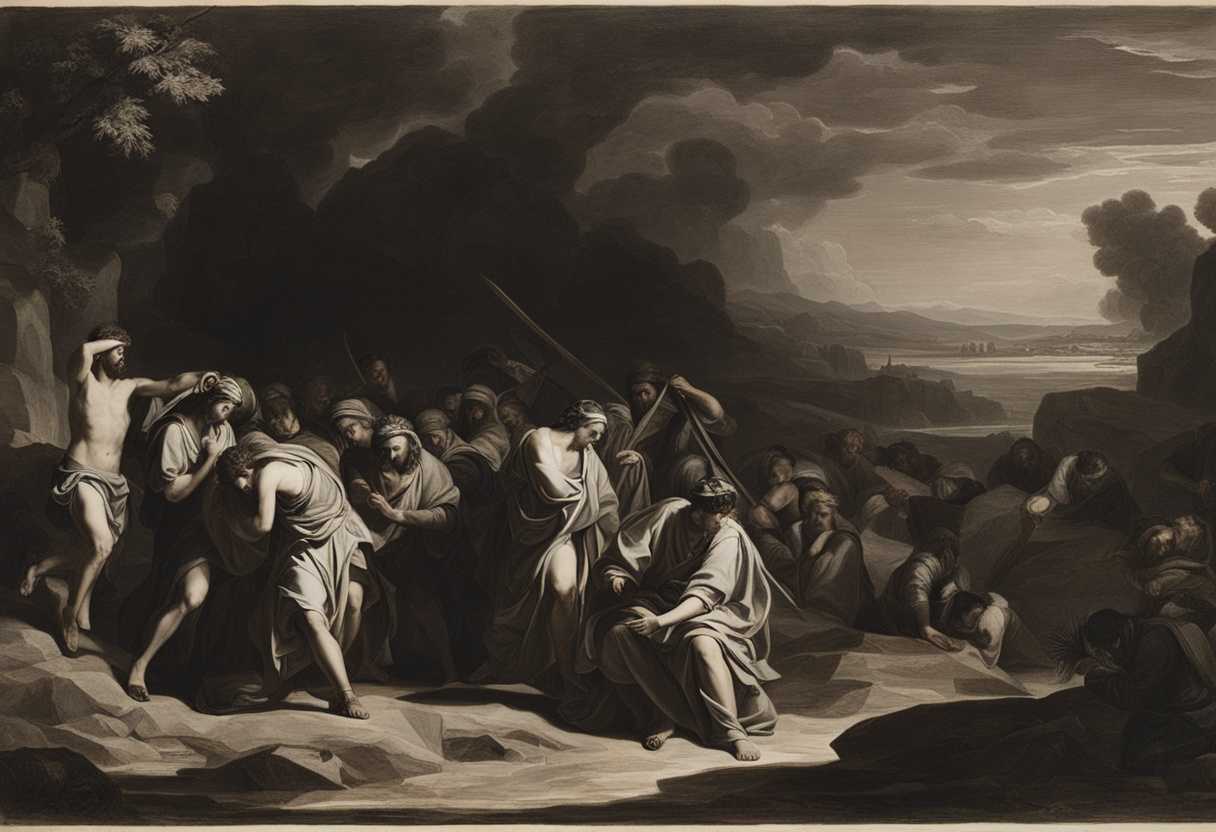
Setting the Scene for Joshua 7:1-9
The scene in Joshua 7:1-9 takes place shortly after the Israelites’ victory at Jericho. The Israelites, led by Joshua, had just experienced a miraculous conquest of the city, where the walls came tumbling down after they marched around it for seven days. The people were filled with confidence and faith in God’s power as they continued their conquest of the Promised Land.
In this particular scene, Joshua is gathered with his leaders and soldiers to discuss their next move. The atmosphere is one of triumph and anticipation as they plan their strategy for the next battle. However, their joy is short-lived as they soon realize that something is amiss. Achan, one of the Israelites, had disobeyed God’s command by taking forbidden plunder from Jericho, causing the Lord’s anger to burn against the entire camp.
The surroundings are likely a campsite set up near Jericho, with the walls of the conquered city still visible in the distance. The mood shifts from celebration to solemnity as Joshua and the leaders grapple with the consequences of Achan’s sin. The scene serves as a reminder of the importance of obedience and faithfulness to God’s commands, even in the midst of victory.
What is Joshua 7:1-9 about?
Achan’s disobedience to God’s command not to take any of the forbidden items from the city of Jericho is seen in this passage. The Israelites suffered defeat in battle against the city of Ai, a much smaller and supposedly weaker opponent, as a result of Achan’s sin. This defeat was a direct consequence of Achan’s actions, demonstrating the interconnectedness of individual sins with the collective well-being of the community.
Have you ever considered how your own actions can impact not only yourself but also those around you? The story of Achan serves as a reminder that our decisions and actions, whether noble or sinful, can have far-reaching consequences that extend beyond ourselves. It prompts us to reflect on the importance of living in accordance with God’s will and the need for accountability within the community. Let us delve into this story and ponder on the significance of obedience, trust, and the destructive nature of sin. Just like Achan, our own disobedience can lead to unintended and unfavorable outcomes. We should strive to uphold integrity, righteousness, and faithfulness in all aspects of our lives, recognizing that our choices not only affect ourselves but also influence the well-being of those around us.
Understanding what Joshua 7:1-9 really means
The Book of Joshua recounts the Israelites’ conquest of Canaan, led by Joshua. In Joshua 7:1-9, we witness a significant setback following the victory at Jericho, attributed to Achan’s sin of taking forbidden items. This narrative underscores the repercussions of disobedience and emphasizes the crucial role of communal responsibility within the community of believers. “The Israelites were unfaithful in regard to the devoted things” highlights the collective nature of accountability, where Achan’s transgression impacts the entire nation, showcasing the interconnectedness of the community. The phrase “The Lord’s anger burned against Israel” signifies God’s displeasure towards sin and the severe outcomes that follow defiance of His commands.
Joshua’s poignant reaction, “Joshua tore his clothes and fell facedown to the ground before the ark of the Lord,” exemplifies a leader’s humility and reliance on divine guidance during times of crisis. This act of mourning and seeking God’s intervention portrays Joshua’s recognition of the need for spiritual direction in navigating challenges. Drawing parallels from other biblical passages like Deuteronomy 7:25-26, which warns against taking devoted things, and 1 Corinthians 12:26, emphasizing the shared suffering within a community, reinforces the enduring relevance of communal responsibility and obedience to God’s will. Romans 6:23 further underscores the gravity of sin’s consequences and the promise of redemption through Christ, offering hope amidst the narrative of disobedience.
The timeless lesson from Joshua 7:1-9 resonates with contemporary audiences, urging reflection on the significance of integrity, obedience, and communal accountability. It prompts individuals to consider the ripple effects of their choices, recognizing that personal actions can profoundly impact the wider community. In a world increasingly interconnected, the concept of communal responsibility remains pertinent, highlighting the interconnectedness of humanity and the shared consequences of individual decisions. Consider a sports team scenario where one player’s misconduct tarnishes the entire team’s reputation and success, mirroring Achan’s sin affecting all of Israel and leading to collective repercussions.
In conclusion, Joshua 7:1-9 stands as a poignant reminder of the imperative of obedience, integrity, and communal responsibility within the faith community. It beckons individuals to evaluate their conduct and its implications on the broader community, emphasizing the need for adherence to God’s commands and the cultivation of a community founded on trust and faithfulness. By seeking divine guidance and upholding moral principles, we can navigate the pitfalls of disobedience and foster a community characterized by mutual support and spiritual steadfastness.
How can we ensure we are acting in alignment with God’s will?
To ensure we are acting in alignment with God’s will, we must first seek His guidance in all our actions. We should also turn to God in prayer and seek His wisdom before making decisions, just as Joshua sought the Lord’s counsel before taking any action. We demonstrate our commitment to following His will by acknowledging God’s sovereignty and seeking His direction in all that we do.
Additionally, it is essential to remain faithful and obedient to God’s commandments. Disobedience to God’s specific instructions caused the Israelites to suffer defeat in the story of Joshua. We can align our actions with His will and walk in His ways by faithfully following God’s commandments and living in accordance with His teachings. Obedience to God’s word is crucial in ensuring that we are on the right path and in alignment with His divine plan for us.
Furthermore, maintaining a humble and contrite heart is key to discerning and following God’s will. When we approach God with humility, acknowledging our dependence on Him and our need for His guidance, we open ourselves up to receiving His direction. We position ourselves to act in alignment with His purposes and fulfill the plans He has for us by surrendering our own desires and seeking God’s will above all else.
Application
Reflect on how every action you take has a ripple effect on those around you, just like in the workplace or at home. Be truthful and righteous in all you do, knowing that your decisions impact not just yourself but the entire community. Stay faithful and diligent in following what you believe in, for your actions matter more than you think. Are you willing to be the guiding light of honesty and obedience in your circles?

Reverend Michael Johnson is an experienced Church Minister with a profound expertise in spirituality and guidance. With a serene presence and a compassionate heart, he has faithfully served his congregation for over 20 years, leading them on a spiritual journey towards inner peace and enlightenment. Reverend Johnson’s extensive knowledge of religious philosophies and profound understanding of human nature have made him a trusted confidant and mentor to many, as he seamlessly weaves his profound wisdom into life teachings. Reverend Johnson’s calming demeanor and empathetic nature continue to uplift and heal souls, nurturing a sense of unity and tranquility within his community.