
1 Samson went down to Timnah, and at Timnah he saw one of the daughters of the Philistines.
2 Then he came up and told his father and mother, “I saw one of the daughters of the Philistines at Timnah. Now get her for me as my wife.”
3 But his father and mother said to him, “Is there not a woman among the daughters of your relatives, or among all our people, that you must go to take a wife from the uncircumcised Philistines?” But Samson said to his father, “Get her for me, for she is right in my eyes.”
4 His father and mother did not know that it was from the Lord, for he was seeking an opportunity against the Philistines. At that time the Philistines ruled over Israel.
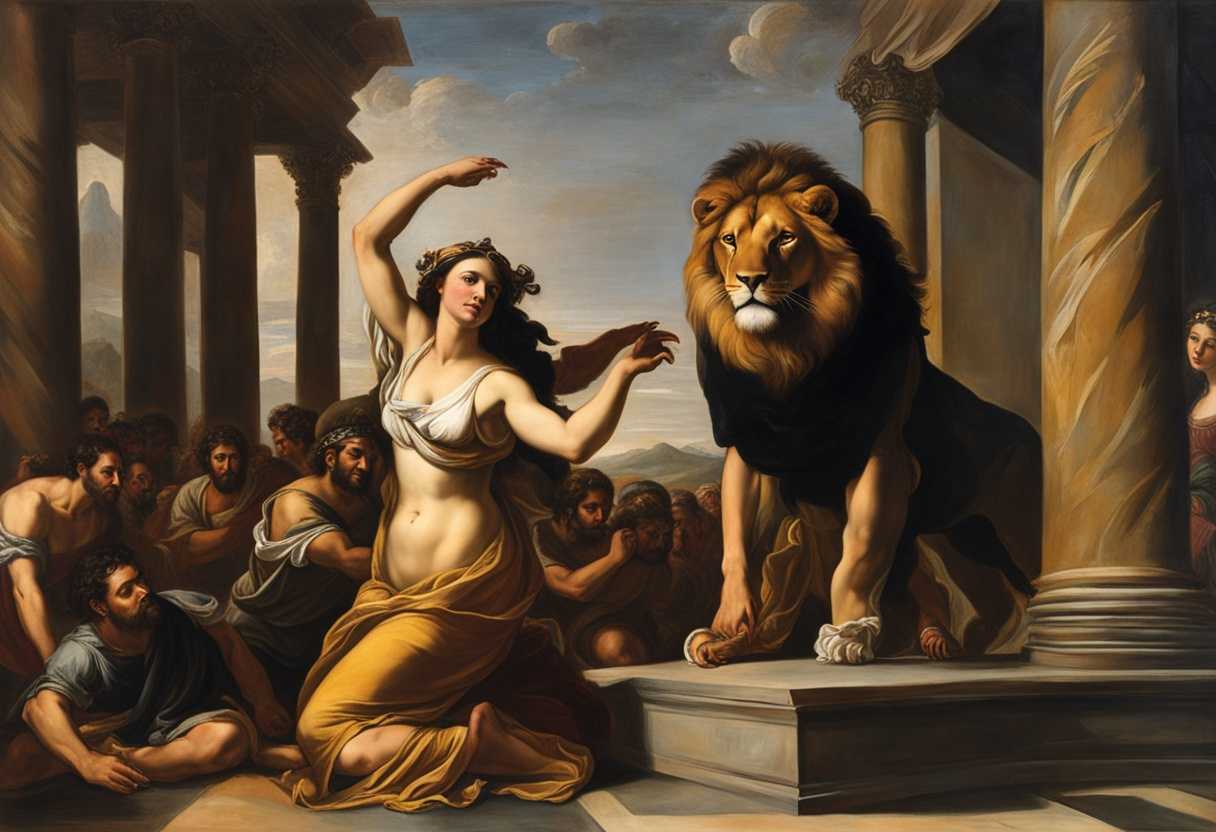
5 Then Samson went down with his father and mother to Timnah, and they came to the vineyards of Timnah. And behold, a young lion came toward him roaring.
6 Then the Spirit of the Lord rushed upon him, and although he had nothing in his hand, he tore the lion in pieces as one tears a young goat. But he did not tell his father or his mother what he had done.
7 Then he went down and talked with the woman, and she was right in Samson’s eyes.
8 After some days he returned to take her. And he turned aside to see the carcass of the lion, and behold, there was a swarm of bees in the body of the lion, and honey.
9 He scraped it out into his hands and went on, eating as he went. And he came to his father and mother and gave some to them, and they ate.
10 His father went down to the woman, and Samson prepared a feast there, for so the young men used to do.
11 And when the people saw him, they praised their god. For they said, “Our god has given our enemy into our hand, the ravager of our country, who has killed many of us.”
12 And Samson said to them, “Let me now put a riddle to you. If you can tell me what it is, within the seven days of the feast, and find it out, then I will give you thirty linen garments and thirty changes of clothes,
13 But if you cannot tell me what it is, then you shall give me thirty linen garments and thirty changes of clothes.” And they said to him, “Put your riddle, that we may hear it.”
14 And he said to them, “Out of the eater came something to eat. Out of the strong came something sweet.” And in three days they could not solve the riddle.
15 On the fourth day they said to Samson’s wife, “Entice your husband to tell us what the riddle is, lest we burn you and your father’s house with fire. Have you invited us here to impoverish us?”
16 And Samson’s wife wept over him and said, “You only hate me; you do not love me. You have put a riddle to my people, and you have not told me what it is.” And he said to her, “Behold, I have not told my father nor my mother, and shall I tell you?”
17 She wept before him the seven days that their feast lasted, and on the seventh day he told her, because she pressed him hard. Then she told the riddle to her people.
18 And the men of the city said to him on the seventh day before the sun went down, “What is sweeter than honey? What is stronger than a lion?” And he said to them, “If you had not plowed with my heifer, you would not have found out my riddle.”
19 And the Spirit of the Lord rushed upon him, and he went down to Ashkelon and struck down thirty men of the town and took their spoil and gave the garments to those who had told the riddle.
20 And Samson’s wife was given to his companion, who had been his best man.
The True Meaning of Judges 14
The book of Judges was written by an unknown author, likely a prophet or scribe, and chronicles the period of Israelite history between the death of Joshua and the rise of the monarchy under King Saul. This particular chapter focuses on the story of Samson, one of the most famous and powerful judges of Israel. Samson’s journey begins in this chapter as he seeks a wife from among the Philistines, the longtime enemies of the Israelites. This decision will set in motion a series of events that will test Samson’s faith and his role as a judge appointed by God to deliver his people from their oppressors. The chapter foreshadows the great strength and cunning that Samson will display, as well as the personal struggles he will face as he navigates his divine calling.
Throughout the narrative, we are reminded of the importance of obedience to God’s commands, as seen in the earlier story of Samson’s birth and the instructions given to his parents (Judges 13:2-5). The chapter also highlights the ongoing conflict between the Israelites and the Philistines, a theme that will continue to play a central role in the book of Judges. We will delve deeper into Samson’s story, and his actions, both heroic and flawed, will shape the course of Israel’s history.
Judges 14:1-4
Samson, a man known for his great strength and unique calling from God, goes down to Timnah, a town in Philistine territory, as the passage opens in Judges 14:1-4. Samson sees a young Philistine woman that he desires and asks his parents to arrange a marriage for him despite the fact that intermarriage between Israelites and non-Israelites was forbidden by Jewish law. Samson’s parents question this choice, wondering why he could not find a wife among his own people. However, verse 4 reveals that God had a larger plan in allowing this desire in Samson’s heart, as the text alludes to the fact that it was from God, who was seeking an occasion to confront the Philistines.
This passage serves as a reminder that God often works in mysterious ways, using even our weaknesses and desires to fulfill His greater purposes. Samson’s attraction to the Philistine woman may seem like an impulsive decision, but it ultimately becomes a key part of God’s plan to bring judgment upon the Philistines. This illustrates the sovereignty of God and His ability to use even our mistakes for His divine purposes. The story of Samson highlights the complexities of God’s plans and His ability to work through flawed human beings.
The forbidden nature of Samson’s desire for a Philistine woman reflects the recurring theme in the Bible of the struggle between staying faithful to God’s commands and giving in to worldly temptations. Throughout the Bible, there are numerous instances where God’s people are warned against intermingling with non-believers or violating His laws. For instance, in Deuteronomy 7:3-4, the Israelites are specifically instructed not to intermarry with the surrounding nations. Samson’s disobedience of this command serves as a cautionary tale of the consequences that can arise from straying from God’s will.
Samson’s choice to marry a Philistine woman also sets the stage for future conflicts and challenges that he will face. His marriage to this woman, as we see in the following chapters of Judges, leads to a series of events where Samson’s strength, cunning, and ultimately downfall are on full display. The story of Samson is one of triumphs and failures, and his relationship with the Philistine woman marks the beginning of his tumultuous journey that ultimately leads to his demise. The narrative of Samson’s life serves as a cautionary example of the consequences of letting worldly desires overpower obedience to God. Samson’s seemingly impulsive decision to pursue a Philistine woman in Judges 14:1-4 captures a pivotal moment in his life, setting the stage for the unfolding of God’s divine plan. This passage highlights the complexities of human desires, God’s sovereignty, and the consequences of disobedience to His commands. Through Samson’s story, we are reminded of the importance of staying faithful to God’s will and the reverberating effects that our choices can have on our lives and the fulfillment of God’s purposes.
Judges 14:5-9
Samson, a well-known figure in the Bible whose life was marked by incredible strength and divine purpose, is the subject of a narrative in Judges 14:5-9. The passage begins with Samson and his parents traveling to Timnath, where he encounters a young Philistine woman whom he desires to marry. This desire, however, goes against the commandments of the Lord, as the Israelites were instructed not to intermarry with the idolatrous nations around them. Despite this, Samson insists on marrying the woman, illustrating his tendency to act impulsively and follow his own desires rather than God’s will. A lion suddenly confronts Samson and his parents as they continue on their journey to Timnath. The Spirit of the Lord comes upon Samson in a remarkable display of supernatural strength, enabling him to tear the lion apart with his bare hands. This act not only showcases Samson’s physical prowess but also serves as a prelude to the extraordinary feats of strength he will later perform in his life.
It is essential to recognize that Samson’s strength was not merely a physical attribute but a manifestation of the Spirit of the Lord working through him. This emphasizes the importance of relying on God’s strength rather than our own, as seen in 2 Corinthians 12:9 where Paul acknowledges that his power is made perfect in weakness. Samson’s encounter with the lion serves as a reminder of the power and presence of God in moments of adversity, reinforcing the message that with faith and reliance on Him, even the fiercest challenges can be overcome. Samson later shares the honey found in the carcass of the lion with his parents without revealing where he obtained it, adding a layer of symbolism to the story. The consumption of honey was often associated with sweetness, pleasure, and prosperity in biblical times. The discovery of honey in the lion’s remains not only highlights the supernatural nature of the event but also foreshadows the future victories and blessings that will come from Samson’s actions, despite the unconventional means through which they are achieved. We are reminded of the complexity of human nature and the constant struggle between following our own desires and adhering to God’s commands in analyzing this passage. Samson’s impulsive decision to marry a Philistine woman ultimately leads to challenges and conflicts that shape his destiny and the course of Israelite history. This narrative serves as a cautionary tale about the consequences of prioritizing personal desires over obedience to God, as seen in Proverbs 14:12, “There is a way that appears to be right, but in the end, it leads to death.” Samson’s journey highlights the importance of seeking God’s guidance, trusting in His strength, and remaining faithful to His word, even in the face of temptation and adversity.
Judges 14:10-14
Samson, one of the most well-known figures in the Bible, experiences a significant event in his life in Judges 14:10-14. This passage describes Samson’s marriage feast, which resulted from his encounter with a lion on his way to Timnah, a Philistine town. After killing the lion with his bare hands, Samson left the carcass and continued on his journey. On his return trip, he discovered that a swarm of bees had settled in the carcass, producing honey.
This event holds multifaceted significance in the life of Samson and in the broader context of the Bible. Firstly, the fact that Samson encountered a lion and later found honey in its carcass is reminiscent of the riddle he presents to the Philistines at his wedding feast. Samson asks them to solve his riddle, “Out of the eater, something to eat; out of the strong, something sweet,” referencing the lion and the honey he found in it. This riddle signifies the mysterious and surprising ways in which God works through Samson, using seemingly impossible situations to demonstrate His power. Samson’s unique calling as a Nazirite, set apart by God from birth to be a deliverer of Israel from the Philistines, is highlighted in this passage. The encounter with the lion and the subsequent discovery of honey reflect the contrast between the strength and ferocity of Samson as a warrior and the sweetness and abundance that God provides for him in unexpected places. This duality in Samson’s character serves as a metaphor for the complex relationship between his divine calling and his human weaknesses, particularly his struggles with pride and lust.
Furthermore, the setting of the marriage feast where the riddle is presented underscores the ongoing tension between Samson and the Philistines, who were oppressors of the Israelites during that time. Samson subtly asserts his defiance against the dominance of the Philistines by challenging them with the riddle, foreshadowing his future confrontations with them and his ultimate role in delivering Israel from their oppression. This episode in the life of Samson reminds us of the intricate ways in which God works through imperfect and flawed individuals to accomplish His purposes in a broader sense. Despite Samson’s many shortcomings and moral failings, God’s power is displayed through him in astonishing ways, showcasing the redemptive work of the Lord in using the weak to confound the strong (1 Corinthians 1:27).
Therefore, Judges 14:10-14 serves as a pivotal moment in the narrative of Samson, emphasizing the paradoxes of strength and weakness, of judgment and grace, and ultimately pointing to the overarching theme of God’s sovereignty and redemption throughout the Bible.
Judges 14:15-18
An intriguing event in the life of Samson, a prominent figure in the Book of Judges known for his incredible strength and tumultuous journey, occurs in Judges 14:15-18. The passage describes a high-stakes situation where Samson proposes a riddle to the Philistines who attend his wedding feast. The riddle revolves around a lion he had killed previously, presenting a challenge for the Philistines to solve within a set time frame. It is essential to break down this verse into two key sections for a deeper understanding.
Firstly, the riddle itself serves as a symbol of the mystery and test of wit that Samson presents to the Philistines. This riddle not only showcases Samson’s cleverness but also his tendency to set the stage for confrontation with the Philistines, with whom he would eventually have numerous conflicts. The riddle reflects a tale of strength and the victory of an individual over a formidable opponent, which is a recurring theme in Samson’s narrative. This incident highlights Samson’s unique character, marked by a blend of physical strength and intellectual prowess, making him a complex and intriguing figure in biblical history.
Secondly, the reaction of the Philistines to Samson’s riddle is significant in shedding light on their cunning nature and desire to overcome any challenge posed by this Hebrew hero. Faced with the potential loss of valuable possessions due to their inability to solve the riddle, the Philistines employ deceit by pressuring Samson’s new wife to extract the answer from him. This deception not only reveals the Philistines’ willingness to use underhanded tactics but also sets the stage for future betrayal and conflicts between Samson and his wife, as well as between Samson and the Philistines.
This episode in Judges 14 underscores themes of trust, deception, and the consequences of hasty actions. Samson’s marriage to a Philistine woman and the subsequent events expose the complexities of his relationships and the challenges he faces due to his unique calling as a Nazirite set apart by God. The riddle incident serves as a precursor to the larger conflicts and feats of strength that define Samson’s story, culminating in his ultimate sacrifice to defeat the enemies of Israel.
Throughout the Bible, there are parallels to this story that highlight the importance of integrity, discernment, and faithfulness in the face of adversity. “The integrity of the upright guides them, but their duplicity destroys the unfaithful.”” This verse resonates with Samson’s experience, illustrating the dangers of deceit and betrayal while emphasizing the value of honesty and moral uprightness in navigating life’s challenges. Samson’s encounter with the Philistines serves as a cautionary tale, reminding readers of the consequences of pride, impulsiveness, and the importance of staying true to one’s principles even in the face of adversity.
Judges 14:19-20
The aftermath of Samson’s riddle at his wedding feast, which ultimately led to violence and destruction, is seen in Judges 14:19-20. The passage states, “Then the Spirit of the Lord came powerfully upon him. He went down to Ashkelon, struck down thirty of their men, stripped them of everything and gave their clothes to those who had explained the riddle. Burning with anger, he returned to his father’s home. And Samson’s wife was given to one of his companions who had attended him at the feast.”
Firstly, it is important to note that the Spirit of the Lord came powerfully upon Samson. Throughout the book of Judges, we see the recurring theme of the Spirit of the Lord empowering individuals for specific tasks. Samson’s empowerment primarily enabled him to perform acts of physical strength and deliver the Israelites from the Philistines.
Samson’s actions in Ashkelon, where he struck down thirty men and took their possessions to settle his riddle debt, demonstrate not only his tremendous physical strength but also his impulsiveness and lack of self-control. Despite being chosen by God from birth to deliver Israel from the Philistines, Samson often succumbed to his own desires and weaknesses, leading to disastrous consequences.
The burning anger that Samson exhibited highlights his volatile personality and tendency towards violence when he felt wronged or dishonored. This episode serves as a cautionary tale about the dangers of unchecked anger and the importance of self-control, even in moments of provocation.
The ending of this passage, where Samson’s wife is given to one of his companions, reveals the tragic consequences of Samson’s actions not only for himself but also for those around him. His reckless behavior not only led to the loss of his wife but also exacerbated the conflict between the Israelites and the Philistines.
This story of Samson in Judges 14 serves as a sobering reminder of the consequences of pursuing personal vendettas and giving in to destructive impulses. It also underscores the theme of God using imperfect individuals to accomplish His purposes, despite their flaws and failings. Samson’s story ultimately points to the need for repentance, humility, and reliance on God’s strength rather than our own.
After Judges 14
The young man had faced many trials, but through it all, he remained steadfast in his faith. He knew that the Lord had been with him, guiding his steps as he walked away from the lion’s carcass. Little did he know that the events of this day would set in motion a chain of events that would change the course of his life forever. The next chapter would reveal the true purpose behind the Lord’s plan for this young man, and the reverend could not wait to share this incredible story with his congregation.

Reverend Michael Johnson is an experienced Church Minister with a profound expertise in spirituality and guidance. With a serene presence and a compassionate heart, he has faithfully served his congregation for over 20 years, leading them on a spiritual journey towards inner peace and enlightenment. Reverend Johnson’s extensive knowledge of religious philosophies and profound understanding of human nature have made him a trusted confidant and mentor to many, as he seamlessly weaves his profound wisdom into life teachings. Reverend Johnson’s calming demeanor and empathetic nature continue to uplift and heal souls, nurturing a sense of unity and tranquility within his community.