
Judges 14:15-18 is about Samson posing a riddle to the Philistines at his wedding feast, showcasing his strength and testing their intellect, which ultimately leads to conflict and violence.
15 On the fourth day they said to Samson’s wife, “Entice your husband to tell us what the riddle is, lest we burn you and your father’s house with fire. Have you invited us here to impoverish us?”
16 And Samson’s wife wept over him and said, “You only hate me; you do not love me. You have put a riddle to my people, and you have not told me what it is.”
17 She wept before him the seven days that their feast lasted, and on the seventh day he told her, because she pressed him hard. Then she told the riddle to her people.
18 And the men of the city said to him on the seventh day before the sun went down, “What is sweeter than honey? What is stronger than a lion?” And he said to them, “If you had not plowed with my heifer, you would not have found out my riddle.”
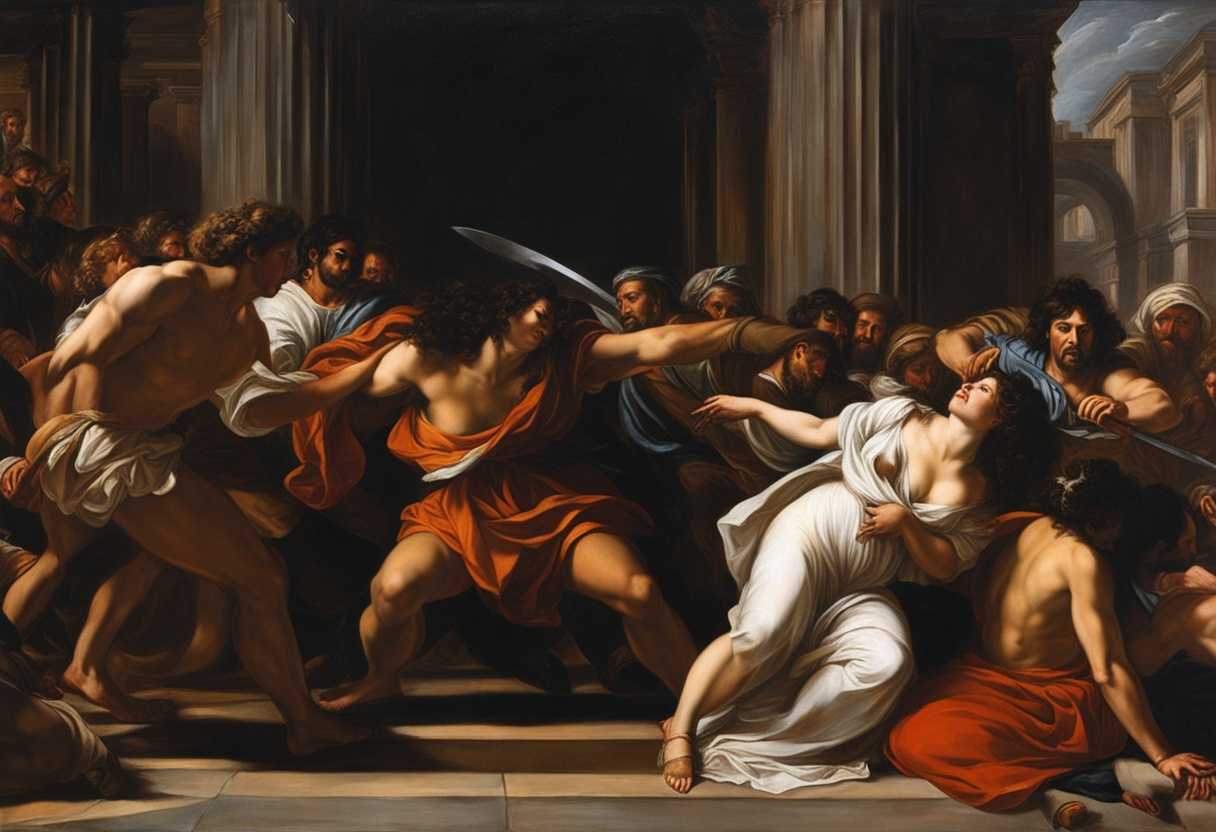
Setting the Scene for Judges 14:15-18
In the scene described in Judges 14:15-18, we find Samson, a powerful and enigmatic figure chosen by God to deliver the Israelites from the Philistines. Samson had just celebrated his wedding feast with a woman from Timnah, a Philistine town. As part of the festivities, Samson proposed a riddle to the thirty Philistine groomsmen who attended the feast. The riddle was a challenge for them to solve within seven days, with the promise of thirty linen garments and thirty sets of clothes if they succeeded, but a forfeit of the same if they failed.
The Philistine groomsmen, unable to solve the riddle on their own, resorted to pressuring Samson’s new wife to extract the answer from him. Succumbing to their threats, she tearfully revealed the solution to the riddle. Faced with this betrayal, Samson was filled with anger and disappointment. In a display of his strength and fury, he journeyed to Ashkelon, a Philistine city, and killed thirty men to fulfill his end of the bargain by taking their garments and giving them to the groomsmen. This act of violence marked the beginning of Samson’s conflict with the Philistines, setting the stage for the tumultuous events that would follow in his life. The scene is tense and charged with emotion, as Samson grapples with the consequences of his riddle and the betrayal he faced on his wedding day.
What is Judges 14:15-18 about?
Imagine the curiosity and surprise that Samson’s audience must have felt when he posed this riddle about honey in a lion’s carcass. What does honey represent here? It symbolizes sweetness and pleasure, something delightful and unexpected found in the most unexpected place—a lion’s carcass. This riddle not only showcases Samson’s cleverness but also hints at his incredible strength. How could he have bravely taken honey from a lion’s decaying remains without being harmed?
This verse about the riddle of honey in a lion’s carcass is not merely a puzzle for entertainment; it is a powerful metaphor for finding beauty and goodness in the most unlikely of places. Moments of light and hope can be found in the darkest of situations, just as honey can be discovered in a place of death and danger. Samson’s riddle challenges us to look beyond the surface, to search for the hidden blessings in challenging circumstances. It reminds us of the resilience and resourcefulness that lie within us, waiting to be discovered and embraced.
Understanding what Judges 14:15-18 really means
The story of Samson, a renowned judge of Israel, is filled with intrigue and moral lessons that resonate through the ages. In Judges 14:15-18, we witness a pivotal moment where Samson’s strength is not the focus, but rather the themes of trust, betrayal, and consequences of deceit come to the forefront. The passage unfolds with Samson’s riddle to the Philistines during his wedding feast, a seemingly innocuous challenge that unravels into a tale of manipulation and deceit.
“Entice your husband to explain the riddle,” a phrase that encapsulates the insidious nature of the Philistines’ actions. Their willingness to use deception to achieve their goals serves as a stark reminder of the lengths to which some may go for personal gain. This manipulation not only tarnishes the joyous occasion of Samson’s wedding but also sets the stage for a deeper exploration of human nature and moral dilemmas.
Samson’s response, “If you had not plowed with my heifer, you would not have solved my riddle,” reveals his profound sense of betrayal and anger. The metaphorical language he employs underscores the violation of trust he feels, emphasizing the gravity of deceit and its repercussions. This moment serves as a cautionary tale, highlighting the fragility of trust and the destructive power of betrayal.
In examining related biblical passages such as Proverbs 12:22 and Ephesians 4:25, we are reminded of the timeless importance of honesty and integrity. The divine disapproval of deceit and the call to speak truthfully to one another echo the values that underpin healthy relationships and communities. These verses provide a moral compass for navigating the complexities of human interactions, urging us to uphold the virtues of honesty and trustworthiness.
The relevance of this passage to contemporary society is striking. In a world where trust is the cornerstone of relationships, the consequences of betrayal and deceit can be devastating. Whether in personal or professional settings, the impact of broken trust reverberates far beyond the initial act of deception. The story of Samson serves as a mirror to our own lives, prompting us to reflect on the importance of maintaining integrity and trust in all our interactions.
Consider a scenario where a breach of trust leads to dire consequences, much like the situation Samson faced. Imagine the ripple effects of deceit in your own life, whether through personal relationships or professional endeavors. By contemplating the implications of betrayal and manipulation, we gain insight into the value of honesty and integrity in fostering meaningful connections and building a foundation of trust.
As we ponder the lessons embedded in Judges 14:15-18, let us strive to be individuals of honesty and integrity. By upholding these virtues, we not only honor the principles outlined in scripture but also cultivate a culture of trust and respect in our communities. The story of Samson serves as a poignant reminder of the enduring significance of trustworthiness and the destructive nature of deceit.
Why do we desire to keep secrets from God?
Humans may desire to keep secrets from God because we may feel embarrassed or ashamed of our actions or thoughts. We may fear judgment or punishment from God if our secrets are exposed. This can be seen in the story of Samson in the book of Judges, where he kept a secret from his parents about a riddle he had posed to the Philistines. Samson’s secrecy ultimately led to consequences and a series of events that unfolded.
However, it is important to remember that God is all-knowing and sees and understands everything, including our secrets. Keeping secrets from God does not change the reality of what is in our hearts and minds. It is better to be open and honest with God, confessing our sins and seeking forgiveness and guidance, rather than trying to hide things from Him. God’s love and grace are always available to us, even when we fall short.
Application
In the fast-paced world we live in, balancing work and family can feel overwhelming. But just like in a well-oiled machine, finding the right balance is crucial for smooth operation. Take a moment to assess where your priorities lie and ensure that your loved ones are not neglected in the process. Are you ready to make the necessary adjustments to nurture your relationships and strengthen the bonds that matter most?

Reverend Michael Johnson is an experienced Church Minister with a profound expertise in spirituality and guidance. With a serene presence and a compassionate heart, he has faithfully served his congregation for over 20 years, leading them on a spiritual journey towards inner peace and enlightenment. Reverend Johnson’s extensive knowledge of religious philosophies and profound understanding of human nature have made him a trusted confidant and mentor to many, as he seamlessly weaves his profound wisdom into life teachings. Reverend Johnson’s calming demeanor and empathetic nature continue to uplift and heal souls, nurturing a sense of unity and tranquility within his community.