
Judges 16:21 is about the moment when Samson, a symbol of God’s chosen people, loses his strength and connection with God due to his moral failings and deception by Delilah, representing the seductive and corrupting influences that can lead one away from their true purpose and source of power.
21 And the Philistines seized him and gouged out his eyes and brought him down to Gaza and bound him with bronze shackles. And he ground at the mill in the prison.
Setting the Scene for Judges 16:21
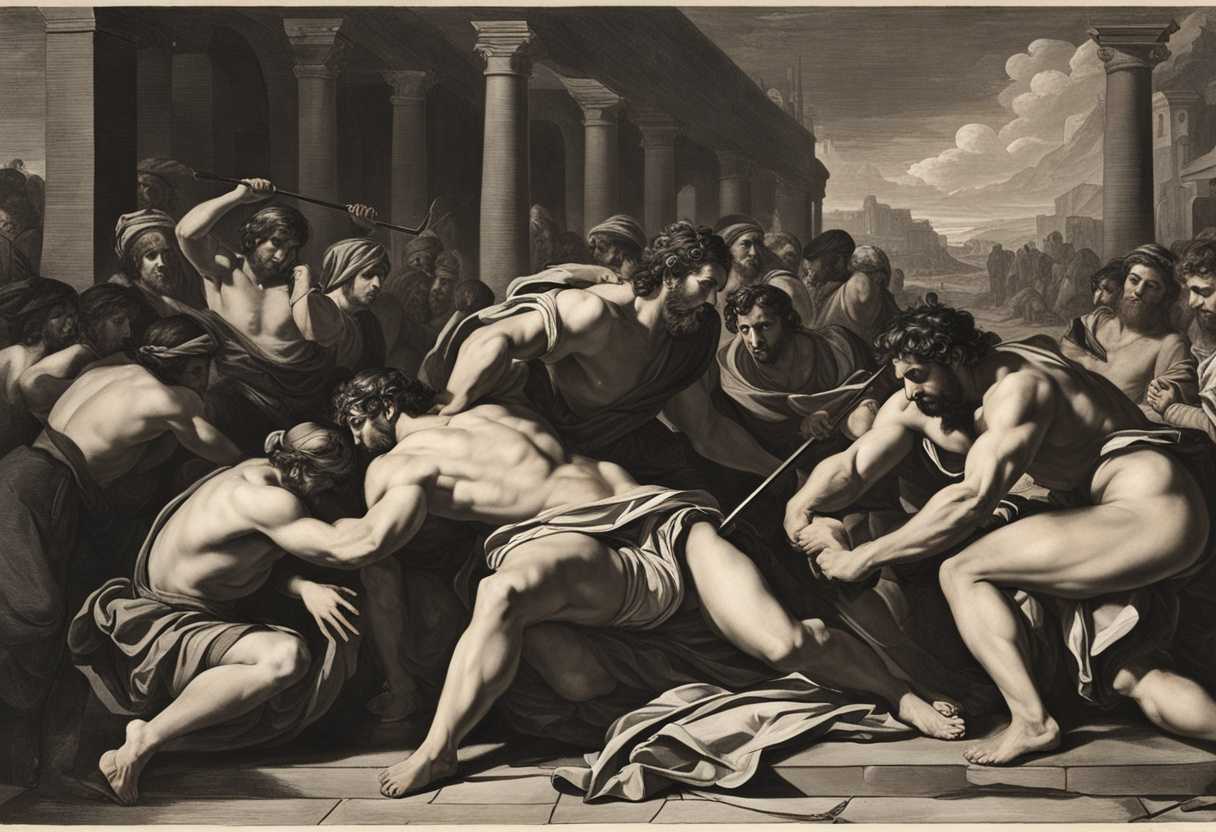
In Judges chapter 16, we find the infamous story of Samson and Delilah. The scene is set in a dimly lit chamber in the city of Gaza, where Samson, a powerful judge of Israel, finds himself betrayed by his lover, Delilah. Delilah, a Philistine woman, had been bribed by the Philistine rulers to discover the secret of Samson’s strength. As Samson lay sleeping in her lap, she called for a man to shave off the seven braids of his hair, the source of his supernatural strength given to him by God.
Surrounded by the oppressive presence of the Philistine lords who had come to capture him, Samson awakens to find himself weakened and vulnerable. The once mighty warrior is now at the mercy of his enemies, his hair gone, and his strength departed. The betrayal by Delilah and the subsequent capture of Samson symbolize the consequences of his disobedience to God’s commands and his repeated disregard for the Nazirite vow he had taken. This pivotal moment in the narrative marks the beginning of Samson’s downfall and eventual redemption through a final act of faith and sacrifice.
What is Judges 16:21 about?
Oh, the tale of Samson and Delilah, a story of trust and betrayal, of strength and vulnerability. Delilah takes Samson’s physical strength, his source of power and confidence, in this verse, marking a pivotal moment. She exposed his deepest weakness and ultimately brought about his downfall by cutting his hair, which symbolized his covenant with God.
Reflecting on this verse, we are reminded of the importance of self-awareness and understanding our own vulnerabilities. Just like Samson, we may have areas in our lives where we feel strong and invincible, but it is crucial to recognize that even our greatest strengths can turn into weaknesses if not handled with care. Delilah’s betrayal serves as a powerful lesson on the consequences of placing our trust in the wrong hands and failing to protect what makes us truly strong. Let us learn from Samson’s story as we navigate through life and strive to cultivate a balanced sense of strength and humility. True power comes from within, from our values and beliefs, and it is essential to guard those aspects of ourselves with vigilance. May we always be mindful of who we allow into our inner circle and never forget that even the mightiest among us can be brought to their knees by a single act of betrayal.
Understanding what Judges 16:21 really means
In the narrative of Samson, a renowned judge of Israel, we encounter a pivotal moment in Judges 16:21. This verse unfolds after the treacherous act of Delilah cutting Samson’s hair, leading to his capture by the Philistines. “The Philistines seized him,” marking the climax of Samson’s downfall, a consequence of betrayal and disobedience. The brutal act of “gouging out his eyes” symbolizes not only physical blindness but also the loss of spiritual vision, reflecting Samson’s earlier blindness in trusting Delilah. As he is brought to Gaza, a significant Philistine city, we witness his complete subjugation, bound with unbreakable bronze shackles, signifying his loss of freedom and strength. Reduced to grinding at the mill in prison, Samson’s humiliation starkly contrasts with his former status as a mighty judge of Israel.
In exploring related biblical passages, Proverbs 16:18 warns, “Pride goes before destruction, a haughty spirit before a fall,” underscoring Samson’s downfall due to his pride and overconfidence in his strength. Hebrews 12:6 reminds us that divine discipline, even through suffering, aims to bring us back to God, echoing Samson’s plight. 2 Corinthians 12:9 offers hope, proclaiming, “My grace is sufficient for you, for my power is made perfect in weakness,” showcasing how God’s strength can manifest through human frailty, as seen in Samson’s eventual redemption.
The relevance of Samson’s story resonates today, highlighting the repercussions of betrayal and disobedience. Just as Samson faced severe consequences, we are reminded of the importance of faithfulness and obedience to God’s will. His journey from loss to redemption serves as a potent reminder that even in our lowest moments, God offers the possibility of renewal and purpose. Samson’s physical blindness mirrors spiritual blindness, prompting introspection on areas where we may be unaware of our faults or straying from God’s path.
Consider a narrative of a successful individual whose pride leads to unethical choices, resulting in a downfall akin to Samson’s. Yet, in seeking forgiveness and guidance, they rebuild their life on humility and integrity, mirroring Samson’s transformation from pride to redemption. In conclusion, Samson’s narrative, particularly encapsulated in Judges 16:21, imparts valuable lessons on the perils of pride, the repercussions of disobedience, and the promise of redemption. It urges us to embrace faithfulness, humility, and self-awareness, trusting that God’s strength shines through our weaknesses.
What are the consequences of compromising your values?
Compromising one’s values can lead to serious and detrimental consequences. When individuals abandon their principles or beliefs for personal gain or temporary satisfaction, they may find themselves in a vulnerable and weakened position. Just like Samson in the story, compromising his vow to God led to his downfall and loss of strength.
The repercussions of compromising one’s values can not only impact the individual but also those around them. Samson’s compromise resulted in not only his own suffering but also in harm to others, such as the people of Israel who were under Philistine rule. When individuals lose sight of their values, they risk causing harm to themselves and those they are responsible for or care about.
Furthermore, compromising one’s values can erode trust and credibility. Samson’s decision to compromise his values ultimately led to his capture and enslavement by the Philistines. When people deviate from their principles, they may lose the respect and trust of others, impacting their relationships and reputation. Therefore, it is essential to uphold one’s values to maintain integrity and avoid the potential negative consequences that come with compromising them.
Application
Let’s learn from Samson’s loss of strength through betrayal and ponder how easily worldly distractions can weaken our spiritual core. Keep your faith strong, shield it from deceptive influences that lure you away. Will you stand firm against such temptations as Samson did?

Reverend Michael Johnson is an experienced Church Minister with a profound expertise in spirituality and guidance. With a serene presence and a compassionate heart, he has faithfully served his congregation for over 20 years, leading them on a spiritual journey towards inner peace and enlightenment. Reverend Johnson’s extensive knowledge of religious philosophies and profound understanding of human nature have made him a trusted confidant and mentor to many, as he seamlessly weaves his profound wisdom into life teachings. Reverend Johnson’s calming demeanor and empathetic nature continue to uplift and heal souls, nurturing a sense of unity and tranquility within his community.