
Judges 19-21 is about a horrifying incident in Gibeah that reveals the moral decay and lack of righteous leadership among the Israelites, leading to civil war and the near eradication of the tribe of Benjamin.
1 In those days, when there was no king in Israel, a certain Levite was sojourning in the remote parts of the hill country of Ephraim, who took to himself a concubine from Bethlehem in Judah.
2 And his concubine was unfaithful to him, and she went away from him to her father’s house at Bethlehem in Judah, and was there some four months.
3 Then her husband arose and went after her, to speak kindly to her and bring her back.
4 His father-in-law, the girl’s father, made him stay, and he remained with him three days. So they ate and drank and spent the night there.
5 And on the fourth day they arose early in the morning, and he prepared to go, but the girl’s father said to his son-in-law, “Strengthen your heart with a morsel of bread, and after that you may go.”
6 So the two of them sat and ate and drank together. And the girl’s father said to the man, “Be pleased to spend the night, and let your heart be merry.”
7 And when the man rose up to go, his father-in-law urged him; so he spent the night there again.
8 And on the fifth day he arose early in the morning to depart. But the girl’s father said, “Strengthen your heart with a morsel of bread, and after that you may go.”
9 And when the man and his concubine and his servant rose up to depart, his father-in-law, the girl’s father, said to him, “Behold, now the day has waned toward evening. Please, spend the night. Behold, the day draws to its close. Lodge here and let your heart be merry, and tomorrow you shall arise early in the morning for your journey, and go home.”
10 But the man would not spend the night. He rose up and departed and arrived opposite Jebus (that is, Jerusalem).
11 And when they were near Jebus, the day was nearly over, and the servant said to his master, “Come now, let us turn aside to this city of the Jebusites and spend the night in it.”
12 And his master said to him, “We will not turn aside into the city of foreigners, who do not belong to the people of Israel, but we will pass on to Gibeah.”
13 And he said to his young man, “Come, let us draw near to one of these places and spend the night at Gibeah or at Ramah.”
14 So they passed on and went their way. And the sun went down on them near Gibeah, which belongs to Benjamin,
15 And they turned aside there to go in and spend the night in Gibeah.
16 And behold, an old man was coming from his work in the field at evening. He was from the hill country of Ephraim, and he was sojourning in Gibeah. The men of the place were Benjaminites.
17 And when he lifted up his eyes and saw the traveler in the open square of the city, the old man said, “Where are you going? And where do you come from?”
18 And he said to him, “We are passing from Bethlehem in Judah to the remote parts of the hill country of Ephraim, from which I come. I went to Bethlehem in Judah, and I am going to the house of the Lord, but no one has taken me into his house.
19 We have straw and feed for our donkeys, with bread and wine for me and your female servant and the young man with your servants. There is no lack of anything.”
20 And the old man said, “Peace be to you; I will care for all your wants. Only, do not spend the night in the square.”
21 So he brought him into his house and gave the donkeys feed. And they washed their feet, and ate and drank.
22 As they were making their hearts merry, behold, the men of the city, worthless fellows, surrounded the house, beating on the door. And they said to the old man, the master of the house, “Bring out the man who came into your house, that we may know him.”
23 And the man, the master of the house, went out to them and said to them, “No, my brothers, do not act so wickedly; since this man has come into my house, do not do this vile thing.
24 Behold, here are my virgin daughter and his concubine. Let me bring them out now. Violate them and do with them what seems good to you, but against this man do not do this outrageous thing.”
25 But the men would not listen to him. So the man seized his concubine and made her go out to them. And they knew her and abused her all night until the morning. And as the dawn began to break, they let her go.
26 And as the morning appeared, the woman came and fell down at the door of the man’s house where her master was, until it was light.
27 And her master rose up in the morning, and when he opened the doors of the house and went out to go on his way, behold, there was his concubine lying at the door of the house, with her hands on the threshold.
28 And he said to her, “Get up, let us be going.” But there was no answer. Then he put her on the donkey, and the man rose up and went away to his home.
29 When he entered his house, he took a knife, and taking hold of his concubine he divided her, limb by limb, into twelve pieces, and sent her throughout all the territory of Israel.
30 And all who saw it said, “Such a thing has never happened or been seen from the day that the people of Israel came up out of the land of Egypt until this day; consider it, take counsel, and speak.”
1 Then all the people of Israel came out, from Dan to Beersheba, including the land of Gilead, and the congregation assembled as one man to the Lord at Mizpah.
2 The chiefs of all the people, of all the tribes of Israel, presented themselves in the assembly of the people of God, 400,000 men on foot that drew the sword.
3 (Now the Benjaminites heard that the people of Israel had gone up to Mizpah.) And the people of Israel said, “Tell us, how did this evil happen?”
4 And the Levite, the husband of the woman who was murdered, answered and said, “I came to Gibeah that belongs to Benjamin, I and my concubine, to spend the night.
5 And the men of Gibeah rose against me and surrounded the house by night. They meant to kill me, and they violated my concubine, and she is dead.
6 Then I took my concubine and cut her in pieces and sent her throughout all the country of the inheritance of Israel, for they have committed abomination and outrage in Israel.
7 Behold, all you people of Israel, give your advice and counsel here.
8 Then all the people arose as one man, saying, “None of us will go to his tent, and none of us will return to his house.
9 But now this is the thing that you shall do: you shall utterly destroy all the males, and also the women and children.
10 And we will take ten men of a hundred throughout all the tribes of Israel, and a hundred of a thousand, and a thousand of ten thousand, to bring provisions for the people, that when they come they may repay Gibeah of Benjamin, for all the outrage that they have committed in Israel.”
11 So all the men of Israel gathered against the city, united as one.
12 The tribes of Israel sent men through all the tribe of Benjamin, saying, “What evil is this that has taken place among you?
13 Now therefore give up the men, the worthless fellows in Gibeah, that we may put them to death and purge evil from Israel.” But the Benjaminites would not listen to the voice of their brothers, the people of Israel.
14 And the people of Benjamin mustered out of their cities on that day twenty-six thousand men who drew the sword, besides the inhabitants of Gibeah, who mustered seven hundred chosen men.
15 And the people of Benjamin mustered out of their cities on that day twenty-six thousand men who drew the sword, besides the inhabitants of Gibeah, who mustered seven hundred chosen men.
16 Among all these were 700 chosen men who were left-handed; every one could sling a stone at a hair and not miss.
17 And the men of Israel, apart from Benjamin, mustered four hundred thousand men who drew the sword. All these were men of war.
18 The people of Israel arose and went up to Bethel and inquired of God, “Who shall go up first for us to fight against the people of Benjamin?” And the Lord said, “Judah shall go up first.”
19 The people of Israel rose early and encamped against Gibeah.
20 And the men of Israel went out to battle against Benjamin, and the men of Israel drew up the battle line against them at Gibeah.
21 And the people of Benjamin came out of Gibeah and destroyed on that day 22,000 men of the Israelites.
22 But the people, the men of Israel, took courage, and again formed the battle line in the same place where they had formed it on the first day.
23 And the people of Israel went up and wept before the Lord until the evening. And they inquired of the Lord, “Shall we again draw near to fight against our brothers, the people of Benjamin?” And the Lord said, “Go up against them.”
24 And the people of Israel came near against the people of Benjamin the second day.
25 And Benjamin went against them out of Gibeah the second day, and destroyed 18,000 men of the people of Israel.
26 Then all the people of Israel, the whole army, went up and came to Bethel and wept. They sat there before the Lord and fasted that day until evening, and offered burnt offerings and peace offerings before the Lord.
27 And the people of Israel inquired of the Lord (for the ark of the covenant of God was there in those days,
28 and Phinehas the son of Eleazar, son of Aaron, ministered before it in those days), saying, “Shall we go out once more to battle against our brothers, the people of Benjamin, or shall we cease?” And the Lord said, “Go up, for tomorrow I will give them into your hand.”
29 And Israel set men in ambush around Gibeah.
30 And the people of Israel went up against the people of Benjamin on the third day and set themselves in array against Gibeah, as at other times.
31 And the people of Benjamin went out against the people and were drawn away from the city. And as at other times they began to strike and kill some of the people in the highways, one of which goes up to Bethel and the other to Gibeah, and in the open country, about thirty men of Israel.
32 And the Benjaminites said, “They are routed before us, as at the first.” But the people of the men of Israel took courage, and again formed the battle line in the same place where they had formed it on the first day.
33 And all the men of Israel rose up out of their place and set themselves in array at Baal-tamar, and the men of Israel who were in ambush rushed out of their place west of Geba.
34 And ten thousand men, chosen from all Israel, came against Gibeah, and the battle was fierce, but the Benjaminites did not know that disaster was close upon them.
35 And the Lord defeated Benjamin before Israel, and the people of Israel destroyed 25,100 men of Benjamin that day.
36 So the people went to Bethel and sat there before God until evening, and they lifted up their voices and wept bitterly.
37 And the men in ambush rose quickly out of their place, and as soon as he had stretched out his hand, they ran and entered the city and captured it.
38 Now the appointed signal between the men of Israel and the men in the main ambush was that when they made a great cloud of smoke rise up out of the city,
39 And the men of Israel turned back against the people of Benjamin and struck them with the edge of the sword, the city, men and beasts and all that they found. And all the towns that they found they set on fire.
40 But when the signal began to rise out of the city in a column of smoke, the Benjaminites looked behind them, and behold, the whole of the city went up in smoke to heaven.
41 Then the men of Israel turned back, and the men of Benjamin were dismayed, for they saw that disaster was close upon them.
42 And about 22,000 men of Israel fell that day.
43 They surrounded Benjamin, pursued them, and trod them down from Noh as far as opposite Gibeah on the east.
44 And 18,000 men of Benjamin fell, all of them men of valor.
45 And they turned and fled toward the wilderness to the rock of Rimmon. But 5,000 men of them were cut down on the highways. And they were pursued hard to Gidom, and 2,000 men of them were struck down.
46 So all who fell that day of Benjamin were 25,000 men who drew the sword, all of them men of valor.
47 But six hundred men turned and fled toward the wilderness to the rock of Rimmon and remained at the rock of Rimmon four months.
48 And the men of Israel turned back against the people of Benjamin and struck them with the edge of the sword, the city, men and beasts and all that they found. And all the towns that they found they set on fire.
21 Now the men of Israel had sworn at Mizpah, “No one of us shall give his daughter in marriage to Benjamin.”
2 And the people came to Bethel and sat there till evening before God, and they lifted up their voices and wept bitterly.
3 And they said, “O Lord, the God of Israel, why has this happened in Israel, that today there should be one tribe lacking in Israel?”
4 And the next day the people rose early and built there an altar and offered burnt offerings and peace offerings.
5 And the people of Israel said, “Which one of all the tribes of Israel did not come up in the assembly to the Lord?” For they had taken a great oath concerning him who did not come up to the Lord to Mizpah, saying, “He shall surely be put to death.”
6 And the people of Israel had compassion for Benjamin their brother and said, “One tribe is cut off from Israel this day.
7 What shall we do for wives for those who are left, since we have sworn by the Lord that we will not give them any of our daughters for wives?”
8 And they said, “What one is there of the tribes of Israel that did not come up to the Lord to Mizpah?” And behold, no one had come to the camp from Jabesh-gilead, to the assembly.
9 For when the people were counted, behold, there were none of the inhabitants of Jabesh-gilead there.
10 So the congregation sent 12,000 of their bravest men there and commanded them, “Go and strike the inhabitants of Jabesh-gilead with the edge of the sword; also the women and the little ones.
11 So the Israelites did so. They sent twelve thousand of their bravest men there and commanded them, “Go and strike the inhabitants of Jabesh-gilead with the edge of the sword; also the women and the little ones.
12 And they found among the inhabitants of Jabesh-gilead 400 young virgins who had not known a man by lying with him, and they brought them to the camp at Shiloh, which is in the land of Canaan.
13 And the whole congregation sent word to the people of Benjamin who were at the rock of Rimmon and proclaimed peace to them.
14 And Benjamin returned at that time. And they gave them the women whom they had saved alive of the women of Jabesh-gilead, but they were not enough for them.
15 And the people had compassion on Benjamin because the Lord had made a breach in the tribes of Israel.
16 Then the elders of the congregation said, “What shall we do for wives for those who are left, since the women are destroyed out of Benjamin?”
17 And they said, “There must be an inheritance for the survivors of Benjamin, that a tribe not be blotted out from Israel.
18 But we cannot give them wives from our daughters.” For the people of Israel had sworn, “Cursed be he who gives a wife to Benjamin.”
19 So they said, “Behold, there is the yearly feast of the Lord at Shiloh, which is north of Bethel, on the east of the highway that goes up from Bethel to Shechem, and south of Lebonah.”
20 So they commanded the people of Benjamin, saying, “Go and lie in ambush in the vineyards,
21 And watch. If the daughters of Shiloh come out to dance in the dances, then come out of the vineyards and snatch each man his wife from the daughters of Shiloh, and go to the land of Benjamin.
22 And when their fathers or their brothers come to complain to us, we will say to them, ‘Grant them graciously to us, because we did not take for each man of them his wife in battle, neither did you give them to them, else you would now be guilty.’”
23 So the people of Benjamin did so and took their wives, according to their number, from the dancers whom they carried off.
24 And the people of Israel departed from there at that time, every man to his tribe and family, and they went out from there every man to his inheritance.
25 In those days there was no king in Israel. Everyone did what was right in his own eyes.
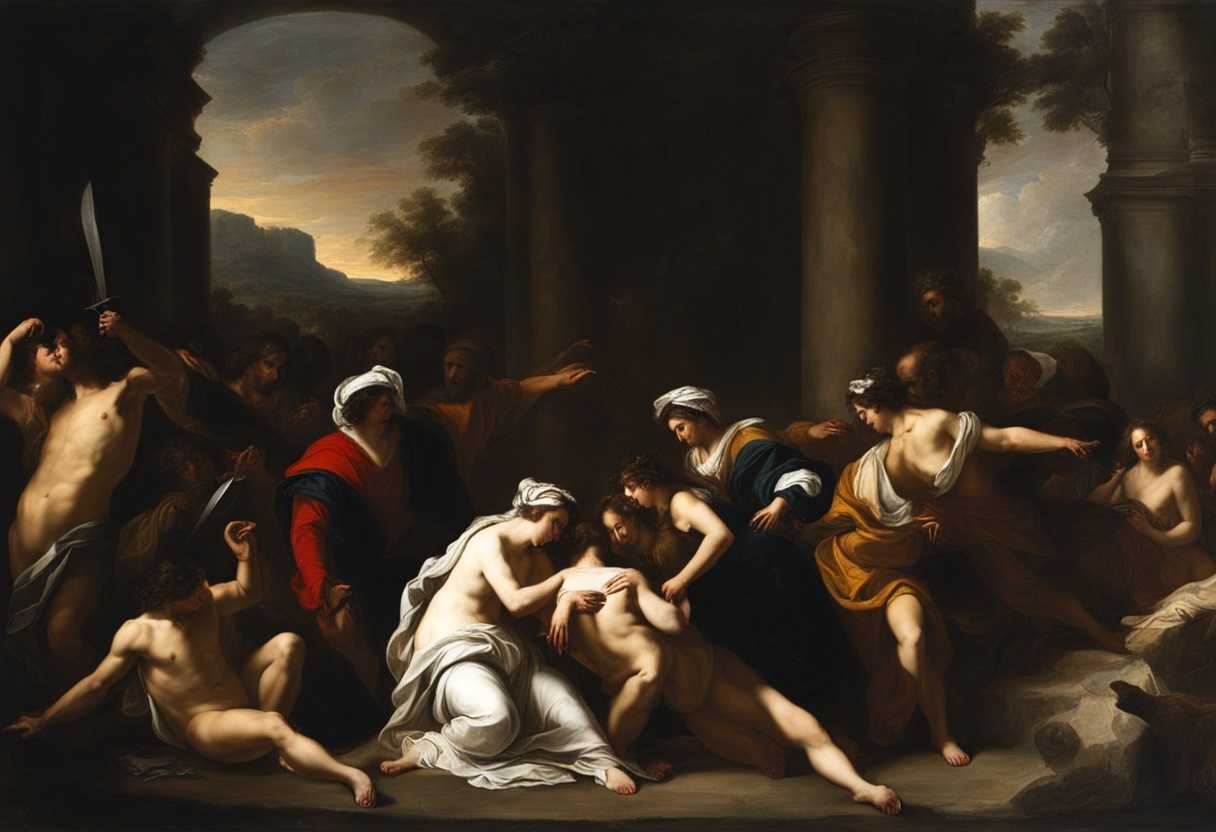
Setting the Scene for Judges 19-21
In the book of Judges, chapters 19-21 recount a dark and tragic event in Israel’s history. The scene is set in the town of Gibeah, where an unnamed Levite, his concubine, and his servant find themselves seeking shelter for the night. A kind old man takes them in, but the peace is shattered when the men of the city surround the house, demanding to have sexual relations with the Levite. In a shocking turn of events, the Levite offers his concubine to the mob, who brutally assault her throughout the night, leading to her death.
The next morning, the Levite callously places his concubine’s body on his donkey and returns home. Outraged by the atrocity, the other tribes of Israel gather to address the situation. The scene shifts to a solemn assembly at Mizpah, where the tribes confront the tribe of Benjamin, to which the men of Gibeah belong. This confrontation escalates into a devastating civil war, resulting in the near annihilation of the tribe of Benjamin.
The scene is one of chaos, betrayal, and moral decay, highlighting the consequences of turning away from God’s ways. It serves as a sobering reminder of the importance of justice, righteousness, and unity among God’s people.
What is Judges 19-21 about?
This verse depicts a grave situation in Israel where a woman has been raped and murdered. It paints a picture of a society plagued by sin and violence, where the vulnerable are not safe and justice seems out of reach. The verse highlights the need for justice to be served, for the perpetrators to be held accountable for their actions. It also calls for unity among the people of Israel, to come together in the face of such atrocities and work towards a better, more just society. The harsh realities of the world we live in confront us as we reflect on this verse. It urges us to think about the ways in which we can work towards creating a more just and compassionate society, where violence and sin do not hold sway. It challenges us to take a stand against injustice, to speak up for the marginalized and oppressed, and to strive for unity and peace in our communities. Let us heed the call of this verse and work towards a world where we treat all people with dignity and respect, and where justice and righteousness prevail.
Understanding what Judges 19-21 really means
Commentary on Judges 19-21
Introduction
In the tumultuous period of the Judges in Israel’s history, where there was no king, the people often spiraled into moral chaos. Judges 19-21 captures a dark episode marked by violence, injustice, and the consequences of moral relativism. The narrative unfolds with the account of the Levite and his concubine, leading to a heinous act in Gibeah, the subsequent war against the tribe of Benjamin, and the aftermath of these tragic events.
Key Themes and Phrases
The phrase “Everyone did what was right in his own eyes” epitomizes the moral decay prevalent in the era of the Judges. It reflects a society where individuals determined their actions based on personal whims rather than a moral standard. The men of Gibeah symbolize the depths of depravity to which unchecked sin can lead, showcasing the ripple effects of wickedness on an entire nation. The assembly of the people highlights the necessity of collective action and unity in addressing grave injustices and upholding communal values.
Related Biblical Passages
Drawing from Deuteronomy 12:8, the chaos in Judges serves as a cautionary tale against moral relativism and the dangers of forsaking God’s laws for self-defined morality. Romans 12:19 contrasts human vengeance with divine justice, urging a reliance on God’s righteous judgment. Hosea 9:9’s reference to Gibeah underscores the enduring infamy of sin and the importance of learning from past transgressions.
Relevance to People Today
The events in Judges 19-21 resonate with contemporary society, warning against the perils of moral relativism and emphasizing the need for communal responsibility in combating injustice. The narrative prompts reflection on forgiveness, reconciliation, and the power of unity in addressing societal ills and fostering healing.
Anecdote
Consider a community rallying together to confront a prevalent issue, showcasing the strength found in unity and collective action. This anecdote mirrors the tribes of Israel uniting against the atrocities in Judges, illustrating the transformative impact of communal solidarity in the face of adversity.
Detailed Explanation of Phrases
Exploring the implications of “Everyone did what was right in his own eyes” reveals the chaos and suffering that ensue when moral standards are subjective. Analyzing the wickedness of the men of Gibeah underscores the far-reaching consequences of unchecked sin and the importance of confronting evil. Reflecting on “The assembly of the people” underscores the significance of communal accountability and the power of unified action in addressing moral decay.
Conclusion
In summary, Judges 19-21 serves as a stark reminder of the dangers of moral relativism and the necessity of collective responsibility in upholding justice and righteousness. As readers reflect on these themes, may they be inspired to actively contribute to the well-being and moral integrity of their communities. Let us pray for wisdom, justice, and unity in our midst, seeking to learn from the lessons of the past to build a better future.
How can we advocate for justice and protection?
Advocating for justice and protection involves speaking up for those who are oppressed or vulnerable, and working towards creating a more just society. It requires taking a stand against injustices and standing up for the rights of others. The story found in Judges 19-21 illustrates the importance of seeking justice and protection for the innocent and oppressed. It shows the consequences of turning a blind eye to wrongdoing and the importance of taking action to right the wrongs that have been committed.
Advocacy for justice and protection can take many forms, including raising awareness about inequalities, advocating for policy changes, and supporting marginalized communities. It involves standing up against oppression and discrimination and working towards a more equitable society for all. We can help create a world where all individuals are valued and supported by being proactive in seeking justice and protection for those who are vulnerable.
Application
Let the stories in Judges 19-21 be your compass in navigating the complexities of your modern world. Just as you work diligently in your professional life and prioritize your family, may you also prioritize your spiritual journey. Draw strength from the tales of faith, justice, and consequences to guide your actions and decisions. Are you ready to embrace righteousness and serve the Lord with unwavering devotion in all aspects of your life?

Reverend Michael Johnson is an experienced Church Minister with a profound expertise in spirituality and guidance. With a serene presence and a compassionate heart, he has faithfully served his congregation for over 20 years, leading them on a spiritual journey towards inner peace and enlightenment. Reverend Johnson’s extensive knowledge of religious philosophies and profound understanding of human nature have made him a trusted confidant and mentor to many, as he seamlessly weaves his profound wisdom into life teachings. Reverend Johnson’s calming demeanor and empathetic nature continue to uplift and heal souls, nurturing a sense of unity and tranquility within his community.