
Judges 7:1-9 is about how God values humility and faith over human strength, as demonstrated by the reduction of Gideon’s army from thousands to three hundred to ensure that the victory in battle is credited to the power of God alone.
1 Then Jerubbaal (that is, Gideon) and all the people who were with him rose early and encamped beside the spring of Harod. And the camp of Midian was north of them, by the hill of Moreh, in the valley.
2 The Lord said to Gideon, “The people with you are too many for me to give the Midianites into their hand, lest Israel boast over me, saying, ‘My own hand has saved me.’
3 Now therefore proclaim in the ears of the people, saying, ‘Whoever is fearful and trembling, let him return home and hurry away from Mount Gilead.’” Then 22,000 of the people returned, and 10,000 remained.
4 And the Lord said to Gideon, “The people are still too many. Take them down to the water, and I will test them for you there, and anyone of whom I say to you, ‘This one shall go with you,’ shall go with you, and anyone of whom I say to you, ‘This one shall not go with you,’ shall not go.”
5 So he brought the people down to the water. And the Lord said to Gideon, “Every one who laps the water with his tongue, as a dog laps, you shall set by himself. Likewise, every one who kneels down to drink.”
6 And the number of those who lapped, putting their hands to their mouths, was 300 men, but all the rest of the people knelt down to drink water.
7 And the Lord said to Gideon, “With the 300 men who lapped I will save you and give the Midianites into your hand, and let all the others go every man to his home.”
8 So the people took provisions in their hands, and their trumpets. And he sent all the rest of Israel every man to his tent, but retained the three hundred men. And the camp of Midian was below him in the valley.
9 That same night the Lord said to him, “Arise, go down against the camp, for I have given it into your hand.
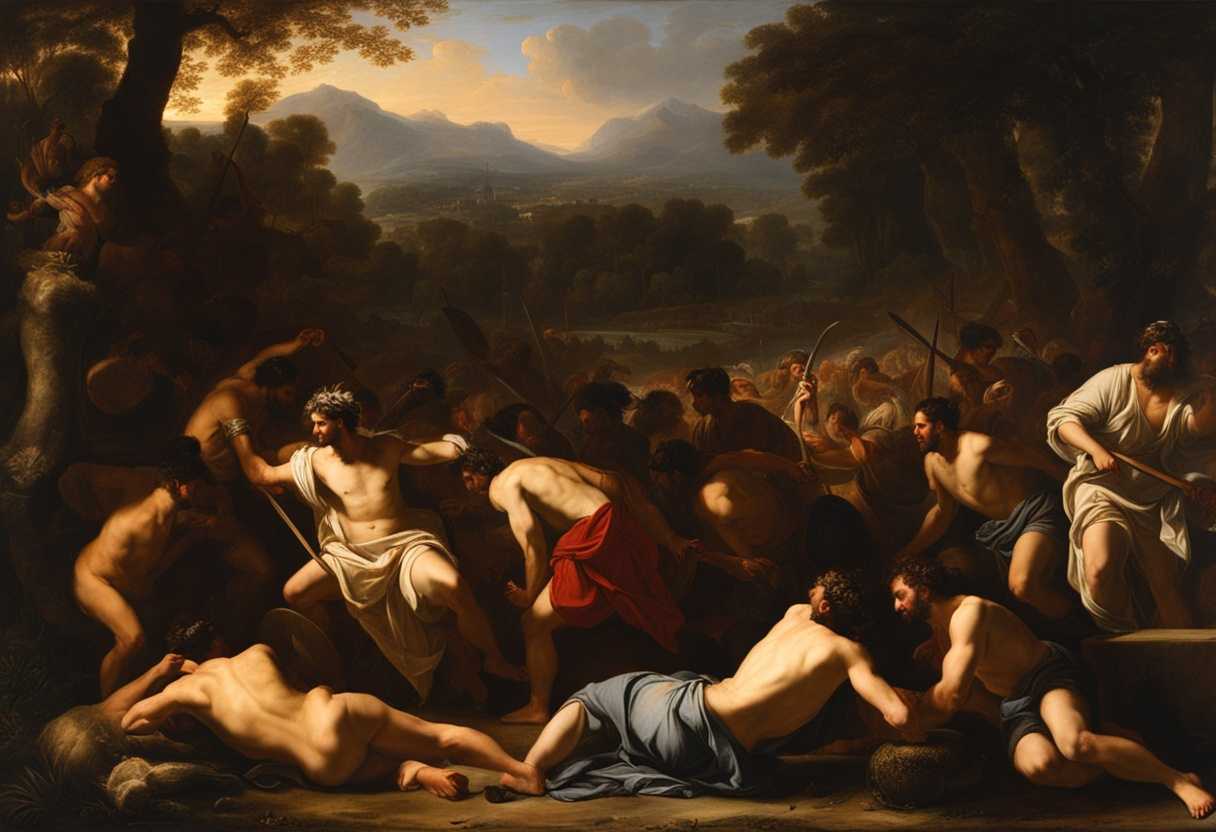
Setting the Scene for Judges 7:1-9
In Judges chapter 7, we find Gideon, a judge of Israel, preparing to lead his army against the Midianites. The scene is set in the valley of Jezreel, a vast plain surrounded by hills. Gideon has gathered an army of 32,000 men to face the Midianites, who had a much larger force. However, God instructs Gideon to reduce his army to test the faith and obedience of his men.
Gideon addresses his troops, explaining that those who are fearful or trembling should depart. As a result, 22,000 men leave, leaving only 10,000 soldiers remaining. Still, God tells Gideon that the army is too large, and he must further reduce the numbers. Gideon is instructed to take the men to the water, where God will show him who should go with him and who should not.
As the men drink from the stream, Gideon observes their behavior. Those who kneel down to drink are separated from those who lap the water with their hands to their mouths. Only 300 men drink by lapping the water, and God tells Gideon that with these 300, he will defeat the Midianites. This scene sets the stage for a miraculous victory orchestrated by God with a small, faithful army led by Gideon.
What is Judges 7:1-9 about?
The story of Gideon and his army being reduced to only 300 men in this verse is a powerful display of God’s might and deliverance. When faced with a vast enemy army, Gideon’s initial army of thousands seemed insufficient. However, God instructed Gideon to reduce the size of his army to only 300 men. This drastic reduction was a strategic move by God to demonstrate His power in battle. God showed that He is not constrained by human limitations and that His strength is unmatched by overwhelming odds.
This verse serves as a reminder that God’s ways are higher than our ways and His thoughts higher than our thoughts. It challenges us to trust in God’s wisdom and power even when things seem impossible. Just like Gideon and his small army, we are called to rely on God’s strength rather than our own. It prompts us to question if we are willing to step out in faith and allow God to showcase His power in our lives. Through this story, we are encouraged to have unwavering faith in God’s ability to overcome any obstacle or challenge we may face.
Understanding what Judges 7:1-9 really means
In the book of Judges, we find a compelling narrative that unfolds during a tumultuous period in Israel’s history. Gideon, also known as Jerubbaal, is appointed by God to lead the Israelites in a battle against the Midianites. The passage in Judges 7:1-9 delves into a pivotal moment where Gideon’s army is drastically reduced from 32,000 to a mere 300 men. This reduction serves as a profound lesson in reliance on God’s power rather than human strength, emphasizing the importance of faith and courage in God’s divine plan.
God’s directive to Gideon, stating that the people with him are too many, underscores the fundamental principle that victory ultimately belongs to the Lord. By thinning out the army and allowing only the fearless and unwavering to remain, God highlights the significance of faith over fear in accomplishing His purposes. The selection of the 300 men who lapped water as the chosen few to bring salvation showcases God’s sovereignty in using the seemingly insignificant to showcase His mighty power.
Drawing parallels from other biblical passages, such as 1 Samuel 14:6, where Jonathan acknowledges God’s ability to save by many or by few, reinforces the theme of divine power surpassing human limitations. Zechariah 4:6 echoes the sentiment that victory does not stem from human might but from the Spirit of the Lord. Similarly, 2 Corinthians 12:9 emphasizes how God’s strength is magnified in human weakness, aligning with the narrative of Gideon’s reduced army as a vessel for divine intervention.
The relevance of this passage extends to contemporary audiences, urging individuals to place their trust in God’s plan amidst a culture that exalts strength and self-reliance. Just as Gideon’s soldiers had to confront their fears and exhibit faith, we are called to overcome our anxieties with trust in God’s ability to work through our vulnerabilities. The story of Gideon’s 300 men serves as a poignant reminder that success and deliverance stem from God’s provision rather than human efforts or resources.
To illustrate this timeless message, envision a modern-day scenario where a small community faces a crisis, relying on faith and prayer for divine intervention. Despite their limited means, they witness unexpected aid arriving, leading to a miraculous recovery. This anecdote mirrors Gideon’s narrative, showcasing how God can utilize small, faithful groups to achieve remarkable outcomes, underscoring the truth that God’s strength shines brightest in our moments of weakness.
In conclusion, the account of Gideon and his 300 men encapsulates a profound truth: God’s strength is most evident in our weaknesses. It beckons us to trust in His plans, confront our fears with unwavering faith, and acknowledge that genuine victory emanates solely from Him. This narrative serves as a timeless beacon, guiding believers to rely on God’s power, confront their fears with faith, and embrace the assurance that God’s provision surpasses human understanding.
How can we trust in God’s plan over fear?
Gideon trusts in God’s plan over fear in this passage. Despite being fearful and doubtful at first, Gideon eventually follows God’s instructions and reduces his army in size significantly. This act displays Gideon’s trust in God’s plan, believing that God’s ways are greater than his own understanding. Gideon demonstrates his willingness to surrender control and rely on God’s guidance by letting go of fear and putting his faith in God.
Similarly, we can apply this lesson to our own lives. When faced with fear, uncertainty, or doubt, we can choose to trust in God’s plan rather than giving in to our worries. We can find peace and assurance in the midst of life’s challenges by letting go of our need for control and placing our faith in God’s wisdom and sovereignty. We too can find strength and hope by choosing to rely on God’s plan over our fears, just as Gideon experienced God’s faithfulness and victory by trusting in Him.
Application
In the modern dance of life, like Gideon following a strategic plan, we are also called to trust the guidance of a higher power. Just as Gideon put his faith in God’s hands, we can trust that the path laid before us is purposeful and fulfilling. Let us embrace challenges as opportunities for growth, knowing that we are equipped to handle whatever comes our way. Will you take that leap of faith today, confident in the direction set out for you?

Reverend Michael Johnson is an experienced Church Minister with a profound expertise in spirituality and guidance. With a serene presence and a compassionate heart, he has faithfully served his congregation for over 20 years, leading them on a spiritual journey towards inner peace and enlightenment. Reverend Johnson’s extensive knowledge of religious philosophies and profound understanding of human nature have made him a trusted confidant and mentor to many, as he seamlessly weaves his profound wisdom into life teachings. Reverend Johnson’s calming demeanor and empathetic nature continue to uplift and heal souls, nurturing a sense of unity and tranquility within his community.