
1 Then the men of Ephraim said to him, “What is this that you have done to us, not to call us when you went to fight against Midian?” And they accused him fiercely.
2 And he said to them, “What have I done now in comparison with you? Is not the gleaning of the grapes of Ephraim better than the grape harvest of Abiezer?
3 God has given into your hands the princes of Midian, Oreb and Zeeb. What have I been able to do in comparison with you?” Then their anger against him subsided when he said that.
4 And Gideon came to the Jordan and crossed over, he and the 300 men who were with him, exhausted yet pursuing.
5 And he said to the men of Succoth, “Please give loaves of bread to the people who follow me, for they are exhausted, and I am pursuing after Zebah and Zalmunna, the kings of Midian.”
6 And the officials of Succoth said, “Are the hands of Zebah and Zalmunna already in your hand, that we should give bread to your army?”
7 And Gideon said, “Well then, when the Lord has given Zebah and Zalmunna into my hand, I will flail your flesh with the thorns of the wilderness and with briers.”
8 And he went up from there to Penuel and spoke to them in the same way, and the men of Penuel answered him as the men of Succoth had answered.
9 And he said to the men of Penuel, “When I come again in peace, I will break down this tower.”
10 Now Zebah and Zalmunna were in Karkor with their army, about fifteen thousand men, all who were left of all the army of the people of the East, for there had fallen a hundred and twenty thousand men who drew the sword.
11 And Gideon went up by the way of the tent dwellers east of Nobah and Jogbehah and attacked the army, for the army felt secure.
12 And when Zebah and Zalmunna fled, he pursued them and captured the two kings of Midian, Zebah and Zalmunna, and he threw all the army into a panic.
13 Gideon the son of Joash returned from the battle by the ascent of Heres.
14 And he captured a young man of Succoth and questioned him. And he wrote down for him the officials and elders of Succoth, seventy-seven men.
15 And he came to the men of Succoth and said, “Behold Zebah and Zalmunna, about whom you taunted me, saying, ‘Are the hands of Zebah and Zalmunna already in your hand, that we should give bread to your men who are exhausted?’”
16 And he took the elders of the city and he took thorns of the wilderness and briers and with them taught the men of Succoth.
17 And he broke down the tower of Penuel and killed the men of the city.
18 Then he said to Zebah and Zalmunna, “Where are the men whom you killed at Tabor?” They answered, “As you are, so were they. Every one of them resembled the children of a king.”
19 And he said, “They were my brothers, the sons of my mother. As the Lord lives, if you had saved them alive, I would not kill you.”
20 And he said to Jether his firstborn, “Rise and kill them!” But the young man did not draw his sword, for he was afraid, because he was still a young man.
21 Then Zebah and Zalmunna said, “Rise yourself and fall upon us, for as the man is, so is his strength.” And Gideon arose and killed Zebah and Zalmunna, and he took the crescent ornaments that were on the necks of their camels.
22 Then the men of Israel said to Gideon, “Rule over us, you and your son and your grandson also, for you have saved us from the hand of Midian.”
23 Gideon said to them, “I will not rule over you, and my son will not rule over you; the Lord will rule over you.”
24 And Gideon said to them, “Let me make a request of you: every one of you give me the earrings from his spoil.” For they had golden earrings, because they were Ishmaelites.
25 And they said, “We will willingly give them.” And they spread a cloak, and every man threw in it the earrings of his spoil.
26 And the weight of the golden earrings that he requested was 1,700 shekels of gold, besides the crescent ornaments and the pendants and the purple garments worn by the kings of Midian, and besides the collars that were around the necks of their camels.
27 And Gideon made an ephod of it and put it in his city, in Ophrah. And all Israel whored after it there, and it became a snare to Gideon and to his family.
28 So Midian was subdued before the people of Israel, and they raised their heads no more. And the land had rest forty years in the days of Gideon.
29 Jerubbaal the son of Joash went and lived in his own house.
30 Now Gideon had seventy sons, his own offspring, for he had many wives.
31 And his concubine who was in Shechem also bore him a son, and he called his name Abimelech.
32 And Gideon the son of Joash died in a good old age and was buried in the tomb of Joash his father, at Ophrah of the Abiezrites.
33 As soon as Gideon died, the people of Israel turned again and whored after the Baals and made Baal-berith their god.
34 And the people of Israel did not remember the Lord their God, who had delivered them from the hand of all their enemies on every side,
35 and they did not show steadfast love to the family of Jerubbaal (that is, Gideon) in return for all the good that he had done to Israel.
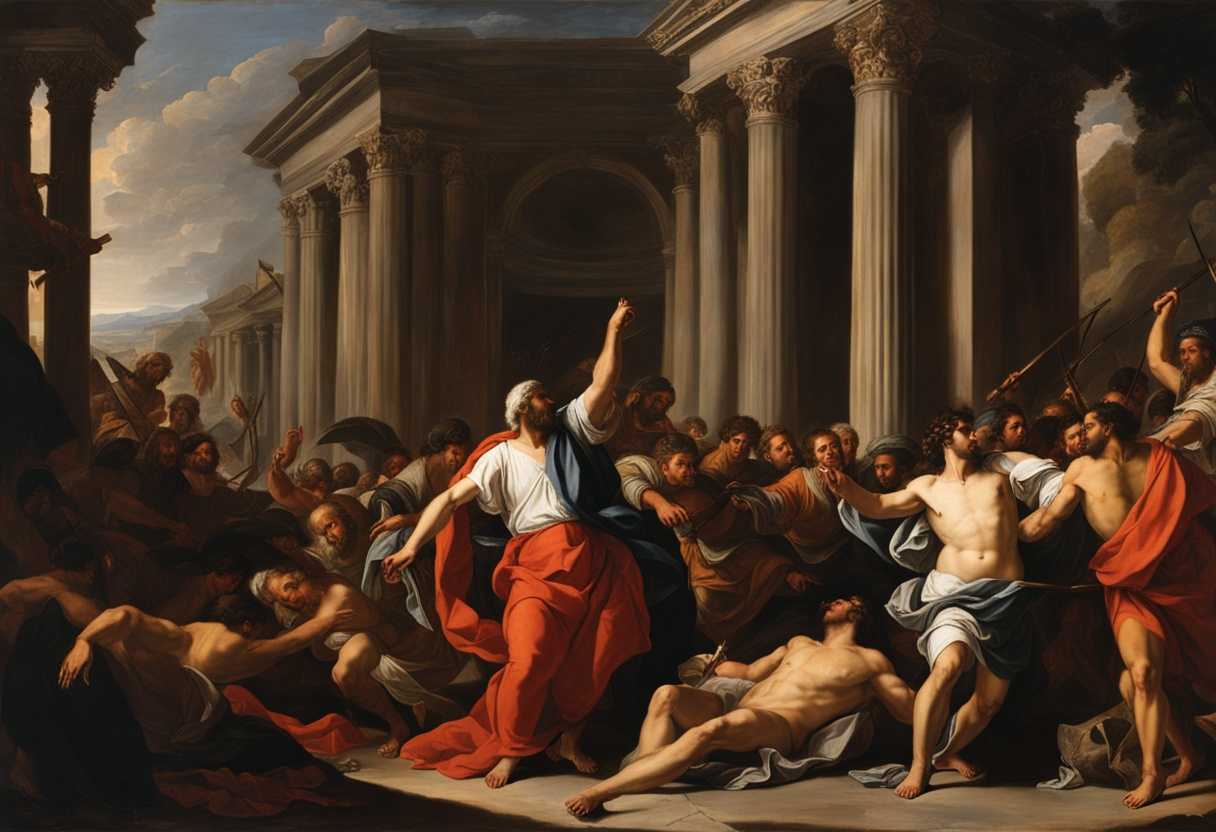
The True Meaning of Judges 8
The Book of Judges is believed to have been written by the prophet Samuel, who lived during a tumultuous time in the history of ancient Israel. This chapter continues the narrative of the Israelites’ struggle to establish their nation in the Promised Land, focusing on the exploits of the judge Gideon. We witness the aftermath of Gideon’s decisive victory over the Midianite army in this passage. However, the chapter also foreshadows the challenges that will arise as the Israelites grapple with internal divisions and the temptation of idolatry. Gideon’s actions, both heroic and flawed, serve as a cautionary tale about the dangers of pride and the importance of remaining faithful to God’s commands, as echoed in Deuteronomy 8:11-14. The chapter also highlights the ongoing tensions between the various tribes of Israel, as they vie for power and recognition. This foreshadows the eventual division of the kingdom, as described in 1 Kings 12. The events in Judges 8 serve as a crucial stepping stone in the larger narrative of Israel’s journey towards a united monarchy under the leadership of kings like Saul and David.
Judges 8:1-3
Gideon’s victory over the Midianites is seen in the aftermath in Judges 8:1-3. After the stunning triumph where Gideon and his 300 men defeated a vast enemy army, the men of Ephraim confront Gideon for not calling them to join the battle against Midian. The men of Ephraim were upset that they had not been involved in the initial stages of the battle and felt sidelined by Gideon’s actions. This reaction from the men of Ephraim can be seen as a display of pride and a desire for recognition. They wanted to share in the glory of the victory without necessarily having gone through the hardships of the battle.
Gideon, in his response to the men of Ephraim, tries to placate them by praising their contributions in capturing the two Midianite princes, Oreb and Zeeb. Gideon acknowledges their efforts in capturing these two enemy leaders to show that their actions were also significant in achieving the overall victory. However, we can see a sense of diplomacy in Gideon’s response, as he attempts to prevent any discord among the Israelites after their victory over the common enemy, the Midianites. This incident teaches us about the importance of unity and teamwork, even in times of success. It is crucial to recognize and appreciate the contributions of all individuals, regardless of the scale of their actions, in order to maintain harmony and cohesion within a community.
This episode with the men of Ephraim reflects a recurring theme in the Bible where human pride and a desire for recognition can lead to discord and conflicts among people. Those who take advice find wisdom, but pride only breeds quarrels.” This verse emphasizes the destructive nature of pride and how it can sow seeds of contention. Gideon’s handling of the situation with the men of Ephraim demonstrates a level of humility and wisdom in conflict resolution, traits that are praised in the Bible. Gideon sought to unify the tribes of Israel in the aftermath of the victory over the Midianites, reminding Christians to put aside personal ambitions and ego, and instead, focus on working together towards common goals.
Judges 8:4-9
Gideon engages in a conflict with the men of Ephraim after his victory over the Midianites in Judges 8:4-9. The men of Ephraim were upset that Gideon had not called upon them to join the battle against Midian and confront him about their exclusion from the victory. This incident highlights the importance of communication, unity, and humility in the face of success.
Gideon wisely defuses the situation with diplomacy and tact. He calms the men of Ephraim by acknowledging their bravery in capturing Oreb and Zeeb, two princes of Midian, comparing their achievement to his own. Rather than engaging in a battle of egos, Gideon chooses to focus on the common enemy they had faced and the shared victory they had attained. This demonstrates his humility and wisdom as a leader.
This passage also serves as a reminder of the dangers of pride and jealousy within a community. The men of Ephraim allow their wounded pride to nearly lead them into conflict with their fellow Israelites. This echoes the biblical theme that pride comes before a fall (Proverbs 16:18), and emphasizes the need for humility and unity among believers. It is a cautionary tale warning against allowing jealousy and resentment to create division within the body of believers.
Furthermore, Gideon’s response to the men of Ephraim reflects the biblical principle of reconciliation and forgiveness. Instead of responding in anger or defensiveness, Gideon chooses reconciliation and peace. This mirrors Jesus’ teachings on forgiveness and reconciliation (Matthew 5:23-24), emphasizing the importance of resolving conflicts within the community of believers. This passage from Judges 8 teaches us valuable lessons about leadership, humility, communication, unity, reconciliation, and the dangers of pride and jealousy. It reminds us of the importance of working together, celebrating each other’s victories, and humbly acknowledging the contributions of others for the greater good of the community and the Kingdom of God.
Judges 8:10-12
Zebah and Zalmunna, two kings of Midian, fled from Gideon after their armies had been defeated, as recounted in Judges 8:10-12. This passage follows the victory of Gideon and his small band of 300 men over the massive Midianite army by the grace and power of God. The capturing of Zebah and Zalmunna marked a crucial moment in Gideon’s triumph and the fulfillment of God’s plan for the Israelites.
Zebah and Zalmunna were not ordinary kings; they were the leaders of the Midianites who had oppressed the Israelites for seven years. Their defeat and capture symbolize the downfall of the Midianite oppression and the restoration of peace to Israel. This event showcases God’s faithfulness and His commitment to deliver His people from their enemies. It also emphasizes the importance of obedience and faith in God’s promises, as Gideon followed God’s instructions and experienced victory.
The capture of Zebah and Zalmunna is a testament to God’s power over the enemies of His people. Throughout the Bible, we see countless examples of God intervening on behalf of His chosen ones, defeating their adversaries, and bringing justice to the oppressed. This narrative serves as a reminder that no enemy is too powerful for God to overcome, and that He is always faithful to His promises of protection and deliverance. Gideon’s story and the defeat of the Midianites are significant parts of the larger narrative of the Book of Judges. It underscores the cyclical nature of Israel’s history, where they would drift away from God, face oppression as a consequence, cry out for help, and be rescued by a chosen leader whom God raised up. This pattern of disobedience, judgment, repentance, and deliverance is seen throughout the book and serves as a cautionary tale for us to remain faithful to God and His commands. Gideon’s victory over the oppressive Midianites is highlighted in Judges 8:10-12 through the capture of their kings, Zebah and Zalmunna. It emphasizes God’s power, faithfulness, and deliverance for His people, as well as the importance of obedience and trust in His promises. This account contributes to the overarching theme of the Book of Judges, illustrating the consequences of straying from God and the hope found in repentance and restoration through God’s appointed leaders.
Judges 8:13-17
Gideon has a significant interaction with two kings of Midian, Zebah and Zalmunna, in Judges 8:13-17. After the great victory that God granted Gideon and the Israelites over the Midianites, Gideon pursued Zebah and Zalmunna. These two kings had ruthlessly oppressed the Israelites for many years, and their defeat was crucial for the liberation of God’s people. It is noteworthy that Gideon did not only rely on his military skills and strategy, but he also sought divine guidance and assistance in his campaign against the Midianites. Gideon noticed that the two kings he captured resembled the appearance of noble princes. Despite their regal appearance, Zebah and Zalmunna had caused immense suffering to the Israelites. This serves as a reminder that outward appearances can be deceiving, and true character is revealed through one’s actions and treatment of others. This theme is recurrent in the Bible, emphasizing the importance of inner qualities over external traits. God tells Samuel in 1 Samuel 16:7, “Do not look at his appearance or at his physical stature.”.. For the Lord does not see as man sees; for man looks at the outward appearance, but the Lord looks at the heart. Gideon’s shrewd response is seen when he asked the two kings about the men they had killed at Tabor. Zebah and Zalmunna’s answer implicated themselves in their own demise, as they revealed that they had killed Gideon’s brothers. This revelation not only justified their punishment but also fulfilled the prophecy of Gideon’s brothers’ deaths in Judges 7:14-15. It is a powerful reminder that God’s Word never fails to come to fruition. “My word that goes forth from My mouth shall not return to Me void, but it shall accomplish what I please, and it shall prosper in the thing for which I sent it,” as stated in Isaiah 55:11. The narrative in Judges 8:13-17 highlights the themes of divine intervention, the revelation of true character, and the fulfillment of God’s promises. Gideon’s victory over Zebah and Zalmunna not only brought justice for the Israelites but also demonstrated the faithfulness of God in fulfilling His plans and prophecies. This account reminds believers of the importance of seeking God’s guidance, discerning true character beyond appearances, and trusting in the fulfillment of His promises.
Judges 8:18-21
Gideon, a judge chosen by God, encounters a pivotal moment in Judges 8:18-21 in the story of delivering the Israelites from the oppression of the Midianites. These verses depict Gideon’s encounter with two leaders of the Midianite army, Zebah and Zalmunna. The interaction between Gideon and these captured leaders reveals important themes such as justice, mercy, and God’s faithfulness.
When Gideon asks them about the men they killed at Tabor, Zebah and Zalmunna reveal that they had killed Gideon’s own brothers. This revelation must have stirred deep emotions within Gideon, as he was now faced with the opportunity to avenge his brothers’ deaths. The desire for justice and retribution could have easily consumed him in that moment, but it is crucial to note how Gideon responds.
Gideon’s mercy and wisdom shine through as he spares the lives of Zebah and Zalmunna, despite the personal vendetta they had inflicted upon him. This act of mercy contrasts sharply with the ruthless nature of war during that time period. It exemplifies a higher moral standard that Gideon adhered to under the guidance of God. This display of mercy is not only a reflection of Gideon’s character but also a testament to the transformative power of God’s presence in the lives of His people. This story underscores the importance of forgiveness and redemption in the biblical narrative in a broader sense. Gideon’s choice to spare the lives of his enemies echoes the teachings of Jesus in the New Testament about loving one’s enemies and praying for those who persecute you (Matthew 5:44). Gideon demonstrates a sense of compassion that transcends mere human emotions and reflects the divine love and grace that God extends to all His creations by forgiving Zebah and Zalmunna.
Furthermore, Gideon’s decision to spare Zebah and Zalmunna also plays a significant role in the fulfillment of God’s plan for the Israelites. Later in the chapter, we see how the capture and interrogation of these Midianite leaders lead to the downfall of the Midianite oppressors and the eventual deliverance of the Israelites. This victory serves as a reminder that God’s ways are higher than our ways, and His plans include redemption even for the enemies of His chosen people. Judges 8:18-21 offers a powerful lesson on the importance of mercy, forgiveness, and trust in God’s ultimate justice. Through Gideon’s actions, we see a vivid portrayal of how divine grace can transform lives and bring about deliverance for His people. It serves as a timeless reminder for believers to emulate the traits of mercy and forgiveness, knowing that God’s redemptive power can work wonders even in the most challenging circumstances.
Judges 8:22-27
Gideon responds to the people of Israel’s request to rule over them and establish a dynasty after the victory over the Midianites in Judges 8:22-27. Identify the subject: “Let’s”
Rewrite the sentence in active voice: Let’s identify important sections in this passage and delve into their meanings.
Starting with verse 22, “The Israelites said to Gideon, ‘Rule over us—you, your son and your grandson—because you have saved us from the hand of Midian.’” This request from the Israelites reflects a common desire among the people to have a human king ruling over them. They were looking for stability and security under a royal lineage. It is essential to note that the Israelites were turning away from God as their true king and seeking a human ruler instead. This mirrors a recurring theme in the Old Testament where the people’s desire for a king leads to problems and disobedience to God’s laws (1 Samuel 8:7). Gideon declines the Israelites’ offer of kingship in verse 23, stating, “I will not rule over you, nor will my son rule over you.” The Lord will rule over you.” Gideon acknowledges that the true authority and kingship belong to the Lord alone. His humility in refusing to establish a dynasty shows his understanding of God’s sovereign rule over His people. This emphasizes the importance of God’s supremacy and the need for His people to submit to His divine authority rather than seeking power and control for themselves.
However, despite his refusal to become king, Gideon makes a request for the Israelites to give him gold earrings taken as plunder from the defeated Midianites. Gideon collects the gold in verses 24-26 and makes it into an ephod, which he sets up in his hometown. An ephod was a sacred garment worn by the high priest to seek God’s guidance. Gideon’s actions in this context may have been well-intentioned as he aimed to create a place for the people to seek God’s direction. Yet, the ephod later becomes a snare for Gideon and the Israelites, leading them into idolatry (Judges 8:27).
The passage ends with a statement in verse 27, “All Israel prostituted themselves by worshiping [the ephod] there, and it became a snare to Gideon and his family.” This verse serves as a warning against the dangers of idolatry and the consequences of straying from God’s commandments. The Israelites’ inclination to worship the ephod instead of God Himself illustrates the human tendency to put our trust in physical objects or rituals rather than in the Lord. This narrative highlights the importance of wholehearted devotion to God and the avoidance of anything that may lead us away from Him. The account of Gideon in Judges 8:22-27 showcases the themes of God’s sovereignty, human fallibility, and the temptation of idolatry. Through Gideon’s response to the Israelites’ request for kingship, his acknowledgment of God’s rule, and the subsequent events with the ephod, we are reminded of the importance of staying obedient to God’s commands, avoiding the worship of false idols, and recognizing God as the ultimate authority in our lives.
Judges 8:28-32
Gideon achieved victory over the Midianites, and Judges 8:28-32 focuses on the aftermath. Let’s break down the verses into important sections for closer examination.
Verse 28 states, “Thus Midian was subdued before the people of Israel, and they raised their heads no more. And the land had rest forty years in the days of Gideon.” This verse encapsulates the main theme of the book of Judges – the cycle of disobedience, oppression, repentance, and deliverance. Gideon, chosen by God to lead the Israelites against the Midianites, was successful in subduing their enemies and bringing peace to the land for forty years. This period of peace was a direct result of Gideon’s obedience to God and his willingness to be used as an instrument for God’s purposes. It serves as a reminder of the blessings that come from following God faithfully. Jerubbaal the son of Joash went and lived in his own house, as mentioned in verse 29.” Jerubbaal is another name for Gideon, given to him as a sign of victory over the altar of Baal. Gideon’s decision to return to his home signifies the end of his military leadership and a shift back to his domestic life. This transition from a warrior to a civilian is a reminder of the temporary nature of earthly victories and the importance of fulfilling different roles throughout one’s life. Even after achieving great success, it is necessary to return to a sense of normalcy and humility.
The next verse, 30, is a pivotal point in Gideon’s story, as it introduces a new element, “Now Gideon had seventy sons, his own offspring, for he had many wives.” The fact that Gideon had many wives and seventy sons is significant for a few reasons. Firstly, it highlights the moral decline that occurred during this period in Israel’s history. Polygamy was never part of God’s plan for marriage (Genesis 2:24) and often led to discord and division within families, as seen in Gideon’s own household later in Judges 9. Gideon, despite his faithfulness in battle, made poor choices in his personal life that had far-reaching consequences.
Lastly, verses 31 and 32 narrate a somber turn in the story, “And his concubine who was in Shechem also bore him a son, and he called his name Abimelech. And Gideon the son of Joash died in a good old age and was buried in the tomb of Joash his father, at Ophrah of the Abiezrites.” The introduction of Abimelech as Gideon’s son from a concubine foreshadows the tragic events that will unfold in the next chapter of Judges. Abimelech’s rise to power and his brutal pursuit of kingship bring further turmoil to the land and reveal the dangers of ambition, pride, and the consequences of Gideon’s family dynamics. The verses in Judges 8:28-32 capture the multifaceted nature of Gideon’s life – his triumphs in battle, his return to civilian life, his personal shortcomings, and the legacy he leaves behind. This passage serves as a cautionary tale about the importance of staying true to God’s principles in all aspects of life, as well as the repercussions of decisions made in moments of power and success. It underscores the need for humility, faithfulness, and obedience in order to avoid the pitfalls of personal and moral failure.
Judges 8:33-35
The passage in Judges 8:33-35 describes the tragic aftermath of Gideon’s great victory over the Midianites. After Gideon’s triumphant military success, we see a shift in focus to the moral decline of the Israelites. The Israelites, rather than remaining faithful and grateful to God for delivering them, succumb to idolatry. They turned away from the Lord and instead worshipped the false gods Baal and Asherah.
This section serves as a cautionary tale about the dangers of forgetting God’s faithfulness and succumbing to idolatry. Throughout the Old Testament, the theme of idolatry recurs as a consistent stumbling block for the Israelites. It is a reminder that turning away from the one true God leads to moral decay and spiritual emptiness. The allure of false gods and the pressures of the world can easily sway believers away from their devotion to God. This serves as a timeless message for Christians today to remain steadfast in their faith and guard against the temptation to prioritize worldly desires over their relationship with God.
The mention of Baal and Asherah in these verses is significant because these were common idols worshipped in the region during that time. Baal was the god of storms and fertility, while Asherah was considered the goddess of fertility. The worship of these idols involved immoral practices and rituals that were contrary to the commands of God. The Israelites were not only betraying God but also engaging in sinful behavior that would have lasting consequences by engaging in this idolatry. The Bible condemns idolatry repeatedly in the broader context. God explicitly commands His people not to have any other gods before Him or make graven images in Exodus 20:3-4. Throughout the history of Israel, idolatry led to severe punishments and calamities. The Israelites’ failure to remain faithful to the Lord resulted in their captivity, destruction of their nation, and exile. This serves as a stark reminder of the consequences of turning away from God and the importance of wholehearted devotion to Him. Believers are ultimately called to remain steadfast in their faith and worship the one true God. The example of the Israelites in Judges 8:33-35 reminds us of the consequences of idolatry and the importance of prioritizing our relationship with God above all else. It is a poignant lesson that continues to resonate throughout the pages of the Bible, serving as a warning to future generations to heed God’s commands and remain faithful to Him.
After Judges 8
The people of Israel had been delivered from the oppression of the Midianites, thanks to the leadership of Gideon. Yet, as the chapter draws to a close, we see a troubling turn of events. Gideon’s actions, though well-intentioned, had unintended consequences that would cast a shadow over the future of the nation. We must heed the lessons of this chapter and consider the weight of our own decisions as we move forward. For even the most righteous among us can be led astray by the allure of power and the temptation of personal gain. It is only through humility, wisdom, and a steadfast commitment to the will of the Almighty that we can hope to navigate the challenges that lie ahead.

Reverend Michael Johnson is an experienced Church Minister with a profound expertise in spirituality and guidance. With a serene presence and a compassionate heart, he has faithfully served his congregation for over 20 years, leading them on a spiritual journey towards inner peace and enlightenment. Reverend Johnson’s extensive knowledge of religious philosophies and profound understanding of human nature have made him a trusted confidant and mentor to many, as he seamlessly weaves his profound wisdom into life teachings. Reverend Johnson’s calming demeanor and empathetic nature continue to uplift and heal souls, nurturing a sense of unity and tranquility within his community.