
Judges 8:13-17 is about Gideon’s strategic and clever use of deception during battle to achieve victory, showcasing the unforeseen ways in which God can work through human actions for His divine purpose.
13 Gideon the son of Joash returned from the battle by the ascent of Heres.
14 And he captured a young man of Succoth and questioned him. And he wrote down for him the officials and elders of Succoth, seventy-seven men.
15 And he came to the men of Succoth and said, “Behold Zebah and Zalmunna, about whom you taunted me, saying, ‘Are the hands of Zebah and Zalmunna already in your hand, that we should give bread to your men who are exhausted?’”
16 And he took the elders of the city and he took thorns of the wilderness and briers and with them taught the men of Succoth.
17 And he broke down the tower of Penuel and killed the men of the city.
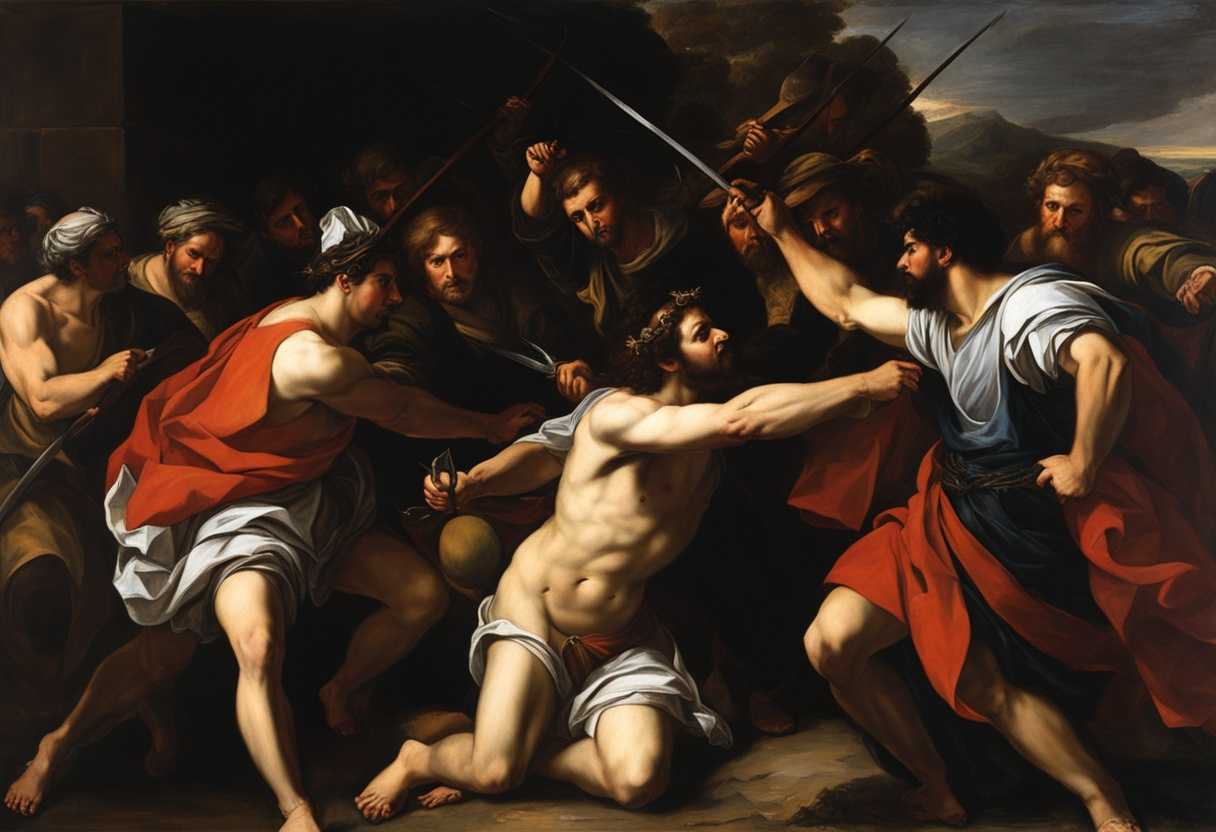
Setting the Scene for Judges 8:13-17
In Judges 8:13-17, we find Gideon, a judge of Israel, pursuing the Midianite kings Zebah and Zalmunna after a decisive victory over the Midianites. Gideon’s pursuit leads him to a place called Succoth, where he encounters the elders of the city. These elders are likely gathered together, discussing the recent events and the looming threat of the Midianites. The scene is tense, as the elders are wary of Gideon’s intentions and unsure of whether to support him in his pursuit of the remaining enemies.
Gideon, accompanied by his 300 men who had fought alongside him, approaches the elders of Succoth to request provisions for his weary troops. However, the elders of Succoth, perhaps fearing reprisal from the Midianites, refuse to help Gideon and his men. This refusal highlights the lack of unity and support among the Israelites during this tumultuous time. The setting is likely a dusty, war-torn village with weary soldiers and wary elders, showcasing the aftermath of a hard-fought battle and the complexities of tribal loyalties in ancient Israel.
What is Judges 8:13-17 about?
Let’s dive into the story of Gideon’s victory over the Midianites with the support of the Ephraimites. This biblical account showcases how a seemingly outnumbered and unassuming force can triumph over a powerful adversary with divine guidance and strategic collaboration. Gideon, a humble farmer, was called upon by God to lead the Israelites in battle against the Midianites, who had oppressed them for years.
The unity and cooperation between Gideon’s small army and the Ephraimites symbolize the importance of solidarity and working together towards a common goal. Despite initial tensions between Gideon and the Ephraimites, they ultimately joined forces to achieve a remarkable victory. This story teaches us the significance of faith, courage, and unity, illustrating how underdogs can overcome overwhelming odds through perseverance and trust in a higher power.
Reflecting on this powerful narrative, we are reminded of the strength that can be found in unity and faith. It encourages us to embrace challenges with determination and to seek support from others in times of need. Just like Gideon and the Ephraimites, we can achieve great things when we come together, trust in our abilities, and have faith in a greater purpose guiding us.
Understanding what Judges 8:13-17 really means
Gideon, also known as Jerubbaal, emerges as a prominent figure in the biblical narrative as a judge of Israel who led his people to victory against the Midianites. Following this triumph, Gideon’s pursuit of the remaining Midianite kings, Zebah and Zalmunna, reveals his unwavering commitment to securing peace for his nation. However, the narrative takes a turn when the people of Succoth and Penuel refuse to aid Gideon and his men, showcasing a stark lack of solidarity and support in the face of adversity.
As Gideon returns from the battle through the Pass of Heres, the imagery of his victorious homecoming underscores his role as a deliverer of Israel, a leader who has triumphed against formidable odds. The subsequent actions of Gideon, such as capturing a young man of Succoth to hold the town accountable, demonstrate his resolve to address the betrayal and lack of assistance faced by his forces. By taking the elders of Succoth and imparting a lesson to the men of the town, Gideon’s actions highlight the importance of accountability and the consequences of failing to support those in need.
The drastic measures taken by Gideon, including the destruction of the tower of Penuel and the punishment of its inhabitants, serve as a stark reminder of the severity of consequences that can arise from withholding aid and support from others. These actions reflect a sense of justice and retribution in response to the betrayal experienced by Gideon and his men, emphasizing the biblical principle of accountability and communal responsibility. The narrative prompts reflection on the ethical implications of turning a blind eye to the needs of others and the repercussions that may follow.
Drawing parallels to contemporary society, the story of Gideon and the towns of Succoth and Penuel resonates as a cautionary tale about the significance of community support and solidarity. In a world where individuals and communities often face challenges requiring collective assistance, the refusal to extend help can exacerbate hardships and deepen divisions. By considering scenarios like communities grappling with natural disasters, we recognize the vital role of mutual aid in fostering resilience and fostering unity in the face of adversity.
In conclusion, the passage from Judges 8:13-17 serves as a poignant reminder of the imperative to support one another in times of need. Through examining Gideon’s actions and the responses of Succoth and Penuel, we glean valuable insights into the consequences of withholding aid and the enduring value of community solidarity. By internalizing the lessons from this narrative and related biblical teachings, we are encouraged to cultivate a spirit of compassion and support in our interactions, ensuring that we uphold the principles of mutual assistance and avoid replicating the failings of Succoth and Penuel.
What value do we place on serving others selflessly?
Serving others selflessly is a fundamental value in the verse cited. It emphasizes the importance of putting the needs of others above our own, even when it requires great sacrifice. This act of selflessness is shown through Gideon’s actions as he willingly helps and supports his companions in their time of need, despite facing his own challenges and limitations. Gideon exemplifies the virtue of selfless service by prioritizing the well-being of others and offering his assistance with no expectation of personal gain. We demonstrate humility and a genuine concern for others’ welfare by practicing selfless service, showing compassion and empathy towards them. It involves setting aside our own desires and preferences in order to help those who rely on our support. Serving others selflessly also reflects a deeper sense of connection and unity within a community, fostering a culture of mutual care and generosity. We uphold the principle of treating others with kindness and respect, regardless of our own circumstances or needs, by embodying this value.
Application
Let’s dig deep and face the music. The passage challenges us to step up and show up when needed. Are we ready to put in the hard work and make sacrifices if necessary? Let’s show some guts and embrace the challenges that come our way in both our personal and professional lives. So, will you choose to step up and answer God’s call, no matter the cost?

Reverend Michael Johnson is an experienced Church Minister with a profound expertise in spirituality and guidance. With a serene presence and a compassionate heart, he has faithfully served his congregation for over 20 years, leading them on a spiritual journey towards inner peace and enlightenment. Reverend Johnson’s extensive knowledge of religious philosophies and profound understanding of human nature have made him a trusted confidant and mentor to many, as he seamlessly weaves his profound wisdom into life teachings. Reverend Johnson’s calming demeanor and empathetic nature continue to uplift and heal souls, nurturing a sense of unity and tranquility within his community.