
is about the purity laws and regulations regarding clean and unclean animals, as well as guidelines for bodily cleanliness and purification rituals in order to maintain holiness and health within the community of ancient Israelites.
1 And the Lord spoke to Moses and Aaron, saying to them,
2 “Speak to the people of Israel, saying, These are the living things that you may eat among all the animals that are on the earth.”
3 Whatever parts the hoof and is cloven-footed and chews the cud, among the animals, you may eat.
4 Nevertheless, among those that chew the cud or part the hoof, you shall not eat these: The camel, because it chews the cud but does not part the hoof, is unclean to you.
5 And the rock badger, because it chews the cud but does not part the hoof, is unclean to you.
6 And the hare, because it chews the cud but does not part the hoof, is unclean to you.
7 And the pig, because it parts the hoof and is cloven-footed but does not chew the cud, is unclean to you.
8 You shall not eat any of their flesh, and you shall not touch their carcasses; they are unclean to you.
9 “These you may eat, of all that are in the waters. Everything in the waters that has fins and scales, whether in the seas or in the rivers, you may eat.
10 But anything in the seas or the rivers that has not fins and scales, of the swarming creatures in the waters and of the living creatures that are in the waters, is detestable to you.
11 You shall regard them as detestable; you shall not eat any of their flesh, and you shall detest their carcasses.
12 Everything in the waters that has not fins and scales is detestable to you.
13 “And these you shall detest among the birds; they shall not be eaten; they are detestable: the eagle, the bearded vulture, the black vulture,
14 the kite, the falcon of any kind;
15 Every swarming thing that swarms on the ground is detestable; it shall not be eaten.
16 the ostrich, the nighthawk, the sea gull, the hawk according to its kind,
17 And the little owl and the cormorant and the short-eared owl,
18 the stork, the heron of any kind, the hoopoe, and the bat.
19 the stork, the heron of any kind, the hoopoe, and the bat.
20 “All winged insects that go on all fours are detestable to you.”
21 Yet among the winged insects that go on all fours you may eat those that have jointed legs above their feet, with which to hop on the ground.
22 Of them you may eat: the locust of any kind, the bald locust of any kind, the cricket of any kind, and the grasshopper of any kind.
23 But all other winged insects that have four feet are detestable to you.
24 “And by these you shall become unclean. Whoever touches their carcass shall be unclean until the evening,
25 And whoever carries any part of their carcass shall wash his clothes and be unclean until the evening.
26 Every animal that parts the hoof but is not cloven-footed or does not chew the cud is unclean to you. Everyone who touches them shall be unclean.
27 And among the animals that go on all fours, those that have a true hoof that is completely split open at the bottom, you shall regard as unclean.
28 But the swarming thing that crawls on the ground you shall not eat; they are detestable.
29 “And these are unclean to you among the swarming things that swarm on the ground: the mole rat, the mouse, the great lizard of any kind,
30 the gecko, the monitor lizard, the lizard, the sand lizard, and the chameleon.
31 These are unclean to you among all that swarm. Whoever touches them when they are dead shall be unclean until the evening.
32 And anything on which any of them falls when they are dead shall be unclean, whether it is an article of wood or a garment or a skin or a sack, any article that is used for any purpose. It must be put into water, and it shall be unclean until the evening; then it shall be clean.
33 And if any of them falls into any earthenware vessel, all that is in it shall be unclean, and you shall break it.
34 Any food in it that could be eaten, on which water comes, shall be unclean. And all drink that could be drunk from every such vessel shall be unclean.
35 And everything on which any part of their carcass falls shall be unclean. Whether oven or stove, it shall be broken in pieces. They are unclean and shall remain unclean for you.
36 Nevertheless, a spring or a cistern holding water shall be clean, but whoever touches a carcass in them shall be unclean.
37 If any part of their carcass falls upon any seed grain that is to be sown, it is clean,
38 But if water is put on the seed and any part of their carcass falls on it, it is unclean to you.
39 And if any animal which you may eat dies, whoever touches its carcass shall be unclean until the evening.
40 Whoever eats of its carcass shall wash his clothes and be unclean until the evening.
41 “Every swarming thing that swarms on the ground is detestable; it shall not be eaten.”
42 Whatever goes on its belly, and whatever goes on all fours, or whatever has many feet, any swarming thing that swarms on the ground, you shall not eat, for they are detestable.
43 You shall not make yourselves detestable with any swarming thing that swarms, and you shall not defile yourselves with them, and become unclean through them.
44 For I am the Lord your God. Consecrate yourselves therefore, and be holy, for I am holy. You shall not defile yourselves with any swarming thing that crawls on the ground.
45 For I am the Lord who brought you up out of the land of Egypt to be your God. You shall therefore be holy, for I am holy.”
46 This is the law about beast and bird and every living creature that moves through the waters and every creature that swarms on the ground,
47 to make a distinction between the unclean and the clean and between the living creature that may be eaten and the living creature that may not be eaten.
1 The Lord spoke to Moses, saying,
2 “Speak to the people of Israel, saying, If a woman conceives and bears a male child, then she shall be unclean seven days. As at the time of her menstruation, she shall be unclean.
3 And on the eighth day the flesh of his foreskin shall be circumcised.
4 Then she shall continue for thirty-three days in the blood of her purifying. She shall not touch anything holy, nor come into the sanctuary, until the days of her purifying are completed.
5 But if she bears a female child, then she shall be unclean two weeks, as in her menstruation. And she shall continue for sixty-six days in the blood of her purifying.
6 “And when the days of her purifying are completed, whether for a son or for a daughter, she shall bring to the priest at the entrance of the tent of meeting a lamb a year old for a burnt offering, and a pigeon or a turtledove for a sin offering,”
7 who shall offer it before the Lord and make atonement for her. Then she shall be clean from the flow of her blood. This is the law for her who bears a child, whether male or female.
8 And if she cannot afford a lamb, then she shall take two turtledoves or two pigeons, one for a burnt offering and the other for a sin offering. And the priest shall make atonement for her, and she shall be clean.”
1 The Lord spoke to Moses and Aaron, saying,
2 When a person has on the skin of his body a swelling or an eruption or a spot, and it turns into a case of leprous disease on the skin of his body, then he shall be brought to Aaron the priest or to one of his sons the priests.
3 And the priest shall examine the diseased area on the skin of his body. And if the hair in the diseased area has turned white and the disease appears to be deeper than the skin of his body, it is a case of leprous disease. When the priest has examined him, he shall pronounce him unclean.
4 If the case of leprous disease is deeper than the skin of his body, then the priest shall examine him, and if the leprous disease has spread in the skin, the priest shall pronounce him unclean; it is a case of leprous disease.
5 And the priest shall examine him on the seventh day, and if in his eyes the disease is checked and the disease has not spread in the skin, then the priest shall shut him up for another seven days.
6 And the priest shall look, and if the itch has spread in the skin, then the priest shall pronounce him unclean; it is a case of leprous disease.
7 But if the eruption spreads in the skin, after he has shown himself to the priest for his cleansing, he shall appear again before the priest.
8 And the priest shall examine him again on the seventh day, and if the diseased area has faded and the disease has not spread in the skin, then the priest shall pronounce him clean; it is only an eruption.
9 “When the infection of leprosy is on a man, then he shall be brought to the priest,”
10 And the priest shall examine the sore on the skin of the body, and if the hair in the diseased area has turned white and the disease appears to be deeper than the skin of the body, it is a case of leprous disease. When the priest has examined him, he shall pronounce him unclean.
11 It is a chronic leprous disease in the skin of his body, and the priest shall pronounce him unclean. He shall not shut him up, for he is unclean.
12 And if the leprous disease breaks out in the skin, so that the leprous disease covers all the skin of the diseased person from head to foot, so far as the priest can see,
13 then the priest shall look, and if the leprous disease has covered all his body, he shall pronounce him clean of the disease; it has all turned white, and he is clean.
14 But when raw flesh appears on him, he shall be unclean.
15 And the priest shall examine the raw flesh and pronounce him unclean, for the raw flesh is unclean; it is a leprous disease.
16 And if the priest examines, and if the disease has faded after it has been washed, he shall tear it out of the garment, or the warp or the woof, or the skin.
17 And the priest shall examine him, and if the itch has turned white in the skin and has affected the hair, and the itch appears to be deeper than the skin of his body, it is a case of leprous disease. When the priest has examined him, he shall pronounce him unclean.
18 “If there is in the skin of one’s body a boil and it heals,”
19 And in the place of the boil there comes a white swelling or a reddish-white spot, reddish-white, like a spot of leprous disease in the skin of the body.
20 And if, when the priest sees it, behold, it appears lower than the skin, and the hair in it has turned white, the priest shall pronounce him unclean. It is a case of leprous disease that has broken out in the boil.
21 But if the priest examines it and there is no white hair in it and it is not deeper than the skin, but has faded, then the priest shall shut him up seven days.
22 And if it spreads in the skin, then the priest shall pronounce him unclean; it is a case of leprous disease.
23 But if the spot remains in one place and does not spread, it is the scar of the boil, and the priest shall pronounce him clean.
24 Or if there is any flesh in the skin of the body and it is healed and the fresh appears in the skin, then the priest shall pronounce him unclean; it is a case of leprous disease that has broken out in the boil.
25 the priest shall examine it, and if the hair in the diseased area has turned white and the disease appears to be deeper than the skin of his body, it is a case of leprous disease. When the priest has examined him, he shall pronounce him unclean.
26 But if the priest examines it and there is no white hair in it and it is not deeper than the skin, but has faded, then the priest shall shut him up seven days.
27 And the priest shall examine him on the seventh day, and if in his eyes the disease is checked and the disease has not spread in the skin, then the priest shall shut him up for another seven days.
28 And if the itch spreads in the skin after he has shown himself to the priest for his cleansing, he shall appear again before the priest.
29 “When a man or woman has a disease on the head or the beard,”
30 then the priest shall examine the disease. And if it appears deeper than the skin, and the hair in it is yellow and thin, then the priest shall pronounce him unclean. It is an itch, a leprous disease of the head or the beard.
31 But if the priest examines the itching disease and it does not appear deeper than the skin and there is no black hair in it, then the priest shall shut up the person with the itching disease for seven days.
32 And on the seventh day the priest shall examine the disease. If the disease has not spread in the skin and it appears to be no deeper than the skin, then the priest shall shut him up for another seven days.
33 then the man shall be shaven, but the woman shall not be shaven.
34 And on the seventh day the priest shall examine the itch, and if the itch has not spread in the skin and it appears to be no deeper than the skin, then the priest shall pronounce him clean. And he shall wash his clothes and be clean.
35 But if the itch spreads in the skin after his cleansing,
36 then the priest shall examine him, and if the itch has spread in the skin, the priest need not seek for the yellow hair; he is unclean.
37 But if in his eyes the itch is unchanged and black hair has grown in it, the itch is healed and he is clean, and the priest shall pronounce him clean.
38 When a man or a woman has spots on the skin of the body, white spots,
39 “And on the seventh day the priest shall look at the infection, and if the infection has not spread in the skin and it appears to be no deeper than the skin, then the priest shall pronounce him clean. And he shall wash his clothes and be clean.”
40 “If a man’s hair falls out from his head, he is bald; he is clean.”
41 But if in his eyes the itch is unchanged and black hair has grown in it, the itch is healed and he is clean, and the priest shall pronounce him clean.
42 But if there is in the bald head or the bald forehead a reddish-white diseased area, it is a leprous disease breaking out on his bald head or his bald forehead.
43 “Then the priest shall examine it, and if the swelling of the itch is reddish-white on his bald head or on his bald forehead like the appearance of leprous disease in the skin of the body,”
44 he is a leprous man; he is unclean. He shall live alone. His dwelling shall be outside the camp.
45 “The leprous person who has the disease shall wear torn clothes and let the hair of his head hang loose, and he shall cover his upper lip and cry out, ‘Unclean, unclean.’”
46 He shall remain unclean as long as he has the disease. He is unclean. He shall live alone. His dwelling shall be outside the camp.
47 “If there is any garment of wool or linen in the warp or the woof of the linen or of the wool or in a skin or in any article made of skin,
48 If the priest examines the itching disease and it appears no deeper than the skin and there is no black hair in it, then the priest shall shut up the person with the itching disease for seven days.
49 if the disease is greenish or reddish in the garment, or in the skin or in the warp or the woof or in any article made of skin, it is a case of leprous disease, and it shall be shown to the priest.
50 The priest shall examine the plague and shut up the person for seven days.
51 He shall examine the disease on the seventh day. If the disease has spread in the garment, in the warp or the woof, or in the skin, whatever be the use of the skin, the disease is a persistent leprous disease; it is unclean.
52 He shall burn the garment, whether diseased in warp or woof, in wool or in linen, or anything of skin, for it is a persistent leprous disease. It shall be burned in the fire.
53 “But if the priest examines, and the disease has not spread in the skin and it appears no deeper than the skin, then the priest shall shut up the person with the disease for seven days.”
54 then the priest shall command that they wash the thing in which is the disease, and he shall shut it up for seven days.
And the priest shall examine the disease after it has been washed. And behold, if the diseased area has not changed color, though the disease has not spread, it is unclean. You shall burn it in the fire, whether the rot is on the back or on the front.
56 And if the priest examines, and if the disease has faded after it has been washed, he shall tear it out of the garment, or the warp or the woof, or the skin.
57 And if it appears again in the garment, in the warp or the woof, or in any article made of skin, it is spreading. You shall burn with fire that in which it is.
58 But the garment, or the warp or the woof, or any article made of skin from which the disease departs when you have washed it, shall then be washed a second time, and be clean.”
59 This is the law for a case of leprous disease in a garment of wool or linen, either in the warp or the woof, or in any article made of skin, to determine whether it is clean or unclean.
1 The Lord spoke to Moses, saying,
2 “This shall be the law of the leprous person for the day of his cleansing. He shall be brought to the priest,”
3 And the priest shall go out of the camp, and the priest shall look. Then, if the case of the leprous disease is healed in the leprous person,
4 the priest shall command them to take for him who is to be cleansed two live clean birds and cedarwood and scarlet yarn and hyssop.
5 And the priest shall command them to kill one of the birds in an earthenware vessel over fresh water.
6 As for the living bird, he shall take it together with the cedarwood and the scarlet yarn and the hyssop, and dip them and the living bird in the blood of the bird that was killed over the fresh water.
7 And he shall sprinkle it seven times on him who is to be cleansed of the leprous disease. Then he shall pronounce him clean and shall let the living bird go into the open field.
8 And he who is to be cleansed shall wash his clothes and shave off all his hair and bathe himself in water, and he shall be clean. And after that he may come into the camp, but live outside his tent seven days.
9 And on the seventh day he shall shave off all his hair from his head, his beard, and his eyebrows. He shall shave off all his hair, and then he shall wash his clothes and bathe his body in water, and he shall be clean.
10 “And on the eighth day he shall take two male lambs without blemish, and one ewe lamb a year old without blemish, and a grain offering of three tenths of an ephah of fine flour mixed with oil, and one log of oil.”
11 And the priest who cleanses him shall set the man who is to be cleansed and these things before the Lord, at the entrance of the tent of meeting.
12 And the priest shall take one of the male lambs and offer it for a guilt offering, along with the log of oil, and wave them for a wave offering before the Lord.
13 And he shall kill the lamb in the place where they kill the sin offering and the burnt offering, in the place of the sanctuary. For the guilt offering, like the sin offering, belongs to the priest; it is most holy.
14 the priest shall take some of the blood of the guilt offering, and the priest shall put it on the lobe of the right ear of him who is to be cleansed, and on the thumb of his right hand and on the big toe of his right foot.
15 And the priest shall take some of the log of oil and pour it into the palm of his own left hand
16 the priest shall dip his finger in the blood and sprinkle it seven times before the Lord in front of the veil of the sanctuary.
17 And of the rest of the oil that is in the priest’s hand he shall put on the head of him who is to be cleansed.
18 And the rest of the oil that is in the priest’s hand he shall put on the head of him who is to be cleansed. Then the priest shall make atonement for him before the Lord.
19 the priest shall offer the sin offering, to make atonement for him who is to be cleansed from his uncleanness. Then afterward he shall kill the burnt offering.
20 And the priest shall offer the burnt offering and the grain offering on the altar. Thus the priest shall make atonement for him, and he shall be clean.
21 But if he is poor and cannot afford so much, then he shall take one male lamb for a guilt offering to be waved, to make atonement for him, and a tenth of an ephah of fine flour mixed with oil for a grain offering, and a log of oil;
22 And two turtledoves or two pigeons, whichever he can afford, one shall be a sin offering and the other a burnt offering.
23 And on the eighth day he shall bring them for his cleansing to the priest, to the entrance of the tent of meeting, before the Lord.
24 And the priest shall take the lamb of the guilt offering and the log of oil, and the priest shall wave them for a wave offering before the Lord.
25 And he shall kill the lamb of the guilt offering. And the priest shall take some of the blood of the guilt offering and put it on the lobe of the right ear of him who is to be cleansed, and on the thumb of his right hand and on the big toe of his right foot.
26 And the priest shall take one male lamb and offer it for a guilt offering, along with the log of oil, and wave them for a wave offering before the Lord.
27 And if he is poor and cannot afford so much, then he shall take one male lamb for a guilt offering to be waved, to make atonement for him, and a tenth of an ephah of fine flour mixed with oil for a grain offering, and a log of oil;
28 And the priest shall put some of the oil that is in his hand on the lobe of the right ear of him who is to be cleansed and on the thumb of his right hand and on the big toe of his right foot, in the place where the blood of the guilt offering was put.
29 And the rest of the oil that is in the priest’s hand he shall put on the head of the one to be cleansed. Then the priest shall make atonement for him before the Lord.
30 And he shall offer, of the turtle-doves or pigeons, such as he can afford,
31 And if the priest makes the anointed one, who is to be cleansed, stand before the Lord, and the priest shall take from the log of oil and shall pour it into the palm of his own left hand
32 This is the law for him in whom is a case of leprous disease, who cannot afford the offerings for his cleansing.”
33 The Lord spoke to Moses and Aaron, saying,
34 “When you come into the land of Canaan, which I give you for a possession, and I put a case of leprous disease in a house in the land of your possession,”
35 Then he who owns the house shall come and tell the priest, ‘It seems to me there is some case of disease in my house.’
36 Then the priest shall command that they empty the house before the priest goes to examine the disease, lest all that is in the house be declared unclean. And afterward the priest shall go in to see the house.
37 And he shall examine the disease on the walls of the house with the stones with which the disease is found, and he shall scrape off the plaster and throw it into an unclean place outside the city.
38 then the priest shall go out of the house to the door of the house and shut up the house seven days.
39 And on the seventh day the priest shall go out of the house, to the door of the house, and shut up the house seven days.
40 then the priest shall command that they take out the stones in which is the disease and throw them into an unclean place outside the city.
41 And he shall have the inside of the house scraped all around, and the plaster that they scrape off they shall pour out in an unclean place outside the city.
42 And they shall take other stones and put them in the place of those stones, and he shall take other plaster and plaster the house.
43“If the disease breaks out again in the house, after he has taken out the stones and scraped the house and plastered it,”
44 then the priest shall go and look. And if the disease has spread in the house, it is a persistent leprous disease in the house; it is unclean.
45 And he shall break down the house, its stones and timber and all the plaster of the house, and he shall carry them out of the city to an unclean place.
46 And he shall let the live bird go out of the city into the open country. So he shall make atonement for the house, and it shall be clean.’”
47 And whoever lies in the house shall wash his clothes, and whoever eats in the house shall wash his clothes.
48 “But if the priest comes and looks, and if the disease has not spread in the house after the house was plastered, then the priest shall pronounce the house clean, for the disease is healed.”
49 And he shall take for the cleansing of the house two small birds, cedarwood, scarlet yarn, and hyssop.
50 and shall kill one of the birds in an earthenware vessel over fresh water.
51 And he shall take the cedarwood and the hyssop and the scarlet yarn, along with the live bird, and dip them in the blood of the bird that was killed and in the fresh water, and sprinkle the house seven times.
52 and he shall cleanse the house with the blood of the bird and with the fresh water and with the live bird and with the cedarwood and hyssop and scarlet yarn.
53 “But the priest shall examine the disease on the skin of the body, and if the hair in the diseased area has turned white and the disease appears to be deeper than the skin of the body, it is a case of leprous disease. When the priest has examined him, he shall pronounce him unclean.”
54 This is the law for any case of leprous disease: for clothing and for a house,
55 and for the living bird he shall take it together with the cedarwood and the scarlet yarn and the hyssop, and dip them and the living bird in the blood of the bird that was killed over the fresh water.
56 and for a swelling or an eruption or a spot,
57 to show when it is unclean and when it is clean. This is the law for leprous disease.
1 The Lord spoke to Moses and Aaron, saying,
2 “Speak to the people of Israel and say to them, When any man has a discharge from his body, his discharge is unclean.
3 And this is the law of his uncleanness for a discharge: whether his body runs with his discharge, or his body is blocked up by his discharge, it is his uncleanness.
4 Every bed on which the one with the discharge lies shall be unclean, and everything on which he sits shall be unclean.
5 And anyone who touches his bed shall wash his clothes and bathe himself in water and be unclean until the evening.
6 And whoever sits on anything on which the one with the discharge has sat shall wash his clothes and bathe himself in water and be unclean until the evening.
7 And whoever touches the body of the one with the discharge shall wash his clothes and bathe himself in water and be unclean until the evening.
8 And if the one with the discharge spits on someone who is clean, then he shall wash his clothes and bathe himself in water and be unclean until the evening.
9 And whatever saddle he who has the discharge rides on shall be unclean.
10 And whoever touches anything that was under him shall be unclean until the evening, and whoever carries such things shall wash his clothes and bathe himself in water and be unclean until the evening.
11 Whoever touches anything that has been on which has the discharge without having rinsed his hands in water shall wash his clothes and bathe himself in water and be unclean until the evening.
12 And the earthenware vessel that he who has the discharge touches shall be broken, and every vessel of wood shall be rinsed in water.
13 “And when the one with a discharge is cleansed of his discharge, then he shall count for himself seven days for his cleansing, and wash his clothes. And he shall bathe his body in fresh water and shall be clean.”
14 And on the eighth day he shall take two turtledoves or two pigeons and come before the Lord to the entrance of the tent of meeting and give them to the priest.
15 And the priest shall offer them, one for a sin offering and the other for a burnt offering. And the priest shall make atonement for him before the Lord for his discharge.
16 “If a man has an emission of semen, he shall bathe his whole body in water and be unclean until the evening.
17 “And every garment and every skin on which the semen comes shall be washed with water and be unclean until the evening.”
18 If a man lies with a woman and has an emission of semen, both of them shall bathe themselves in water and be unclean until the evening.
19 “When a woman has a discharge, and the discharge in her body is blood, she shall be in her menstrual impurity for seven days, and whoever touches her shall be unclean until the evening.”
20 Everything on which she lies during her menstrual impurity shall be unclean. Everything also on which she sits shall be unclean.
21 And whoever touches her bed shall wash his clothes and bathe himself in water and be unclean until the evening.
22 And whoever touches anything on which she sits shall wash his clothes and bathe himself in water and be unclean until the evening.
23 And if a woman has a discharge, and the discharge in her body is blood, she shall be in her menstrual impurity for seven days, and whoever touches her shall be unclean until the evening.
24 And if any man lies with her and her menstrual impurity comes upon him, he shall be unclean seven days, and every bed on which he lies shall be unclean.
25 “If a woman has a discharge of blood for many days, not at the time of her menstrual impurity, or if she has a discharge beyond the time of her impurity, all the days of the discharge she shall continue in uncleanness. As in the days of her impurity, she shall be unclean.
26 “Every bed on which she lies, all the days of her discharge, shall be to her as the bed of her impurity. And everything on which she sits shall be unclean, as in the uncleanness of her menstrual impurity.”
27 Whoever touches these things shall be unclean, and shall wash his clothes and bathe himself in water and be unclean until the evening.
28 But if she is cleansed of her discharge, she shall count for herself seven days, and after that she shall be clean.
29 And on the eighth day she shall take two turtledoves or two pigeons and bring them to the priest, to the entrance of the tent of meeting.
30 And the priest shall offer one for a sin offering and the other for a burnt offering. And the priest shall make atonement for her before the Lord for her unclean discharge.
31 Thus you shall keep the people of Israel separate from their uncleanness, lest they die in their uncleanness by defiling my tabernacle that is in their midst.
32 This is the law for him who has a discharge and for him who has an emission of semen, becoming unclean thereby.
33 And for a woman who is in her menstrual impurity, or for anyone in whom a discharge of semen occurs, or for a man who lies with a woman who is unclean,
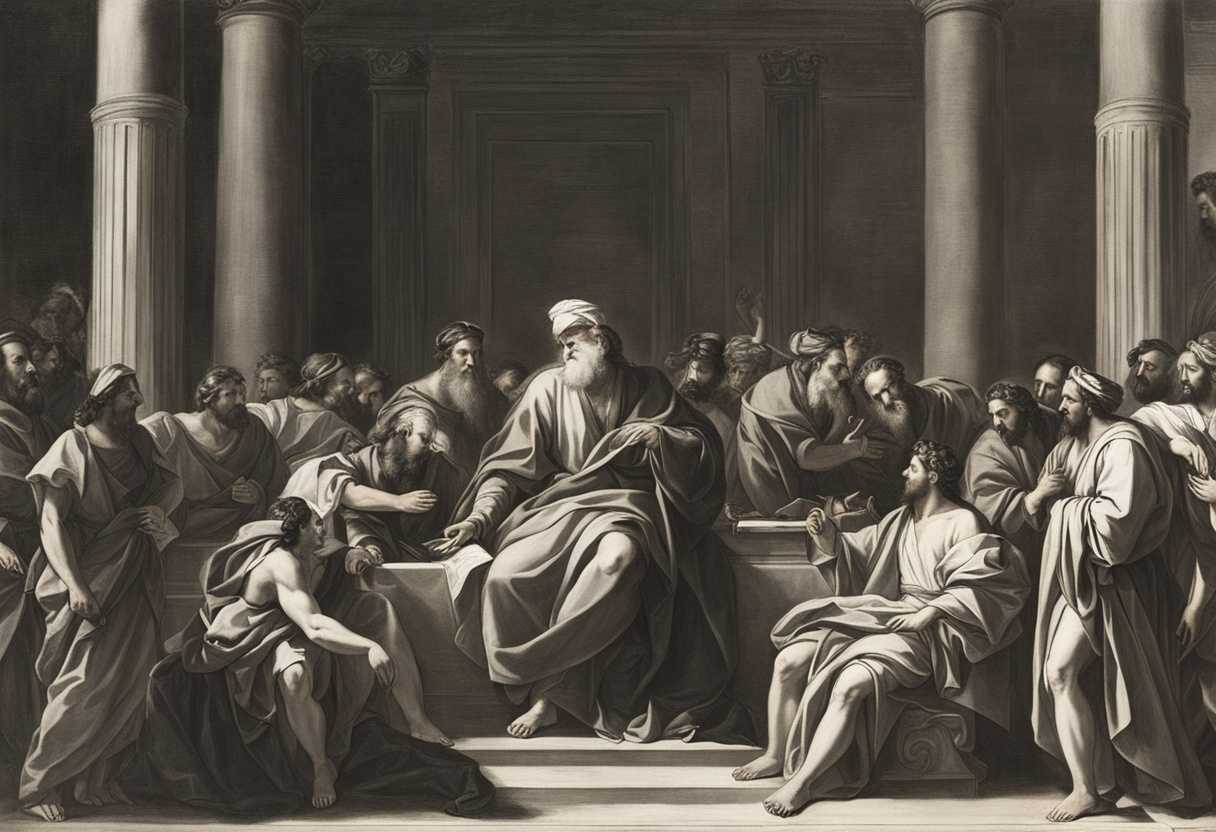
Setting the Scene for Leviticus 11-15
In the book of Leviticus, chapters 11-15 detail various laws and regulations concerning cleanliness and purification in ancient Israel. One particular scene that stands out is the scenario where a person is diagnosed with a skin disease, commonly referred to as leprosy in the Bible. The individual would have noticed some unusual discoloration or swelling on their skin and sought out a priest for examination.
In this scene, we find a man named Aaron, who is a priest, examining a person who has been isolated due to a suspected skin disease. The setting is a secluded area outside the camp where those with skin conditions were required to dwell until they were declared clean by the priest. The person with the skin disease would have been anxious and fearful, as a diagnosis of leprosy meant being ostracized from the community and living in isolation until declared healed.
Surrounded by the barren wilderness, Aaron meticulously inspects the individual’s skin, following the guidelines outlined in Leviticus 13. The tension is palpable as the person awaits Aaron’s verdict, knowing that their entire life could be upended by this diagnosis. This scene serves as a poignant reminder of the strict purity laws in ancient Israel and the importance of ritual cleanliness in the eyes of God.
What is Leviticus 11-15 about?
Leviticus 11-15 outlines the intricate laws and purification rituals found in the book of Leviticus. These chapters emphasize the importance of cleanliness and purity in the eyes of God. These verses serve as a guide for the Israelites on how to remain ritually pure and maintain a sacred relationship with God by distinguishing between clean and unclean animals, as well as detailing purification rituals and guidelines for dealing with skin diseases.
Have you ever wondered why these laws were so specific and detailed? It’s important to remember that in ancient times, purity and cleanliness were deeply intertwined with religious practices. These laws were not just about physical cleanliness but also about spiritual purity. The Israelites were showing their dedication to God and their commitment to living a holy life by following these guidelines. So, as we reflect on Leviticus 11-15, we can see these laws as a way to draw closer to God and to honor Him in all aspects of our lives.
Understanding what Leviticus 11-15 really means
Leviticus 11-15 delves into the intricate laws concerning cleanliness, dietary restrictions, and purification rituals that were crucial for the Israelites to uphold holiness and purity within their community. The distinction between what is deemed clean and unclean extends beyond mere physical hygiene to encompass spiritual purity, emphasizing the importance of maintaining a pure heart and intentions before God. The recurring directive to “be holy, for I am holy” serves as a poignant reminder of the divine call to emulate God’s character in our daily lives, reflecting His love, justice, and mercy in all our actions.
In Acts 10:9-16, Peter’s vision signifies a pivotal shift from the Old Testament dietary laws to the newfound freedom in Christ, where all foods are declared clean. This transition underscores the significance of inner purity over external rituals, as reiterated by Jesus in Matthew 15:11, emphasizing that true defilement stems from the heart rather than external factors. The correlation between holiness and purity is further emphasized in 1 Peter 1:15-16, reinforcing the call to live a life set apart for God, mirroring His holiness in all aspects of our existence.
While the specific regulations outlined in Leviticus may not directly apply to contemporary believers, the underlying principles of seeking spiritual purity and embodying holiness remain pertinent. The concept of holiness challenges us to mirror God’s character in our interactions, decisions, and conduct, fostering a community that reflects His love and grace. Moreover, the emphasis on community health and well-being in Leviticus can be paralleled to modern practices of hygiene and public health, highlighting the enduring relevance of these ancient laws in promoting communal welfare.
Consider a modern parallel where a community center enforces stringent cleanliness and behavioral guidelines to ensure a safe and inclusive environment for all. Though these rules may seem restrictive, they ultimately serve the greater purpose of fostering a healthy and respectful community. Similarly, the regulations in Leviticus aimed to cultivate a society that mirrored God’s holiness and care, emphasizing the importance of upholding purity and sanctity in all aspects of communal life.
By delving into the profound themes of cleanliness, holiness, and purification within Leviticus 11-15 and exploring their connections to other biblical passages, we glean valuable insights into living a life that honors God and promotes communal well-being. Through understanding these foundational principles, we are encouraged to strive for spiritual purity, embody holiness in our daily interactions, and contribute to the flourishing of a community grounded in God’s love and righteousness.
How can we maintain purity in our daily lives?
Maintaining purity in our daily lives can be achieved by following the principles outlined in Leviticus 11-15. We can foster a sense of purity in our thoughts, actions, and surroundings by adhering to the guidelines for cleanliness and avoiding things that are deemed unclean or impure. It is important to be mindful of what we consume, both physically and spiritually, as this can have a direct impact on our overall well-being and purity.
Purity is not just about external cleanliness, but also about maintaining a pure heart and mind. We can cultivate a sense of purity within ourselves and in our relationships with others by practicing virtues such as kindness, honesty, and compassion. Avoiding negativity, harmful speech, and immoral behaviors can help us stay on the path of purity and lead a more fulfilling and spiritually enriched life. Through self-reflection, mindfulness, and conscious efforts to uphold purity in all aspects of our lives, we can strive to live in accordance with the principles outlined in Leviticus 11-15.
Application
Let’s clean up our spiritual house and remove any impurities that tarnish our connection with the divine. Just like we strive for excellence in our careers and nurture our family relationships, let’s prioritize our spiritual growth. Will you take the necessary steps to purify your heart and align your actions with what honors the divine source of all life?

Reverend Michael Johnson is an experienced Church Minister with a profound expertise in spirituality and guidance. With a serene presence and a compassionate heart, he has faithfully served his congregation for over 20 years, leading them on a spiritual journey towards inner peace and enlightenment. Reverend Johnson’s extensive knowledge of religious philosophies and profound understanding of human nature have made him a trusted confidant and mentor to many, as he seamlessly weaves his profound wisdom into life teachings. Reverend Johnson’s calming demeanor and empathetic nature continue to uplift and heal souls, nurturing a sense of unity and tranquility within his community.