
Leviticus 14:1-32 is about the cleansing rituals for those who have recovered from skin diseases serving as symbolic acts of purification and restoration into the community, reflecting God’s desire for physical, spiritual, and social wholeness.
1 The Lord spoke to Moses, saying,
2 “This shall be the law of the leprous person for the day of his cleansing. He shall be brought to the priest,”
3 And the priest shall go out of the camp, and the priest shall look. Then, if the case of the leprous disease is healed in the leprous person,
4 the priest shall command them to take for him who is to be cleansed two live clean birds and cedarwood and scarlet yarn and hyssop.
5 And the priest shall command them to kill one of the birds in an earthenware vessel over fresh water.
6 As for the living bird, he shall take it together with the cedarwood and the scarlet yarn and the hyssop, and dip them and the living bird in the blood of the bird that was killed over the fresh water.
7 And he shall sprinkle it seven times on him who is to be cleansed of the leprous disease. Then he shall pronounce him clean and shall let the living bird go into the open field.
8 And he who is to be cleansed shall wash his clothes and shave off all his hair and bathe himself in water, and he shall be clean. And after that he may come into the camp, but live outside his tent seven days.
9 And on the seventh day he shall shave off all his hair from his head, his beard, and his eyebrows. He shall shave off all his hair, and then he shall wash his clothes and bathe his body in water, and he shall be clean.
10 “And on the eighth day he shall take two male lambs without blemish, and one ewe lamb a year old without blemish, and a grain offering of three tenths of an ephah of fine flour mixed with oil, and one log of oil.”
11 And the priest who cleanses him shall set the man who is to be cleansed and these things before the Lord, at the entrance of the tent of meeting.
12 And the priest shall take one of the male lambs and offer it for a guilt offering, along with the log of oil, and wave them for a wave offering before the Lord.
13 And he shall kill the lamb in the place where they kill the sin offering and the burnt offering, in the place of the sanctuary. For the guilt offering, like the sin offering, belongs to the priest; it is most holy.
14 the priest shall take some of the blood of the guilt offering, and the priest shall put it on the lobe of the right ear of him who is to be cleansed, and on the thumb of his right hand and on the big toe of his right foot.
15 And the priest shall take some of the log of oil and pour it into the palm of his own left hand
16 the priest shall dip his finger in the blood and sprinkle it seven times before the Lord in front of the veil of the sanctuary.
17 And of the rest of the oil that is in the priest’s hand he shall put on the head of him who is to be cleansed.
18 And the rest of the oil that is in the priest’s hand he shall put on the head of him who is to be cleansed. Then the priest shall make atonement for him before the Lord.
19 the priest shall offer the sin offering, to make atonement for him who is to be cleansed from his uncleanness. Then afterward he shall kill the burnt offering.
20 And the priest shall offer the burnt offering and the grain offering on the altar. Thus the priest shall make atonement for him, and he shall be clean.
21 But if he is poor and cannot afford so much, then he shall take one male lamb for a guilt offering to be waved, to make atonement for him, and a tenth of an ephah of fine flour mixed with oil for a grain offering, and a log of oil;
22 And two turtledoves or two pigeons, whichever he can afford, one shall be a sin offering and the other a burnt offering.
23 And on the eighth day he shall bring them for his cleansing to the priest, to the entrance of the tent of meeting, before the Lord.
24 And the priest shall take the lamb of the guilt offering and the log of oil, and the priest shall wave them for a wave offering before the Lord.
25 And he shall kill the lamb of the guilt offering. And the priest shall take some of the blood of the guilt offering and put it on the lobe of the right ear of him who is to be cleansed, and on the thumb of his right hand and on the big toe of his right foot.
26 And the priest shall take one male lamb and offer it for a guilt offering, along with the log of oil, and wave them for a wave offering before the Lord.
27 And if he is poor and cannot afford so much, then he shall take one male lamb for a guilt offering to be waved, to make atonement for him, and a tenth of an ephah of fine flour mixed with oil for a grain offering, and a log of oil;
28 And the priest shall put some of the oil that is in his hand on the lobe of the right ear of him who is to be cleansed and on the thumb of his right hand and on the big toe of his right foot, in the place where the blood of the guilt offering was put.
29 And the rest of the oil that is in the priest’s hand he shall put on the head of the one to be cleansed. Then the priest shall make atonement for him before the Lord.
30 And he shall offer, of the turtle-doves or pigeons, such as he can afford,
31 And if the priest makes the anointed one, who is to be cleansed, stand before the Lord, and the priest shall take from the log of oil and shall pour it into the palm of his own left hand
32 This is the law for him in whom is a case of leprous disease, who cannot afford the offerings for his cleansing.”
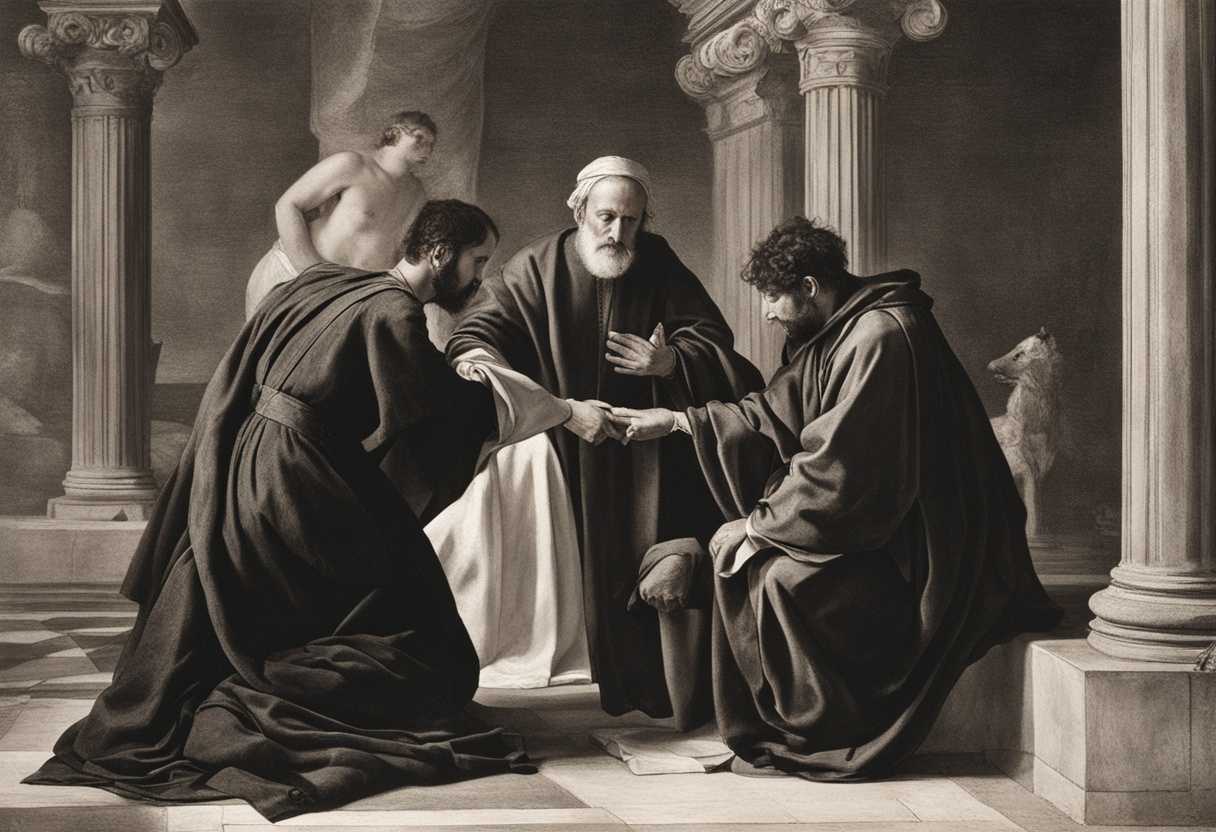
Setting the Scene for Leviticus 14:1-32
In the scene described in Leviticus 14:1-32, we find a group of people gathered outside the camp of the Israelites in the wilderness. Among them are individuals who have been afflicted with various skin diseases, such as leprosy, and have now been healed. These individuals have gone through a period of isolation and purification as prescribed by the laws outlined in Leviticus.
As the sun sets, casting a warm glow over the desert landscape, the healed individuals stand before Moses and Aaron, the leaders of the Israelites. Surrounding them are priests, ready to perform the rituals of cleansing and restoration. The air is filled with a sense of anticipation and hope as the community witnesses the miraculous transformation of these once-outcast individuals.
The scene is solemn yet filled with joy and gratitude as the priests follow the detailed instructions laid out in Leviticus 14:1-32. Sacrifices are made, blood is sprinkled, and prayers are offered up to God for the complete restoration and acceptance of these healed individuals back into the community. The sound of chanting and the smell of incense fill the air, creating a sacred atmosphere that speaks to the power of faith, healing, and redemption.
What is Leviticus 14:1-32 about?
The verse describes the process of cleansing and restoring individuals with skin diseases. The physical act of cleansing is used as a metaphor for spiritual renewal and restoration. It symbolizes the idea of purifying oneself from impurities, sins, and negative energies in order to start afresh. The detailed instructions provided in the verse not only emphasize the importance of cleanliness and hygiene but also carry a deeper meaning of self-reflection, repentance, and transformation.
Imagine the power and significance of this ritual – not only does it heal the physical ailment but it also serves as a powerful symbol of inner cleansing and renewal. A person’s soul is cleansed from any spiritual impurities or burdens they may carry, just as dirt and impurities are washed away from the skin. This verse reminds us of the importance of actively seeking purification and renewal in our spiritual journey, taking small steps towards self-improvement and striving for a pure and wholesome state of being. Let the imagery of this cleansing process prompt you to reflect on your own spiritual state and consider what areas of your life may need a fresh start and a renewed sense of purpose.
Understanding what Leviticus 14:1-32 really means
Leviticus 14:1-32 delves into the intricate purification process for individuals healed of skin diseases, commonly known as leprosy in biblical contexts. This passage is nestled within the Holiness Code, a section emphasizing the significance of purity and cleanliness within the community of Israel. The priest’s departure from the camp symbolizes reaching out to the marginalized, showcasing a profound act of inclusion and care for those isolated due to their condition. The use of two live clean birds, cedarwood, scarlet yarn, and hyssop carries symbolic weight, representing freedom, strength, purification, and cleansing, respectively. The act of sprinkling seven times signifies a thorough and complete purification, echoing the biblical motif of completeness and perfection associated with the number seven.
In Luke 17:12-19, the narrative of Jesus healing ten lepers with only one returning to express gratitude underscores the importance of recognizing divine intervention in our lives. Mark 1:40-45 showcases Jesus healing a man with leprosy and instructing him to present himself to the priest, highlighting the continuity of purification laws and Jesus’ compassionate nature. Psalm 51:7’s plea for cleansing with hyssop ties physical cleansing to spiritual purity, emphasizing the interconnectedness of physical and spiritual well-being. These passages intertwine with Leviticus 14:1-32, reinforcing themes of gratitude, compassion, and the holistic nature of healing.
The relevance of this passage extends to contemporary society, emphasizing the pivotal role of community and spiritual leaders in guiding and restoring individuals. It underscores the ongoing need for both physical and spiritual healing, resonating with the modern emphasis on holistic well-being. The purification process serves as a metaphor for personal transformation and renewal, urging individuals to seek restoration on multiple levels for complete healing.
Consider a scenario where an individual battles addiction, feeling isolated and unclean akin to the lepers of old. Through community support and spiritual guidance, they embark on a journey of recovery and renewal, mirroring the purification process outlined in Leviticus. This anecdote vividly illustrates the importance of communal support and spiritual intervention in the healing process, showcasing the timeless relevance of the passage.
In conclusion, Leviticus 14:1-32 transcends mere ritualistic practices, embodying enduring principles of restoration, community, and holistic healing. It beckons individuals to embody compassion and proactive outreach to the marginalized and suffering, offering a pathway to integration and wholeness. This passage serves as a poignant reminder of the timeless truths encapsulated in ancient texts, urging us to embrace inclusivity, gratitude, and holistic well-being in our interactions with others.
How can we cleanse our lives from sin?
According to the teachings in Leviticus 14:1-32, cleansing ourselves from sin involves following a prescribed ritual that includes specific steps and actions. This process begins with acknowledging the sin and seeking forgiveness. The individual is then required to make a sin offering to atone for their wrongdoing. The individual demonstrates their commitment to turning away from sin and seeking reconciliation with God by participating in this ritual. True repentance and a sincere desire to change one’s ways are also essential for spiritual cleansing, in addition to the physical aspects of the cleansing ritual. It is important to reflect on one’s actions, acknowledge the harm caused by sin, and make a genuine effort to avoid repeating the same mistakes in the future. Individuals can effectively cleanse their lives from sin and restore their spiritual well-being by combining the outward actions of the cleansing ritual with inner reflection and repentance. The process of cleansing from sin ultimately requires humility, self-reflection, and a willingness to change on a personal journey. Individuals can find forgiveness, restoration, and a renewed relationship with God by following the principles outlined in Leviticus 14:1-32 and embodying the spirit of repentance and renewal.
Application
Embrace the message of Leviticus 14:1-32 and cleanse your spirit from impurities like those healed from leprosy. Just as they were purified, purify your spirit and approach the Divine with a pure heart. Let’s work on our spiritual hygiene, and walk in purity and restoration. So, will you make the choice to cleanse your soul and find yourself renewed in the eyes of the Higher Power today?

Reverend Michael Johnson is an experienced Church Minister with a profound expertise in spirituality and guidance. With a serene presence and a compassionate heart, he has faithfully served his congregation for over 20 years, leading them on a spiritual journey towards inner peace and enlightenment. Reverend Johnson’s extensive knowledge of religious philosophies and profound understanding of human nature have made him a trusted confidant and mentor to many, as he seamlessly weaves his profound wisdom into life teachings. Reverend Johnson’s calming demeanor and empathetic nature continue to uplift and heal souls, nurturing a sense of unity and tranquility within his community.