
Luke 20:27-40 is about a theological dispute between Jesus and the Sadducees regarding the nature of resurrection and the afterlife, emphasizing the importance of faith in God’s power over life and death.
27 There came to him some Sadducees, those who deny that there is a resurrection,
28 Now there were seven brothers. The first took a wife, and died without children.
29 Now there were seven brothers. The first took a wife, and died without children.
30 and the second took her as wife, and he died childless.
31 and the third took her, and likewise all seven left no children and died.
32 Last of all the woman also died.
33 In the resurrection, therefore, whose wife will the woman be? For the seven had her as wife.”
34 And Jesus said to them, “The sons of this age marry and are given in marriage,
35 but those who are considered worthy to attain to that age and to the resurrection from the dead neither marry nor are given in marriage,
36 for they cannot die anymore, because they are equal to angels and are sons of God, being sons of the resurrection.
37 But that the dead are raised, even Moses showed, in the passage about the bush, where he calls the Lord the God of Abraham and the God of Isaac and the God of Jacob.
38 Now he is not God of the dead, but of the living, for all live to him.
39 Then some of the scribes answered, “Teacher, you have spoken well.”
40 For they no longer dared to ask him any question.
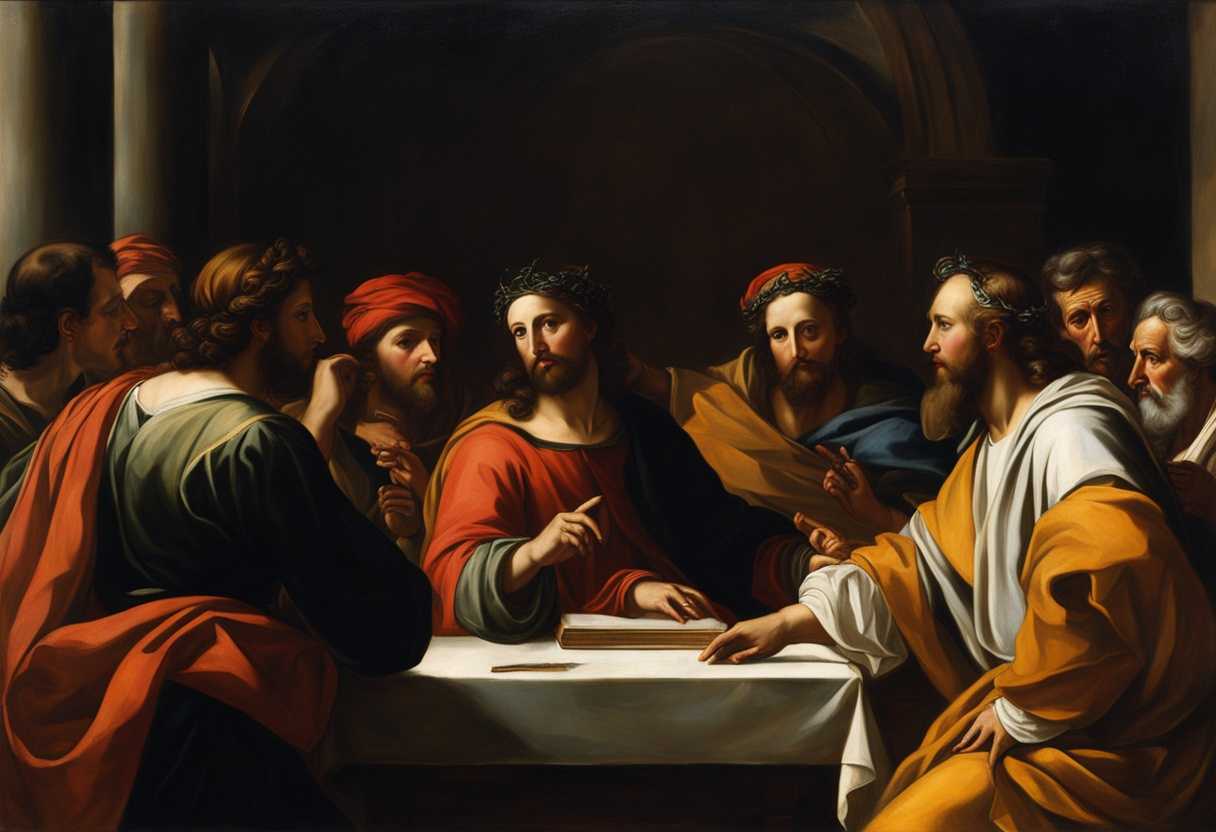
Setting the Scene for Luke 20:27-40
In Luke chapter 20, we find Jesus engaged in a heated discussion with the religious leaders of the time, particularly the Sadducees. The scene is set in the Temple in Jerusalem, a place bustling with activity and filled with people from all walks of life. The air is thick with tension as the religious leaders try to trap Jesus with their questions.
Among the group of religious leaders are the Sadducees, known for their disbelief in the resurrection. They approach Jesus with a hypothetical scenario about a woman who marries seven brothers in succession, each one dying childless. They pose a question about whose wife she will be in the resurrection, trying to stump Jesus with their clever reasoning.
Jesus, in his wisdom, responds to their question by explaining that in the resurrection, people will be like angels and will not marry. He goes on to teach them about the power of God and the truth of the resurrection, leaving the religious leaders amazed at his profound understanding of the Scriptures. The scene serves as a powerful reminder of Jesus’ authority and knowledge, challenging the beliefs of the religious elite of the time.
What is Luke 20:27-40 about?
Jesus is addressing a question posed by the Sadducees about marriage and resurrection in this verse. He clarifies that in the afterlife, there will be no marriage as we understand it on earth. Instead, believers will be like angels, living in eternal communion with God. Jesus emphasizes the reality of resurrection, asserting that God is not a God of the dead but of the living. This reaffirms the promise of life after death and the significance of resurrection in the Christian faith.
Have you ever wondered about the nature of relationships in heaven or what happens to our earthly relationships in the afterlife? Jesus’s response provides insight into the eternal perspective on relationships and the belief in resurrection. This verse challenges us to reflect on our understanding of life after death and the importance of our relationship with God as central to our existence. Jesus emphasizes the God of the living, inviting us to ponder the eternal nature of our connection with Him and the hope of resurrection that awaits believers.
Understanding what Luke 20:27-40 really means
In Luke 20:27-40, we witness a profound exchange between Jesus and the Sadducees, who question Him about the concept of resurrection, a belief they reject. Jesus uses this opportunity to delve into the deeper meaning of resurrection and its implications for our faith and understanding of eternal life. He starts by contrasting the earthly life we know, where people marry and are given in marriage, with the age to come, where those deemed worthy will experience a different reality, devoid of marriage as we know it. This distinction highlights the transformative nature of the resurrection and the unique relationships that will exist in the afterlife.
Moreover, Jesus emphasizes the eternal nature of the resurrected life by likening those who partake in the resurrection to angels, highlighting their imperishable state where death no longer has power over them. This assertion underscores the belief in the resurrection and the eternal life promised by God, who is not a God of the dead but of the living, signifying that all are alive in His sight. This assurance of eternal life challenges our limited earthly perspective and invites us to contemplate the profound reality of life beyond death.
Drawing connections to other biblical passages enriches our understanding of the concept of resurrection. In 1 Corinthians 15:42-44, Paul discusses the transformation of our earthly bodies into resurrection bodies, emphasizing the continuity yet distinctiveness of our future selves. In John 11:25-26, Jesus proclaims Himself as the resurrection and the life, offering eternal life to those who believe in Him. Revelation 21:4 paints a vivid picture of the new heaven and earth, devoid of death and mourning, where the promise of eternal life finds its ultimate fulfillment.
The relevance of this teaching to people today is profound. In a world marked by uncertainty and suffering, the hope of resurrection provides solace and assurance of a future beyond our current struggles. Understanding that earthly relationships are temporary prompts us to prioritize spiritual growth and eternal values, fostering a perspective that transcends the fleeting nature of this world. Trusting in the promise of resurrection strengthens our faith in God’s power and His unwavering commitment to fulfill His promises, even in the face of death.
Consider a scenario where someone grapples with the loss of a loved one. The overwhelming grief they experience can be assuaged by the belief in resurrection, offering comfort and hope in the midst of sorrow. Just as Jesus reassured the Sadducees of the reality of eternal life, this promise serves as a beacon of light for those mourning, reminding them that death is not the final chapter but a gateway to a glorious eternity. Jesus’ teachings in this passage challenge us to shift our focus from the temporal to the eternal, instilling in us a sense of hope and faith in the transformative power of God’s promise.
What happens to relationships after death?
Jesus explains in this passage that those who are considered worthy to attain to that age and the resurrection of the dead will not marry or be given in marriage. Instead, they will be like angels and are children of God, being children of the resurrection. This means that relationships as we know them on earth, especially the marital relationship, do not continue in the same way in the afterlife.
According to this verse, in the afterlife, there is a transformation in relationships. The focus shifts from earthly relationships and institutions like marriage to a more direct relationship with God. The emphasis is on being children of God and experiencing a new way of being that is likened to the state of angels. This suggests that in the afterlife, our primary connection and fulfillment will come from our relationship with God rather than from human relationships.
Therefore, the verse reveals that the afterlife represents a departure from the earthly experiences and structures that define our relationships, such as marriage. Instead, it points towards a spiritual reality where our identity as children of God and our relationship with Him are paramount. This transformation signifies a deeper connection to the divine and a departure from the limitations and constraints of human relationships experienced in this earthly life.
Application
Let this passage in Luke be a gentle nudge to ponder the everlasting impact of life beyond this world. Consider how your choices and beliefs today shape your future in the spiritual realm. Embrace this invitation to cultivate a deeper connection with the divine and find solace in the certainty of God’s promises. Will you seize this moment to evaluate the eternal consequences of your faith and deeds?

Reverend Michael Johnson is an experienced Church Minister with a profound expertise in spirituality and guidance. With a serene presence and a compassionate heart, he has faithfully served his congregation for over 20 years, leading them on a spiritual journey towards inner peace and enlightenment. Reverend Johnson’s extensive knowledge of religious philosophies and profound understanding of human nature have made him a trusted confidant and mentor to many, as he seamlessly weaves his profound wisdom into life teachings. Reverend Johnson’s calming demeanor and empathetic nature continue to uplift and heal souls, nurturing a sense of unity and tranquility within his community.