
Luke 22:1-20 is about Jesus sharing the Last Supper with his disciples, symbolizing the establishment of the new covenant through his body and blood, in preparation for his imminent betrayal, arrest, and crucifixion.
1 Now the Feast of Unleavened Bread drew near, which is called the Passover.
2 and the chief priests and the scribes were seeking how to put him to death, for they feared the people.
3 Then Satan entered into Judas called Iscariot, who was of the number of the twelve.
4 He went away and conferred with the chief priests and officers how he might betray him to them.
5 And they were glad, and agreed to give him money.
6 So he consented and sought an opportunity to betray him to them in the absence of a crowd.
7 Then came the day of Unleavened Bread, on which the Passover lamb had to be sacrificed.
8 Jesus sent Peter and John, saying, “Go and prepare the Passover for us, that we may eat it.”
9 And they said to him, “Where will you have us prepare it?”
10 And he said to them, “Behold, when you have entered the city, a man carrying a jar of water will meet you. Follow him into the house that he enters.
11 and tell the master of the house, ‘The Teacher says to you, Where is the guest room, where I may eat the Passover with my disciples?’
12 And he will show you a large upper room furnished; prepare it there.”
13 And they went and found it just as he had told them, and they prepared the Passover.
14 And when the hour came, he reclined at table, and the apostles with him.
15 And he said to them, “I have earnestly desired to eat this Passover with you before I suffer.
16 for I tell you I will not eat it until it is fulfilled in the kingdom of God.”
17 And he took a cup, and when he had given thanks he said, “Take this, and divide it among yourselves.
18 for I tell you that from now on I will not drink of the fruit of the vine until the kingdom of God comes.”
19 And he took bread, and when he had given thanks, he broke it and gave it to them, saying, “This is my body, which is given for you. Do this in remembrance of me.”
20 And likewise the cup after they had eaten, saying, “This cup that is poured out for you is the new covenant in my blood.
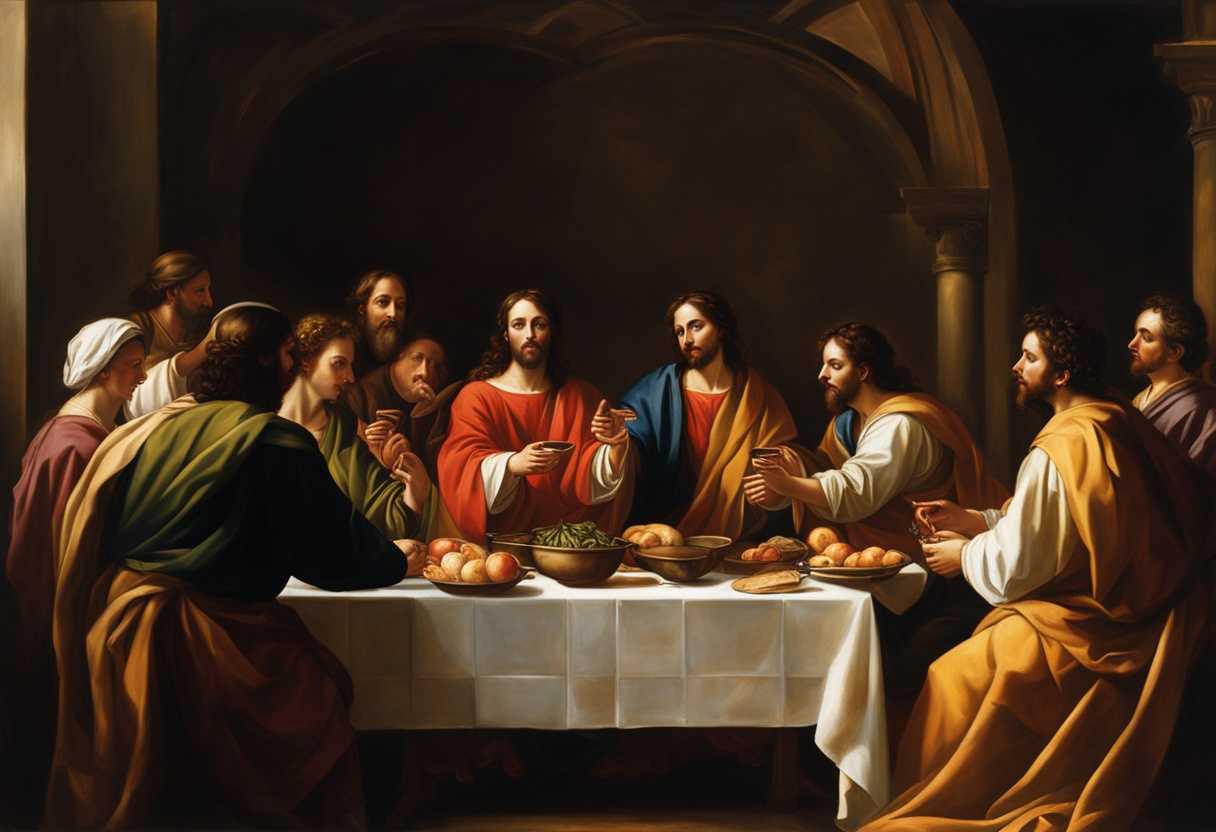
Setting the Scene for Luke 22:1-20
The scene in Luke chapter 22 is set in Jerusalem, specifically in the Upper Room. Jesus and his twelve disciples, including Peter, John, James, and Judas Iscariot, have gathered to celebrate the Passover meal. The room is dimly lit by oil lamps, casting a warm glow over the wooden table set with unleavened bread, bitter herbs, and wine.
As they recline at the table, Jesus begins to speak to his disciples about the events that are about to unfold. He foretells his betrayal by one of them and his impending death, which will fulfill the prophecies of the Old Testament. The disciples are somber, trying to comprehend the weight of Jesus’ words as they pass around the bread and wine, symbols of his body and blood.
In this intimate setting, Jesus institutes the sacrament of the Eucharist, instructing his disciples to remember him through the breaking of bread and the sharing of the cup. This poignant moment in the Upper Room foreshadows the sacrifice Jesus is about to make for the redemption of humanity, setting the stage for the events of his crucifixion and resurrection.
What is Luke 22:1-20 about?
This verse captures a critical moment in the life of Jesus and the history of Christianity. The Last Supper is the final meal that Jesus shared with his disciples before his crucifixion. During this meal, Jesus institutes the Eucharist, a central sacrament in Christianity. He symbolically represents his body and blood by breaking bread and sharing wine with his disciples, emphasizing the importance of communion and unity among his followers.
Additionally, Jesus predicts his betrayal by Judas during the Last Supper, foreshadowing the events that will lead to his crucifixion. This moment serves as a reminder of the challenges and sacrifices Jesus faced in fulfilling his divine mission on earth. Through his actions and words at the Last Supper, Jesus demonstrates the depth of his love and commitment to his disciples and to all of humanity. We reflect on this verse, contemplating the significance of the Eucharist, the power of betrayal, and the ultimate sacrifice that Jesus made for our redemption. Let us ponder the profound spiritual lessons embedded in this verse and strive to embody the qualities of love, forgiveness, and service that Jesus exemplified during the Last Supper.
Understanding what Luke 22:1-20 really means
The passage in Luke 22:1-20 takes us on a journey to the poignant moments leading up to the Last Supper, a significant event where Jesus shares a final meal with His disciples before His crucifixion. This narrative holds immense importance as it lays the foundation for understanding the institution of the Lord’s Supper, also known as Communion, and the establishment of a new covenant between God and humanity.
During the Last Supper, Jesus chooses the occasion of the Passover, a Jewish festival commemorating the Israelites’ deliverance from Egyptian slavery, to symbolize a new kind of deliverance through His impending sacrifice. His words, “This is my body given for you,” as He breaks the bread, and “This cup is the new covenant in my blood,” as He shares the wine, signify the sacrificial nature of His impending death and the establishment of a new covenant based on His sacrifice.
To grasp the full significance of this event, we can look at related biblical passages such as Exodus 12:1-14, which describes the original Passover, providing a backdrop for understanding its importance in Jesus’ time. Jeremiah 31:31-34 prophesies a new covenant where God will inscribe His law on people’s hearts, a prophecy fulfilled through Jesus. Additionally, 1 Corinthians 11:23-26 recounts the Last Supper, emphasizing its enduring importance for Christian practice and belief.
The relevance of the Last Supper extends to believers today in various ways. Firstly, it serves as a source of spiritual nourishment, reminding believers of Jesus’ sacrifice and their relationship with God, akin to how food sustains the body. Secondly, the act of sharing Communion fosters a sense of community and unity among believers, transcending individual differences and fostering a bond of fellowship. Lastly, the new covenant offers hope and redemption, assuring believers of God’s forgiveness and the promise of eternal life.
To illustrate the significance of the Last Supper in a relatable manner, consider a family gathering for a special meal where stories are shared, and gratitude is expressed, strengthening familial bonds. Similarly, the Lord’s Supper acts as a spiritual family meal, strengthening believers’ bonds with one another and with God, reminding them of their shared faith and love.
In conclusion, the Last Supper is not merely a historical event but a living tradition that continues to shape Christian faith and practice. It calls believers to remember Jesus’ sacrifice, embrace the new covenant established through His blood, and live in unity, hope, and the assurance of redemption.
How can we fully surrender to God’s will?
To fully surrender to God’s will, we must first acknowledge that He is in control of all things and has a perfect plan for our lives. This requires having complete trust and faith in God, knowing that His ways are higher than our ways. Surrendering to God means letting go of our own desires and plans, and humbly submitting to His will for us. We need to spend time in prayer and seek His guidance through His Word in order to surrender to God’s will. We can better understand His will for our lives and align our desires with His by staying connected to God through prayer and studying scripture. Surrendering to God means surrendering our own will and submitting to His, even when it may be difficult or goes against our own desires.
True surrender to God’s will also involves a willingness to obey Him, even when it requires sacrifice or stepping out of our comfort zone. We too must be willing to trust in God’s plan and obey Him wholeheartedly, just as Jesus submitted to the Father’s will in the garden of Gethsemane. Surrendering to God’s will is a daily decision to put our trust in Him and follow where He leads, knowing that His plans are ultimately for our good and His glory.
Application
Let us embrace Luke 22:1-20, where the Last Supper symbolizes Jesus’ sacrifice. Take up this call to participate in communion and honor His love for us. These words should ignite a flame within us to embody our beliefs with thankfulness and modesty. Can you step forward and commemorate Jesus in your daily life through communion?

Reverend Michael Johnson is an experienced Church Minister with a profound expertise in spirituality and guidance. With a serene presence and a compassionate heart, he has faithfully served his congregation for over 20 years, leading them on a spiritual journey towards inner peace and enlightenment. Reverend Johnson’s extensive knowledge of religious philosophies and profound understanding of human nature have made him a trusted confidant and mentor to many, as he seamlessly weaves his profound wisdom into life teachings. Reverend Johnson’s calming demeanor and empathetic nature continue to uplift and heal souls, nurturing a sense of unity and tranquility within his community.