
Luke 22:1-23 is about the betrayal of Jesus by Judas Iscariot, showcasing the fulfillment of the Scriptures and the pain of betrayal even among close relationships.
1 Now the Feast of Unleavened Bread drew near, which is called the Passover.
2 and the chief priests and the scribes were seeking how to put him to death, for they feared the people.
3 Then Satan entered into Judas called Iscariot, who was of the number of the twelve.
4 He went away and conferred with the chief priests and officers how he might betray him to them.
5 And they were glad, and agreed to give him money.
6 So he consented and sought an opportunity to betray him to them in the absence of a crowd.
7 Then came the day of Unleavened Bread, on which the Passover lamb had to be sacrificed.
8 Jesus sent Peter and John, saying, “Go and prepare the Passover for us, that we may eat it.”
9 And they said to him, “Where will you have us prepare it?”
10 And he said to them, “Behold, when you have entered the city, a man carrying a jar of water will meet you. Follow him into the house that he enters.
11 and tell the master of the house, ‘The Teacher says to you, Where is the guest room, where I may eat the Passover with my disciples?’
12 And he will show you a large upper room furnished; prepare it there.”
13 And they went and found it just as he had told them, and they prepared the Passover.
14 And when the hour came, he reclined at table, and the apostles with him.
15 And he said to them, “I have earnestly desired to eat this Passover with you before I suffer.
16 for I tell you I will not eat it until it is fulfilled in the kingdom of God.”
17 And he took a cup, and when he had given thanks he said, “Take this, and divide it among yourselves.
18 for I tell you that from now on I will not drink of the fruit of the vine until the kingdom of God comes.”
19 And he took bread, and when he had given thanks, he broke it and gave it to them, saying, “This is my body, which is given for you. Do this in remembrance of me.”
20 And likewise the cup after they had eaten, saying, “This cup that is poured out for you is the new covenant in my blood.
21 But behold, the hand of him who betrays me is with me on the table.
22 For the Son of Man goes as it has been determined, but woe to that man by whom he is betrayed!
23 And they began to question one another, which of them it could be who was going to do this.
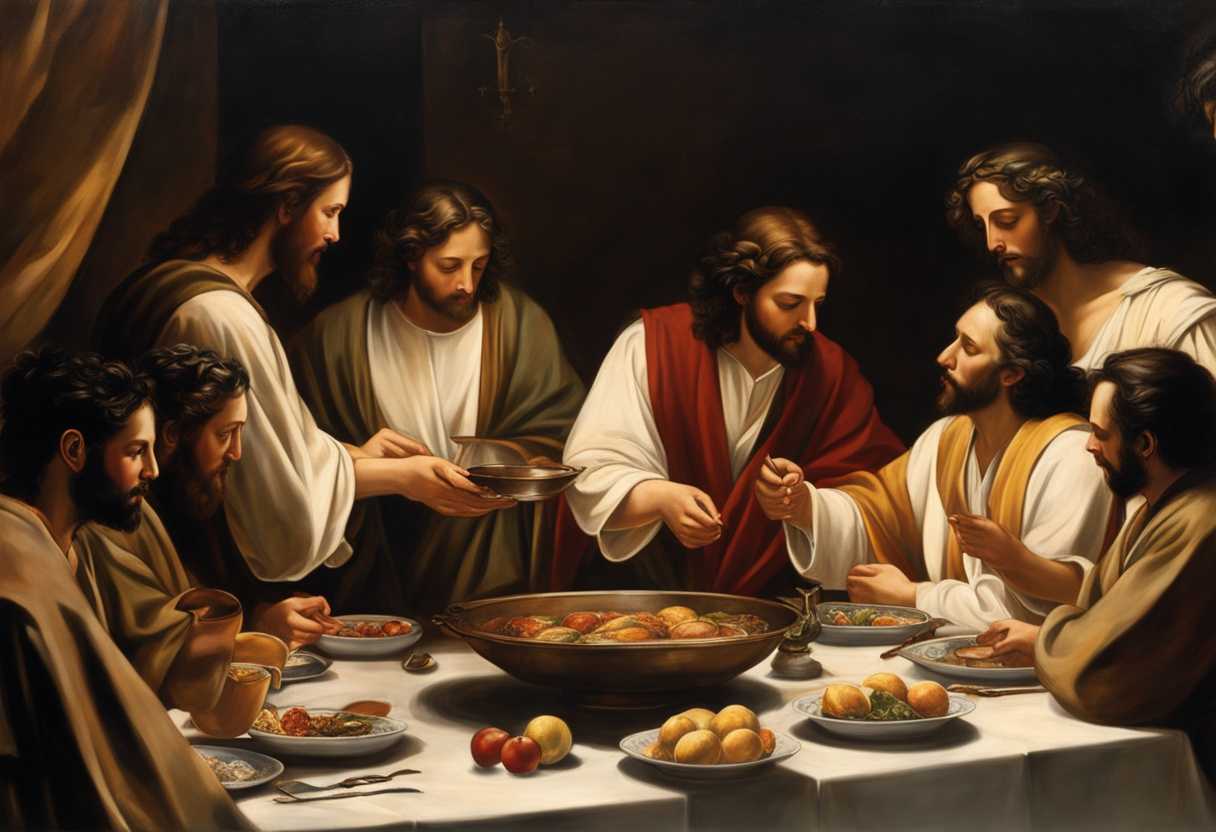
Setting the Scene for Luke 22:1-23
The scene in Luke chapter 22 is set in Jerusalem, during the time of the Passover festival. Jesus is gathered with his twelve disciples in an upper room to share the Passover meal. The room is dimly lit by oil lamps, casting a warm glow over the group as they recline around a low table laden with unleavened bread, bitter herbs, and wine.
The disciples, including Peter, John, James, and Judas Iscariot, are present, having followed Jesus’ instructions to prepare for the meal. There is a sense of anticipation and solemnity in the air as Jesus begins to speak to them about the events that are about to unfold. Judas Iscariot’s betrayal is foreshadowed, and Jesus shares the bread and wine, symbolizing his body and blood, in what will later be known as the Last Supper.
As they partake in the Passover meal, the disciples are unaware of the gravity of the situation, but Jesus knows what lies ahead. The atmosphere is heavy with emotion as Jesus speaks of his impending betrayal and crucifixion, setting the stage for the dramatic events that will soon unfold in the Garden of Gethsemane.
What is Luke 22:1-23 about?
Jesus in this verse is foreshadowing the events that will soon unfold – his betrayal and crucifixion. Despite knowing the pain and suffering that await him, he continues to spend time with his disciples and shares a significant meal with them, known as the Last Supper. This act of sharing a meal holds deep symbolism of unity, sacrifice, and love, as Jesus breaks bread and shares wine with his closest followers. Jesus had a profound love and compassion for his disciples and for all of humanity as we reflect on this verse. Jesus not only strengthens the bond with his followers but also establishes a powerful ritual by sharing the Last Supper that Christians would carry on for centuries through the practice of communion. This verse serves as a poignant reminder of the depth of Jesus’ sacrifice and his unwavering commitment to fulfilling his divine purpose, even in the face of betrayal and suffering.
Think about the significance of sharing a meal with others. How does breaking bread together create a sense of unity and connection? Jesus considers the weight of his actions as he prepares for the trials that lie ahead. What does his willingness to share this final meal with his disciples teach us about love, sacrifice, and forgiveness? Let us ponder the profound meaning behind this verse and the powerful example that Jesus sets for us in moments of hardship and uncertainty.
Understanding what Luke 22:1-23 really means
The passage in Luke 22:1-23 unveils a pivotal moment in Jesus’ ministry, as it captures the events leading up to the Last Supper, a significant occasion where Jesus institutes the Eucharist. Set against the backdrop of the approaching Passover, a crucial Jewish festival symbolizing liberation, the narrative gains depth and significance. The mention of Judas’ betrayal, with the chilling phrase “Satan entered Judas,” underscores the spiritual warfare at play and the profound consequences of betrayal in the unfolding drama.
Jesus’ words, “This is my body given for you; do this in remembrance of me,” resonate with enduring meaning, as they establish the practice of Communion, symbolizing his sacrificial love and the ushering in of a new covenant. This act of sharing bread and wine becomes a central tenet of Christian worship, reminding believers of Jesus’ ultimate sacrifice and the unity it brings to the community of faith. The passage not only recounts historical events but also carries timeless themes of betrayal, sacrifice, and redemption that continue to echo in the human experience.
Drawing parallels to contemporary life, one can envision a scenario where trust is shattered within a close-knit community due to betrayal. However, through forgiveness and communal sharing, healing and unity are restored. This narrative mirrors the essence of the Last Supper, where despite Judas’ betrayal, Jesus extends a path to redemption and unity through his sacrificial act of love. The power of forgiveness and reconciliation shines through, offering a profound lesson for individuals and communities alike.
In exploring related Bible passages such as Exodus 12:1-14 and 1 Corinthians 11:23-26, a deeper understanding of the significance of Jesus’ actions during the Last Supper emerges. These passages provide a rich tapestry of context and theological depth, enriching our grasp of the spiritual truths embedded in the narrative. Additionally, John 13:21-30 offers a nuanced perspective on Judas’ betrayal, shedding light on the complexities of human choices and their consequences.
Ultimately, the passage from Luke 22:1-23 serves as a poignant reminder of the depth of Jesus’ love and the call to remembrance of his sacrificial act. It beckons believers to introspection, urging them to examine their faith and actions in light of Jesus’ example. As we partake in the Eucharist, we are invited to embrace the unity and forgiveness offered through Christ’s body and blood, symbolizing a profound spiritual communion with God and one another.
What does it mean to be a true friend?
To be a true friend means being loyal, supportive, and trustworthy. A true friend stands by you during both the good and bad times, offering their unwavering support and understanding. They share in your joys and sorrows, offering a listening ear and a shoulder to lean on when needed. A true friend is someone you can confide in, knowing that they will keep your secrets safe and offer you honest advice when necessary.
Additionally, a true friend is genuine in their actions and motivations. They are not driven by selfish desires or ulterior motives but rather by a genuine care and concern for your well-being. A true friend accepts you for who you are, flaws and all, and celebrates your successes with you. They are there to lift you up when you are feeling down and to cheer you on as you strive for your goals. True friendship is based on mutual respect, understanding, and love.
Application
Embrace the spirit of Luke 22:1-23 and embody the selflessness and love exemplified by Jesus. Take a moment to assess if your actions mirror His teachings and the compassion He extended to all. Allow His words to ignite a fire in your soul, urging you to radiate grace and empathy to those in your circle. Will you heed the call to love and extend a helping hand at every opportunity? Emulate His essence in your everyday interactions and watch the world around you transform.

Reverend Michael Johnson is an experienced Church Minister with a profound expertise in spirituality and guidance. With a serene presence and a compassionate heart, he has faithfully served his congregation for over 20 years, leading them on a spiritual journey towards inner peace and enlightenment. Reverend Johnson’s extensive knowledge of religious philosophies and profound understanding of human nature have made him a trusted confidant and mentor to many, as he seamlessly weaves his profound wisdom into life teachings. Reverend Johnson’s calming demeanor and empathetic nature continue to uplift and heal souls, nurturing a sense of unity and tranquility within his community.