
Luke 23:1-56 is about the trial, crucifixion, and death of Jesus Christ, highlighting themes of sacrifice, forgiveness, redemption, and the fulfillment of prophetic scriptures.
1 Then the whole company of them arose and brought him before Pilate.
2 And they began to accuse him, saying, “We found this man misleading our nation and forbidding us to give tribute to Caesar, and saying that he himself is Christ, a king.”
3 And Pilate asked him, “Are you the King of the Jews?” He answered him, “You have said so.”
4 Then Pilate said to the chief priests and the crowds, “I find no guilt in this man.”
5 But they were urgent, saying, “He stirs up the people, teaching throughout all Judea, from Galilee even to this place.”
6 When Pilate heard this, he asked whether the man was a Galilean.
7 And when he learned that he belonged to Herod’s jurisdiction, he sent him over to Herod, who was himself in Jerusalem at that time.
8 When Herod saw Jesus, he was very glad, for he had long desired to see him, because he had heard about him, and he was hoping to see some sign done by him.
9 Then he questioned him with many words, but he made no answer.
10 The chief priests and the scribes stood by, vehemently accusing him.
11 And Herod with his soldiers treated him with contempt and mocked him. Then, arraying him in splendid clothing, he sent him back to Pilate.
12 And Herod and Pilate became friends with each other that very day, for before this they had been at enmity with each other.
13 Pilate then called together the chief priests and the rulers and the people,
14 and said to them, “You brought me this man as one who was misleading the people. And after examining him before you, behold, I did not find this man guilty of any of your charges against him.
15 Neither did Herod, for he sent him back to us. Look, nothing deserving death has been done by him.
16 I will therefore punish and release him.”
17 Now he was obliged to release one man to them at the festival.
18 But they all cried out together, “Away with this man, and release to us Barabbas”—
19 (He had been thrown into prison for an insurrection started in the city and for murder.)
20 Pilate addressed them once more, desiring to release Jesus,
21 but they kept shouting, “Crucify, crucify him!”
22 He said to them the third time, “Why, what evil has he done? I have found in him no guilt deserving death. I will therefore punish and release him.”
23 But they were urgent, demanding with loud cries that he should be crucified. And their voices prevailed.
24 So Pilate decided that their demand should be granted.
25 He released the man who had been thrown into prison for insurrection and murder, for whom they asked, but he delivered Jesus over to their will.
26 And as they led him away, they seized one Simon of Cyrene, who was coming in from the country, and laid on him the cross, to carry it behind Jesus.
27 And there followed him a great multitude of the people and of women who were mourning and lamenting for him.
28 But turning to them Jesus said, “Daughters of Jerusalem, do not weep for me, but weep for yourselves and for your children.
29 For behold, the days are coming when they will say, ‘Blessed are the barren and the wombs that never bore and the breasts that never nursed!’
30 Then they will begin to say to the mountains, ‘Fall on us,’ and to the hills, ‘Cover us.’
23 And when they came to the place that is called The Skull, there they crucified him, and the criminals, one on his right and one on his left.
32 Two others, who were criminals, were led away to be put to death with him.
33 And when they came to the place that is called The Skull, there they crucified him, and the criminals, one on his right and one on his left.
34 And Jesus said, “Father, forgive them, for they know not what they do.” And they cast lots to divide his garments.
35 And the people stood by, watching, but the rulers scoffed at him, saying, “He saved others; let him save himself, if he is the Christ of God, his Chosen One!”
36 The soldiers also mocked him, coming up and offering him sour wine
37 and saying, “If you are the King of the Jews, save yourself!”
38 There was also an inscription over him, “This is the King of the Jews.”
43 And he said to him, “Truly, I say to you, today you will be with me in paradise.”
40 But the other rebuked him, saying, “Do you not fear God, since you are under the same sentence of condemnation?
41 And we indeed justly, for we are receiving the due reward of our deeds; but this man has done nothing wrong.”
42 And he said, “Jesus, remember me when you come into your kingdom.”
43 And he said to him, “Truly, I say to you, today you will be with me in paradise.”
44 It was now about the sixth hour, and there was darkness over the whole land until the ninth hour,
45 while the sun’s light failed. And the curtain of the temple was torn in two.
46 Then Jesus, calling out with a loud voice, said, “Father, into your hands I commit my spirit!” And having said this he breathed his last.
47 Now when the centurion saw what had taken place, he praised God, saying, “Certainly this man was innocent!”
48 But all the crowds that had assembled for this spectacle, when they saw what had taken place, returned home beating their breasts.
49 And all his acquaintances and the women who had followed him from Galilee stood at a distance watching these things.
50 Now there was a man named Joseph, from the Jewish town of Arimathea. He was a member of the council, a good and righteous man,
51 who had not consented to their decision and action; and he was looking for the kingdom of God.
52 This man went to Pilate and asked for the body of Jesus.
53 Then he took it down and wrapped it in a linen shroud and laid him in a tomb cut in stone, where no one had ever yet been laid.
54 It was the day of Preparation, and the Sabbath was beginning.
55 The women who had come with him from Galilee followed and saw the tomb and how his body was laid.
56 Then they returned and prepared spices and ointments. On the Sabbath they rested according to the commandment.
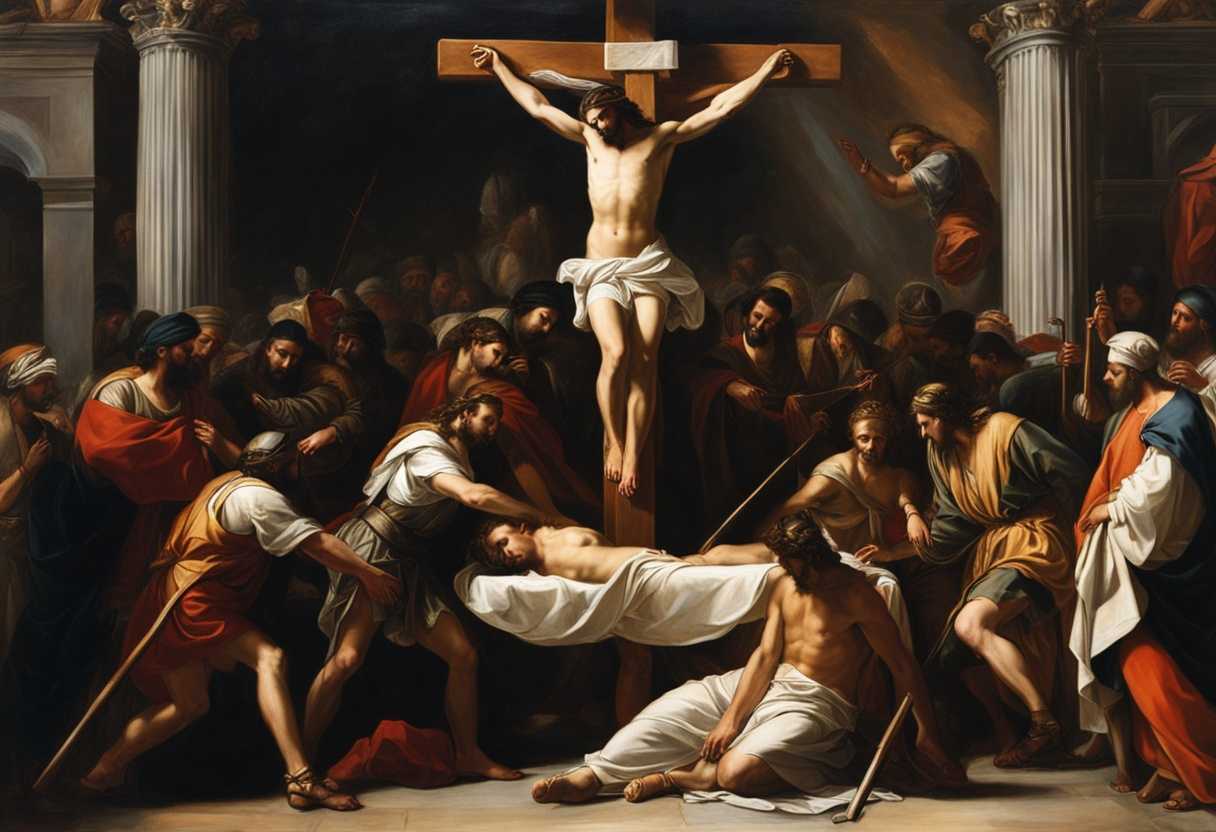
Setting the Scene for Luke 23:1-56
The scene in Luke chapter 23 is set in Jerusalem during the time of Jesus’ crucifixion. The main characters in this scene include Jesus, Pontius Pilate, the chief priests, the crowd, and the two criminals who were also being crucified alongside Jesus. The events leading up to this moment began with Jesus being brought before Pilate by the chief priests and scribes, who accused Him of claiming to be the King of the Jews and inciting the people.
Pilate, the Roman governor, questioned Jesus but found no fault in Him. However, under pressure from the crowd and the chief priests, Pilate ultimately gave in to their demands and sentenced Jesus to be crucified. The scene unfolds with Jesus carrying His cross to Golgotha, where He is crucified between the two criminals. The soldiers cast lots for His garments, and Jesus is mocked by the crowd and the religious leaders.
The atmosphere is tense and somber as Jesus hangs on the cross, enduring immense suffering. Despite the darkness and despair of the moment, there is also a glimmer of hope as one of the criminals recognizes Jesus’ innocence and asks to be remembered when Jesus enters His kingdom. This scene in Luke 23 captures the pivotal moment of Jesus’ crucifixion, highlighting the sacrifice He made for humanity’s redemption.
What is Luke 23:1-56 about?
This verse encapsulates a pivotal moment in Christian theology where Jesus completes his earthly mission by willingly enduring trial, crucifixion, and burial to fulfill God’s plan for the redemption of humanity. Through his sacrificial act, Jesus takes on the sins of the world, offering himself as the ultimate atonement for the salvation of all who believe in him. We reflect on these profound events, inviting us to contemplate the depth of God’s love and the extent of Jesus’ obedience. Jesus’ trial symbolizes the injustice and suffering he bore, while the crucifixion signifies the ultimate sacrifice made for our sins. His burial underscores the reality of his human death, paving the way for the subsequent miracle of his resurrection. Through these events, we are offered the gift of eternal life and the promise of reconciliation with God. Jesus displayed immense love and humility during his trial, crucifixion, and burial. Reflect on the significance of these events in shaping the Christian faith and the profound impact they have had on countless lives throughout history. We should ponder the magnitude of God’s plan for salvation and the depth of Jesus’ sacrifice, drawing inspiration and gratitude from this ultimate act of love.
Understanding what Luke 23:1-56 really means
In Luke 23:1-56, we delve into the profound account of the trial, crucifixion, death, and burial of Jesus Christ. These pivotal moments hold immense significance in the Christian faith as they mark the culmination of Jesus’ earthly mission, leading to the ultimate sacrifice for humanity’s redemption.
As we encounter Pilate’s question to Jesus, “Are you the king of the Jews?” we are confronted with the political tension surrounding Jesus’ identity. Jesus clarifies that His kingdom is not of this world, emphasizing the spiritual nature of His reign over earthly power. This distinction challenges us to consider the difference between worldly authority and the divine sovereignty that Jesus embodies.
In the midst of excruciating suffering on the cross, Jesus utters the powerful words, “Father, forgive them, for they do not know what they are doing.” This plea for forgiveness exemplifies Jesus’ boundless compassion and serves as a profound example for Christians to love their enemies and extend forgiveness, echoing His teachings in Matthew 5:44.
The promise Jesus makes to the repentant thief, “Today you will be with me in paradise,” offers a glimpse of the assurance of salvation and the hope of eternal life for those who turn to Him. This assurance resonates with Jesus’ words in John 14:2-3, where He speaks of preparing a place for believers, underscoring the hope that awaits those who place their trust in Him.
In today’s world, characterized by conflict and animosity, the themes of forgiveness and compassion from Luke 23:1-56 remain profoundly relevant. Stories of individuals who have forgiven deep wrongs serve as powerful illustrations of the transformative power of forgiveness, echoing Jesus’ example on the cross.
Amidst trials and suffering, the endurance of Jesus and His ultimate victory offer hope and strength to those facing challenges. Real-life accounts of individuals finding resilience and hope through their faith in Christ during difficult times serve as poignant reminders of the enduring hope found in Jesus’ sacrifice.
The assurance of salvation depicted in the interaction with the repentant thief provides believers with a profound sense of peace and security in God’s grace. Testimonies of individuals finding solace and assurance in their faith, even in their final moments, serve as beacons of light, illuminating the promise of eternal life through Christ.
Reflecting on the lessons encapsulated in Luke 23:1-56, we are called to contemplate the nature of Jesus’ kingship, the transformative power of forgiveness, the enduring hope in the midst of suffering, and the unwavering assurance of salvation. Let us heed the call to embody these teachings in our daily lives, extending forgiveness, fostering hope, and embracing the promise of eternal life through our faith in Christ.
How can we show compassion and forgiveness to others?
We can show compassion to others by being understanding of their mistakes and shortcomings, just as Jesus showed compassion to the criminals crucified alongside Him. Jesus exhibited forgiveness and understanding even in His own suffering, highlighting the importance of empathizing with others in their struggles. We can extend compassion to those in need of understanding and forgiveness by looking beyond their faults and offering a helping hand or a kind word.
Forgiveness is another way to show compassion to others, as demonstrated by Jesus asking God to forgive those who crucified Him. Forgiving those who have wronged us can release us from the burden of anger and resentment, allowing us to move forward with a sense of peace and understanding. Through forgiveness, we not only show compassion to others but also free ourselves from the chains of bitterness and hatred. We can strive to emulate the example set by Jesus in Luke 23:1-56 by practicing compassion and forgiveness. Approaching others with empathy and a forgiving heart fosters a sense of community and understanding, creating a more compassionate and loving environment for all.
Application
Let’s not just witness Jesus’ sacrifice on the cross, let’s embody its profound impact. This moment urges us to be grateful for the love and forgiveness we’ve received and spread that love in our daily interactions. Let’s carry the light of compassion in our work and family, echoing the sacrifice made for us. How will you let this love transform your life today?

Reverend Michael Johnson is an experienced Church Minister with a profound expertise in spirituality and guidance. With a serene presence and a compassionate heart, he has faithfully served his congregation for over 20 years, leading them on a spiritual journey towards inner peace and enlightenment. Reverend Johnson’s extensive knowledge of religious philosophies and profound understanding of human nature have made him a trusted confidant and mentor to many, as he seamlessly weaves his profound wisdom into life teachings. Reverend Johnson’s calming demeanor and empathetic nature continue to uplift and heal souls, nurturing a sense of unity and tranquility within his community.