
Luke 23:26-49 is about the crucifixion of Jesus, illustrating his physical suffering and spiritual victory, emphasizing his compassion for others even in his own agony, ultimately highlighting the fulfillment of prophecies and the sacrificial atonement for humanity’s sins.
26 And as they led him away, they seized one Simon of Cyrene, who was coming in from the country, and laid on him the cross, to carry it behind Jesus.
27 And there followed him a great multitude of the people and of women who were mourning and lamenting for him.
28 But turning to them Jesus said, “Daughters of Jerusalem, do not weep for me, but weep for yourselves and for your children.
29 For behold, the days are coming when they will say, ‘Blessed are the barren and the wombs that never bore and the breasts that never nursed!’
30 Then they will begin to say to the mountains, ‘Fall on us,’ and to the hills, ‘Cover us.’
23 And when they came to the place that is called The Skull, there they crucified him, and the criminals, one on his right and one on his left.
32 Two others, who were criminals, were led away to be put to death with him.
33 And when they came to the place that is called The Skull, there they crucified him, and the criminals, one on his right and one on his left.
34 And Jesus said, “Father, forgive them, for they know not what they do.” And they cast lots to divide his garments.
35 And the people stood by, watching, but the rulers scoffed at him, saying, “He saved others; let him save himself, if he is the Christ of God, his Chosen One!”
36 The soldiers also mocked him, coming up and offering him sour wine
37 and saying, “If you are the King of the Jews, save yourself!”
38 There was also an inscription over him, “This is the King of the Jews.”
43 And he said to him, “Truly, I say to you, today you will be with me in paradise.”
40 But the other rebuked him, saying, “Do you not fear God, since you are under the same sentence of condemnation?
41 And we indeed justly, for we are receiving the due reward of our deeds; but this man has done nothing wrong.”
42 And he said, “Jesus, remember me when you come into your kingdom.”
43 And he said to him, “Truly, I say to you, today you will be with me in paradise.”
44 It was now about the sixth hour, and there was darkness over the whole land until the ninth hour,
45 while the sun’s light failed. And the curtain of the temple was torn in two.
46 Then Jesus, calling out with a loud voice, said, “Father, into your hands I commit my spirit!” And having said this he breathed his last.
47 Now when the centurion saw what had taken place, he praised God, saying, “Certainly this man was innocent!”
48 But all the crowds that had assembled for this spectacle, when they saw what had taken place, returned home beating their breasts.
49 And all his acquaintances and the women who had followed him from Galilee stood at a distance watching these things.
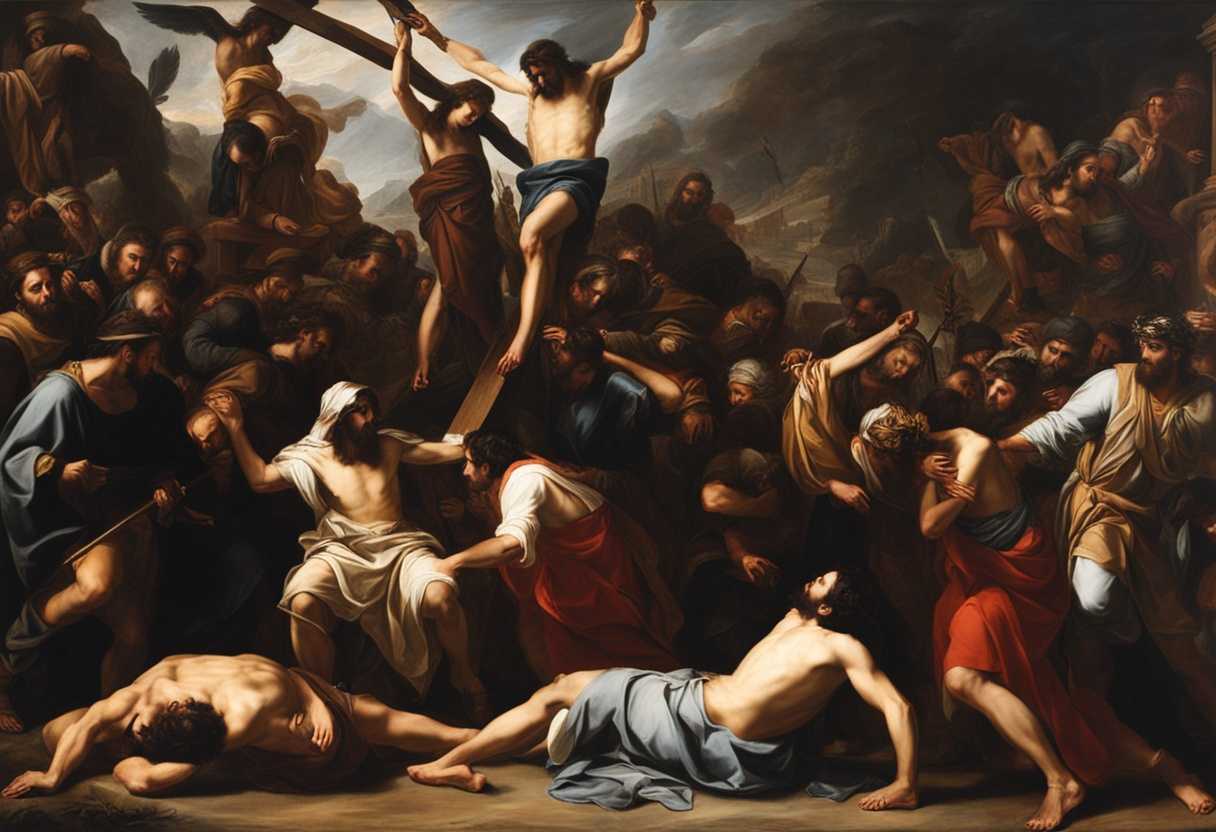
Setting the Scene for Luke 23:26-49
The scene in Luke 23:26-49 takes place on the road to Golgotha, where Jesus is being led to be crucified. The crowd that had gathered to witness the event included Roman soldiers, religious leaders, and onlookers. Among them were Simon of Cyrene, who was compelled to carry Jesus’ cross, and a group of women who were mourning and lamenting for Him.
The atmosphere was tense and somber as Jesus, weakened from the beatings and trials he had endured, struggled to carry the heavy cross. The soldiers were rough and indifferent, pushing Him along the way. The religious leaders looked on with disdain, mocking Him and questioning His claims of being the Son of God. The women in the crowd wept and wailed, overwhelmed with grief at the sight of their beloved teacher and friend being led to His death.
As they reached Golgotha, the place of the skull, Jesus was crucified between two criminals. The scene was chaotic, with the soldiers dividing His garments and casting lots for them. Despite the darkness and despair that surrounded Him, Jesus showed compassion and forgiveness, even in His final moments, praying for those who crucified Him. The scene at Golgotha was a powerful and poignant moment in the life of Jesus, demonstrating His love and sacrifice for all humanity.
What is Luke 23:26-49 about?
Jesus, the Son of God, is crucified, forgives criminals, and ultimately fulfills the prophecy of his death in this powerful verse. Through his crucifixion, Jesus demonstrates unparalleled forgiveness and compassion by offering salvation not only to those who believe in him but also to the criminals who were crucified alongside him. This act of forgiveness is a testament to Jesus’ teachings of love, compassion, and mercy for all, regardless of their past actions or sins. Jesus taught the profound message of redemption and grace throughout his life, reminding us as we reflect on this verse. Through his death on the cross, Jesus atoned for the sins of humanity and opened the door to salvation for all who believe in him. This verse serves as a powerful reminder of the boundless love and forgiveness that Jesus offers to each and every one of us, regardless of our flaws or shortcomings. It challenges us to embody the same spirit of forgiveness and compassion in our own lives, extending grace to others just as Jesus did on the cross.
Understanding what Luke 23:26-49 really means
The passage in Luke 23:26-49 vividly portrays the events leading to Jesus Christ’s crucifixion, a pivotal moment in the Christian faith. As they led Jesus away, Simon of Cyrene was compelled to carry the cross, symbolizing the call to discipleship and the concept of bearing one’s own cross, echoing Jesus’ teachings in Luke 9:23. Jesus’ profound words, “Father, forgive them, for they do not know what they are doing,” exemplify His boundless mercy and love, emphasizing forgiveness as a core principle, as taught in Matthew 6:14-15. His assurance to the repentant thief, “Today you will be with me in paradise,” underscores immediate and assured salvation for those who believe, echoing the message of grace in Ephesians 2:8-9. The darkness that covered the land during Jesus’ crucifixion from noon to three in the afternoon signifies the gravity of the moment and the spiritual significance of His sacrifice, fulfilling prophecies like those in Amos 8:9.
In related passages, Isaiah 53:3-5 prophesies the suffering servant, fulfilled in Jesus’ crucifixion, while John 19:30 records Jesus’ declaration, “It is finished,” signifying the completion of His redemptive mission. Hebrews 12:2 encourages believers to fix their eyes on Jesus, who endured the cross for the joy set before Him. The enduring relevance of this narrative lies in its themes of sacrifice, forgiveness, and redemption, which resonate across time and cultures, reminding us of the depth of God’s love and the extent of Jesus’ sacrifice for humanity’s sins.
Consider the impact of Jesus’ words, “Father, forgive them,” on our lives today. Imagine extending forgiveness to those who have wronged us deeply, drawing inspiration from Jesus’ example. Reflect on stories of forgiveness, like that of a family forgiving a drunk driver who caused a fatal accident, to grasp the transformative power of forgiveness in real-life situations. This passage is not merely a historical account but a living testament to God’s love and the hope of salvation it offers to all who believe. Let the sacrifice of Jesus inspire us to lead lives filled with love, forgiveness, and faith, embodying the essence of His teachings and the ultimate act of redemption for humanity.
Why did the criminal on the cross receive grace?
The criminal on the cross received grace because he acknowledged his sinful nature and recognized Jesus as the Son of God. Despite his own wrongdoing, he humbly asked Jesus to remember him when He entered His kingdom. This act of humility, faith, and repentance demonstrated a true heart change in the criminal, allowing him to receive grace from Jesus in that moment of genuine faith. The criminal displayed a sincere desire to be in a right relationship with God in the midst of his suffering and imminent death. His humble plea for mercy and recognition of Jesus as Lord showed his understanding of his own sinfulness and his need for forgiveness. Jesus, in His infinite mercy and grace, responded to the criminal’s faith by promising him a place in His kingdom, demonstrating that salvation is available to anyone who comes to Him in genuine repentance and faith.
This account serves as a powerful reminder of the boundless grace and mercy of Jesus Christ. No matter how sinful or undeserving we may feel, if we turn to Jesus in genuine repentance and faith, He is ready and willing to offer us forgiveness and salvation. We too can receive the gift of grace through faith in Jesus Christ, just as the criminal on the cross experienced grace in his final moments.
Application
Let’s mirror Jesus’s strength and forgiveness in challenging times. Show love and kindness through difficulties. Let’s embrace faith and forgiveness like Jesus did. Will you answer the call to mirror Christ’s actions?

Reverend Michael Johnson is an experienced Church Minister with a profound expertise in spirituality and guidance. With a serene presence and a compassionate heart, he has faithfully served his congregation for over 20 years, leading them on a spiritual journey towards inner peace and enlightenment. Reverend Johnson’s extensive knowledge of religious philosophies and profound understanding of human nature have made him a trusted confidant and mentor to many, as he seamlessly weaves his profound wisdom into life teachings. Reverend Johnson’s calming demeanor and empathetic nature continue to uplift and heal souls, nurturing a sense of unity and tranquility within his community.