
Luke 23:33-49 is about the crucifixion of Jesus Christ, highlighting the themes of forgiveness, redemption through sacrifice, and the fulfilment of prophecies as the Son of God gave his life for the salvation of humanity.
33 And when they came to the place that is called The Skull, there they crucified him, and the criminals, one on his right and one on his left.
34 And Jesus said, “Father, forgive them, for they know not what they do.” And they cast lots to divide his garments.
35 And the people stood by, watching, but the rulers scoffed at him, saying, “He saved others; let him save himself, if he is the Christ of God, his Chosen One!”
36 The soldiers also mocked him, coming up and offering him sour wine
37 and saying, “If you are the King of the Jews, save yourself!”
38 There was also an inscription over him, “This is the King of the Jews.”
43 And he said to him, “Truly, I say to you, today you will be with me in paradise.”
40 But the other rebuked him, saying, “Do you not fear God, since you are under the same sentence of condemnation?
41 And we indeed justly, for we are receiving the due reward of our deeds; but this man has done nothing wrong.”
42 And he said, “Jesus, remember me when you come into your kingdom.”
43 And he said to him, “Truly, I say to you, today you will be with me in paradise.”
44 It was now about the sixth hour, and there was darkness over the whole land until the ninth hour,
45 while the sun’s light failed. And the curtain of the temple was torn in two.
46 Then Jesus, calling out with a loud voice, said, “Father, into your hands I commit my spirit!” And having said this he breathed his last.
47 Now when the centurion saw what had taken place, he praised God, saying, “Certainly this man was innocent!”
48 But all the crowds that had assembled for this spectacle, when they saw what had taken place, returned home beating their breasts.
49 And all his acquaintances and the women who had followed him from Galilee stood at a distance watching these things.
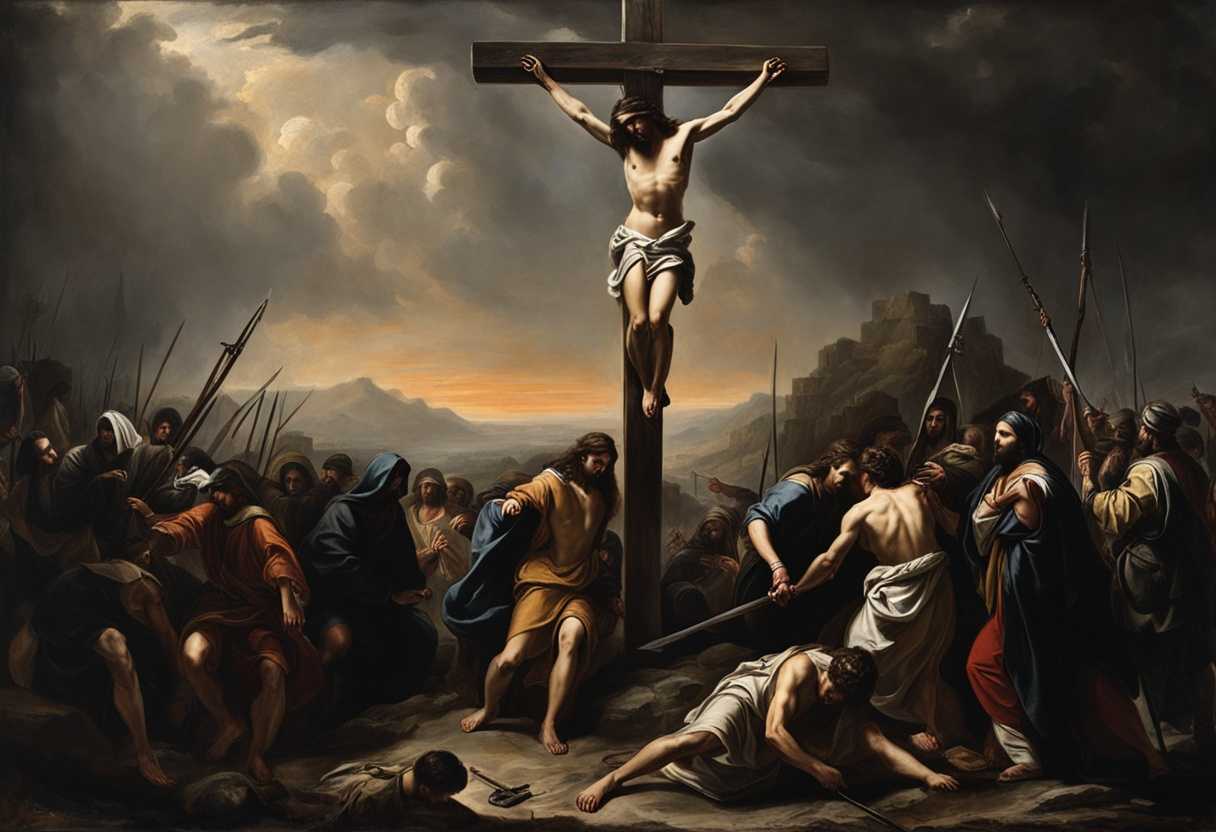
Setting the Scene for Luke 23:33-49
The scene described in Luke 23:33-49 takes place at Golgotha, also known as Calvary, the place where Jesus was crucified. The main characters in this scene are Jesus, two criminals who were also being crucified alongside Him, Roman soldiers, and a crowd of onlookers. Jesus and the two criminals were sentenced to death by crucifixion, a common form of execution in Roman-occupied Judea at the time.
The Roman soldiers were responsible for carrying out the crucifixions, nailing Jesus and the criminals to the wooden crosses. The crowd of onlookers consisted of various people, including religious leaders, Roman officials, and curious bystanders who had gathered to witness the executions. The atmosphere at Golgotha was tense and somber, with the sound of hammers striking nails echoing through the air.
As Jesus hung on the cross, He spoke words of forgiveness and compassion, even towards those who were crucifying Him. The scene is filled with a mix of emotions – from the cruelty of the crucifixion to the profound love and grace demonstrated by Jesus in His final moments. The sky darkened, and an earthquake shook the ground, adding to the dramatic and awe-inspiring nature of the scene at Golgotha.
What is Luke 23:33-49 about?
This verse encapsulates one of the most profound moments in the Christian faith: the crucifixion of Jesus. Jesus demonstrates incredible compassion and forgiveness by pardoning the criminals who are also being executed alongside him as he is being crucified. This act of mercy exemplifies Jesus’ teachings of love, forgiveness, and redemption, even in the face of his own suffering. Jesus fulfills the prophecies about the Messiah’s sacrificial death, showing his divine purpose and solidifying his role as the Savior of humanity.
The crucifixion of Jesus is a powerful symbol of sacrifice and salvation for Christians. It serves as a reminder of the depth of God’s love for humanity, as Jesus willingly endured immense pain and suffering in order to offer redemption and reconciliation. His death on the cross is seen as a pivotal moment in history, marking the ultimate victory over sin and death. Jesus freely offers immense love and grace to all, inviting us to embrace forgiveness and salvation through his sacrifice as we reflect on this verse. Have you ever considered the significance of Jesus’ actions on the cross and how they impact your own life and spiritual journey? How does Jesus’ demonstration of forgiveness and love inspire you to live out these virtues in your own relationships and interactions with others?
Understanding what Luke 23:33-49 really means
The passage in Luke 23:33-49 vividly portrays the crucifixion of Jesus Christ, a moment central to Christian belief and theology. It is a poignant reminder of the ultimate sacrifice made by Jesus for the redemption of humanity, emphasizing themes of forgiveness, redemption, and sacrificial love. In the midst of excruciating pain and suffering, Jesus utters profound words that resonate through the ages, revealing the depth of His compassion and love for all.
One of the key phrases in this passage is when Jesus says, “Father, forgive them, for they do not know what they are doing.” This plea for forgiveness, even for those crucifying Him, exemplifies Jesus’ boundless love and mercy. It challenges us to reflect on the radical teaching of loving our enemies, as instructed in Matthew 5:44. How often do we struggle to forgive those who wrong us, yet Jesus extends forgiveness even in His darkest hour?
Another significant phrase is Jesus’ promise to the repentant thief, “Today you will be with me in paradise.” This declaration underscores the immediate grace and salvation available to those who turn to Him in faith. It echoes the profound truth of salvation by faith alone, as outlined in Ephesians 2:8-9. The thief’s simple act of belief serves as a powerful reminder that it is never too late to receive God’s grace and mercy.
When Jesus declares, “It is finished,” He signifies the completion of His mission to atone for the sins of humanity. This statement not only marks the fulfillment of Old Testament prophecies, particularly Isaiah 53:5, but also encapsulates the magnitude of His sacrificial love. Through His death on the cross, Jesus offers reconciliation and peace to all who believe in Him.
The relevance of this passage extends to people today in profound ways. Jesus’ example of forgiveness challenges us to let go of bitterness and extend grace to those who have wronged us. Stories of individuals finding healing through forgiveness serve as powerful testimonies to the transformative power of grace. The promise of redemption and hope, exemplified by the repentant thief, reminds us that no one is beyond the reach of God’s love and mercy.
Moreover, Jesus’ sacrificial love calls us to emulate His selflessness in our interactions with others. Whether through acts of service, compassion, or love, we are called to reflect the love that Jesus demonstrated on the cross. Sharing anecdotes of individuals or communities embodying sacrificial love can inspire us to seek ways to selflessly serve those around us.
In conclusion, the crucifixion of Jesus Christ encapsulates profound themes of forgiveness, redemption, and sacrificial love. As we meditate on this passage, may we be challenged to embody these virtues in our daily lives. Let us reflect on how we can extend forgiveness, offer hope to the broken, and love others selflessly, following the example set by Jesus on the cross.
How can we show mercy and forgiveness?
We can show mercy and forgiveness by remembering the ultimate act of mercy and forgiveness demonstrated by Jesus on the cross. Despite being unjustly treated and crucified, Jesus asked for forgiveness for those who crucified Him, showing us the epitome of grace and love. We can seek to show mercy and forgiveness towards others, even when they wrong us, by imitating Jesus. We can learn to respond with compassion and forgiveness towards those who hurt us by reflecting on the sacrifice of Jesus on the cross. Showing mercy involves extending kindness and understanding to others, even when they do not deserve it. Forgiveness, on the other hand, involves letting go of resentment and releasing the desire for revenge. Through mercy and forgiveness, we can break the cycle of violence and hatred, choosing instead to respond with grace and love. We, as followers of Christ, are called to embody His teachings of love, mercy, and forgiveness in our daily lives. Through acts of kindness, understanding, and forgiveness, we can reflect the character of Christ and bring healing and reconciliation to our relationships and communities. We demonstrate the transformative power of God’s love and grace, bringing hope and redemption to a broken world.
Application
Embrace the profound sacrifice Jesus made on the cross; let it ignite a fire in your heart. Carry His love and grace as tools in your daily battles, at work and at home. Channel this divine offering by spreading kindness and compassion to those who need it most. Can you let His selfless act shape your existence and touch the lives of others?

Reverend Michael Johnson is an experienced Church Minister with a profound expertise in spirituality and guidance. With a serene presence and a compassionate heart, he has faithfully served his congregation for over 20 years, leading them on a spiritual journey towards inner peace and enlightenment. Reverend Johnson’s extensive knowledge of religious philosophies and profound understanding of human nature have made him a trusted confidant and mentor to many, as he seamlessly weaves his profound wisdom into life teachings. Reverend Johnson’s calming demeanor and empathetic nature continue to uplift and heal souls, nurturing a sense of unity and tranquility within his community.