
Luke 2:1-17 is about the humble birth of Jesus in Bethlehem, fulfilling the prophecy of a Savior being born, bringing hope and salvation to all people.
2 In those days a decree went out from Caesar Augustus that all the world should be registered.
2 This was the first registration when Quirinius was governor of Syria.
3 And all went to be registered, each to his own town.
4 And Joseph also went up from Galilee, from the town of Nazareth, to Judea, to the city of David, which is called Bethlehem, because he was of the house and lineage of David,
5 to be registered with Mary, his betrothed, who was with child.
6 And while they were there, the time came for her to give birth.
7 And she gave birth to her firstborn son and wrapped him in swaddling cloths and laid him in a manger, because there was no place for them in the inn.
8 And in the same region there were shepherds out in the field, keeping watch over their flock by night.
9 And an angel of the Lord appeared to them, and the glory of the Lord shone around them, and they were filled with great fear.
10 And the angel said to them, “Fear not, for behold, I bring you good news of great joy that will be for all the people.
11 For unto you is born this day in the city of David a Savior, who is Christ the Lord.
12 And this will be a sign for you: you will find a baby wrapped in swaddling cloths and lying in a manger.
13 And suddenly there was with the angel a multitude of the heavenly host praising God and saying,
14 “Glory to God in the highest, and on earth peace among those with whom he is pleased!”
15 When the angels went away from them into heaven, the shepherds said to one another, “Let us go over to Bethlehem and see this thing that has happened, which the Lord has made known to us.”
16 And they went with haste and found Mary and Joseph, and the baby lying in a manger.
17 And when they saw it, they made known the saying that had been told them concerning this child.
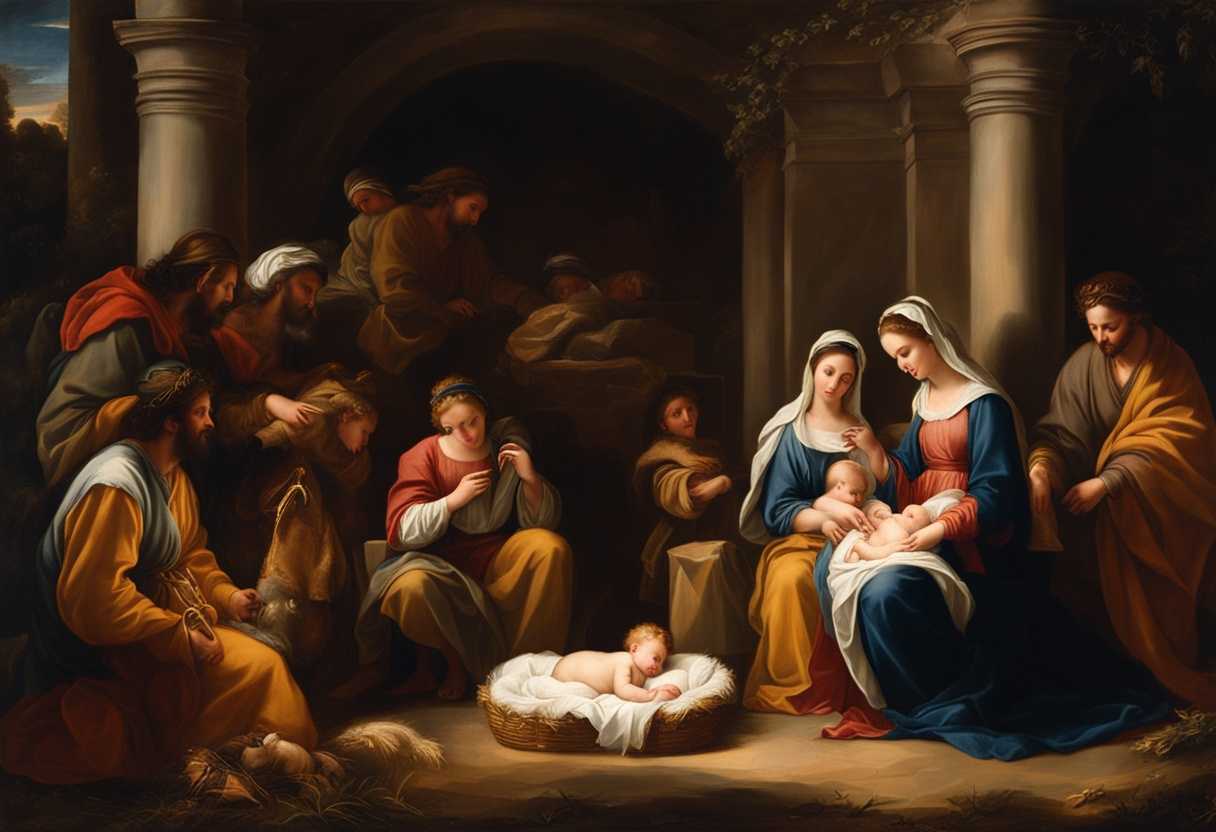
Setting the Scene for Luke 2:1-17
The scene in Luke chapter 2 opens with a bustling town square in Bethlehem, filled with travelers who have come to register for the census decreed by Caesar Augustus. Among the crowd are Joseph, a carpenter from Nazareth, and his betrothed wife Mary, who is with child. They have traveled a long and arduous journey to comply with the Roman decree, finding themselves in Bethlehem, the city of David.
As the sun begins to set, Joseph and Mary seek shelter in a humble stable, as there is no room for them in the overcrowded inns. Surrounded by the sounds of animals and the warm glow of a flickering oil lamp, Mary goes into labor. With only the soft rustling of straw and the gentle lowing of cattle as witnesses, she gives birth to her firstborn son, wrapping him in swaddling clothes and laying him in a manger.
Outside, in the quiet of the night, shepherds tending their flocks in the nearby fields are startled by the appearance of an angel, who proclaims the good news of the Savior’s birth. Overwhelmed with awe and wonder, the shepherds hurry to the stable, where they find the newborn baby, surrounded by his parents and bathed in the soft light of the oil lamp. This humble and miraculous scene marks the beginning of the greatest story ever told.
What is Luke 2:1-17 about?
Imagine the night sky filled with the shining light of angels, and the air filled with their voices as they bring tidings of great joy to humble shepherds. The birth of Jesus in Bethlehem is a moment of profound significance in the Christian faith. This verse symbolizes the arrival of hope and salvation in the form of a newborn baby, born in humble circumstances but destined to change the course of history.
Reflect on the contrast between the divine nature of Jesus and the simplicity of his birthplace and audience. The angels’ proclamation to the shepherds highlights the idea that this miraculous event was meant for all people, regardless of social status or background. It reminds us that the message of Jesus’s birth is one of inclusivity, love, and the promise of redemption for all who believe. As we ponder this verse, let us contemplate how God’s love has the power to transcend barriers and bring light into the darkest of places.
Understanding what Luke 2:1-17 really means
The passage in Luke 2:1-17 narrates the pivotal moment of Jesus Christ’s birth, a cornerstone event in the Christian faith. It opens with Caesar Augustus’s decree, setting the stage within the vast Roman Empire, showcasing how God’s divine plan unfolds amidst historical events. Joseph’s journey to Bethlehem fulfills the prophecy of Micah 5:2, emphasizing Jesus’ royal lineage as the Messiah born in the City of David. The humble setting of Jesus’ birth in a manger signifies accessibility and humility, reflecting God’s presence in the ordinary and marginalized aspects of life.
The shepherds, keeping watch over their flocks, symbolize God’s care and guidance, echoing the imagery of the Good Shepherd in Psalm 23. As the first witnesses to the angelic proclamation of Jesus’ birth, they exemplify God’s message being for all, especially the humble and lowly. The angelic visitation and the heavenly host praising God highlight the divine revelation and the significance of Jesus’ birth, mirroring similar occurrences in the Old Testament, underscoring the continuity of God’s redemptive plan.
The declaration of Jesus as Savior, Messiah, and Lord fulfills prophecies of a coming Savior, emphasizing His role in salvation history. The shepherds’ immediate response to the angelic message underscores the urgency of sharing the good news, portraying them as the first evangelists. This narrative resonates with people today, reminding us of God’s work in ordinary life, the humility and accessibility of Jesus, and the universal message of hope and transformation for all, especially the marginalized.
In our daily lives, we can find purpose and meaning by recognizing God’s hand in the seemingly mundane events. Just as Jesus’ birth in a humble manger made Him accessible to all, we are encouraged to seek His presence in unexpected places and share His message of love and salvation with others. Let us reflect on the humility and accessibility of Jesus, finding hope and inspiration in His birth, and continue to spread the good news of His coming to all those around us.
How can we find joy in humble circumstances?
We can find joy in humble circumstances by recognizing that true wealth and happiness do not come from material possessions or grandeur. The story in Luke highlights how the birth of Jesus, the savior of the world, took place in the humblest of settings – a stable. This teaches us that joy can be found in simplicity and humility, away from the distractions of worldly wealth and status.
Furthermore, finding joy in humble circumstances allows us to appreciate the blessings we do have rather than focusing on what we lack. It encourages us to be content with what we have and to find beauty and meaning in the simple things in life. We can cultivate a sense of gratitude and a deeper connection with our faith by shifting our perspective and seeking joy in the ordinary and modest aspects of life. The message from the verse ultimately is that joy is not dependent on our external circumstances, but rather on our internal state of being and our relationship with God. We can experience a sense of peace and contentment that transcends our earthly situation by embracing humility and finding joy in simplicity.
Application
Reflect on the story of Jesus’ birth and let it ignite a flame of compassion and generosity within you. Just like the shepherds spread the word about Christ’s birth, make it your purpose to radiate love and kindness in your own circles. Allow the humble origins of our Savior to drive you to serve others with pure intentions. Will you embrace the call to share the light of hope and love, just as the shepherds did on that sacred night?

Reverend Michael Johnson is an experienced Church Minister with a profound expertise in spirituality and guidance. With a serene presence and a compassionate heart, he has faithfully served his congregation for over 20 years, leading them on a spiritual journey towards inner peace and enlightenment. Reverend Johnson’s extensive knowledge of religious philosophies and profound understanding of human nature have made him a trusted confidant and mentor to many, as he seamlessly weaves his profound wisdom into life teachings. Reverend Johnson’s calming demeanor and empathetic nature continue to uplift and heal souls, nurturing a sense of unity and tranquility within his community.