
Luke 5:18-26 is about the faith and authority of Jesus to forgive sins and perform miracles, showcasing the interconnectedness of physical healing and spiritual restoration through the story of the paralyzed man being lowered through the roof.
18 And behold, some men were bringing on a bed a man who was paralyzed, and they were seeking to bring him in and lay him before Jesus,
19 But finding no way to bring him in, because of the crowd, they went up on the roof and let him down with his bed through the tiles into the midst before Jesus.
20 And when he saw their faith, he said, “Man, your sins are forgiven you.”
21 And the scribes and the Pharisees began to question, saying, “Who is this who speaks blasphemies? Who can forgive sins but God alone?”
22 But Jesus, aware of their thoughts, answered and said to them, “Why are you reasoning in your hearts?
23 Which is easier, to say, ‘Your sins are forgiven you,’ or to say, ‘Rise and walk’?
24 But that you may know that the Son of Man has authority on earth to forgive sins”—he said to the man who was paralyzed—“I say to you, rise, pick up your bed and go home.”
25 And immediately he rose up before them and picked up what he had been lying on and went home, glorifying God.
26 And amazement seized them all, and they glorified God and were filled with awe, saying, “We have seen extraordinary things today.”
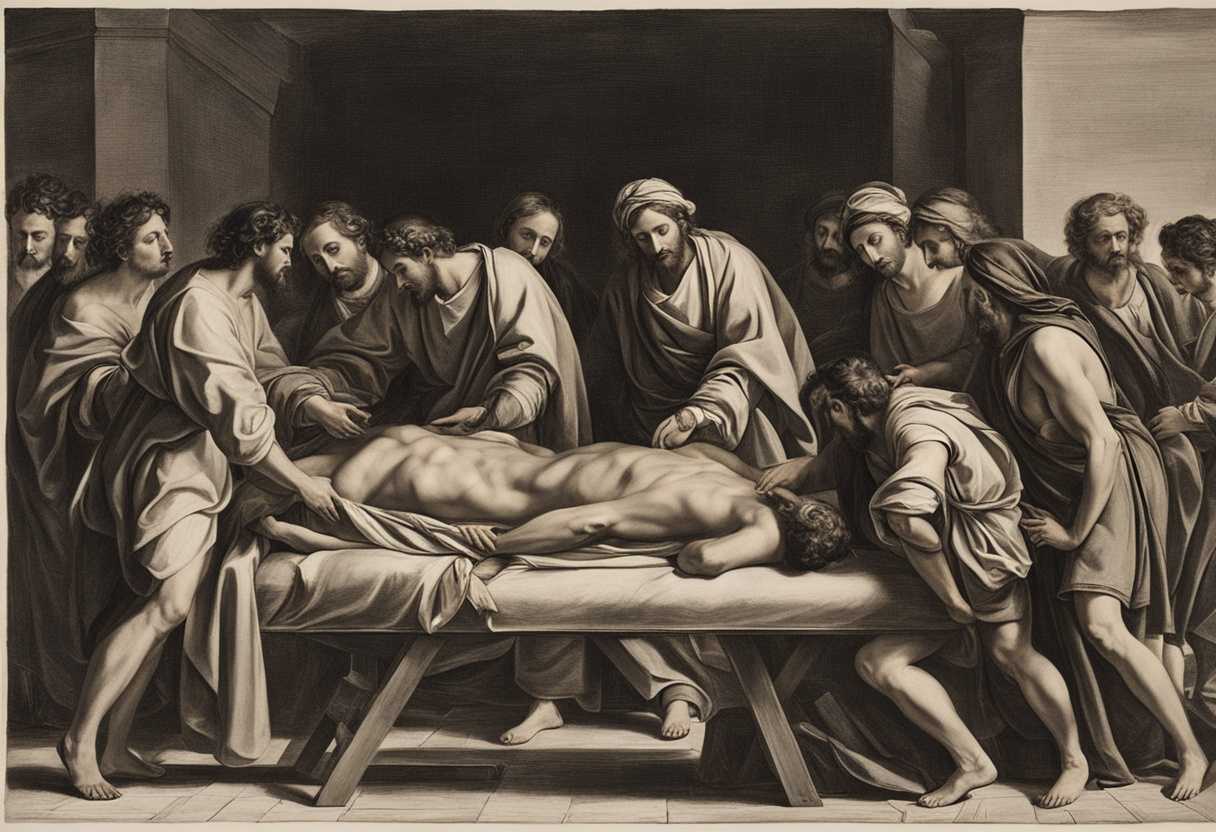
Setting the Scene for Luke 5:18-26
In Luke chapter 5, we find Jesus teaching in a crowded house in Capernaum by the Sea of Galilee. The house is filled with people eager to hear His words and witness His miracles. Among the crowd are Pharisees and teachers of the law who have come from every village of Galilee and Judea, as well as from Jerusalem.
As Jesus is teaching, a group of men arrive carrying a paralyzed man on a mat. They had heard of Jesus’ healing power and were determined to bring their friend to Him for healing. However, the house is so packed that they cannot get in through the door. Undeterred, they climb up to the roof, remove some tiles, and lower the paralyzed man down in front of Jesus.
The scene is tense as everyone watches to see what Jesus will do. Jesus, seeing the faith of the men who brought the paralyzed man, first forgives the man’s sins, causing a stir among the religious leaders present. Then, to demonstrate His authority to forgive sins, Jesus tells the paralyzed man to get up, take his mat, and go home. The man is instantly healed, to the amazement of all who witnessed the miracle.
What is Luke 5:18-26 about?
This verse showcases the immense power and authority of Jesus as the Son of God. Jesus demonstrates his divine ability to forgive sins and shows the transformative nature of his forgiveness by forgiving the sins of the paralyzed man. The healing of the paralyzed man further solidifies Jesus’ authority by showcasing his ability to perform miracles and bring about physical healing through his divine power.
It prompts us to ponder the depth of Jesus’ compassion and his willingness to forgive sins and transform lives. It also challenges us to reflect on our own understanding of authority and power, stirring us to consider whether we place our trust and faith in Jesus as the ultimate authority in our lives. This verse serves as a powerful reminder of the incredible love and mercy Jesus has for all of us, as well as a compelling invitation to turn to him for forgiveness, healing, and salvation.
Understanding what Luke 5:18-26 really means
The passage in Luke 5:18-26 recounts the remarkable story of a paralyzed man whose friends go to great lengths to bring him to Jesus for healing. Unable to reach Jesus due to the crowd, they exhibit extraordinary faith by lowering their friend through the roof. What stands out in this narrative is not only the physical healing that takes place but also the profound spiritual healing that Jesus offers. By first forgiving the man’s sins, Jesus demonstrates His authority to grant spiritual restoration before addressing the physical ailment.
The phrase “Seeing their faith” underscores the significance of communal faith in the story. It highlights the collective belief and effort of the friends in bringing the paralyzed man to Jesus. This emphasizes the power of faith not just on an individual level but also within a supportive community. Jesus’ declaration, “Your sins are forgiven,” prioritizes the man’s spiritual well-being over his physical condition, emphasizing the eternal importance of the soul’s state.
When Jesus commands the man to “Rise, take up your bed and go home,” it symbolizes the completeness of His healing power. This directive addresses both the man’s physical paralysis and spiritual restoration, showcasing Jesus’ ability to provide holistic healing. The passage resonates with other biblical accounts, such as Mark 2:1-12, which reaffirm Jesus’ authority to forgive sins and heal the sick.
In James 5:15 and Isaiah 53:5, we find further connections to the themes of faith, healing, and forgiveness present in the story of the paralyzed man. These passages emphasize the intertwined nature of faith, physical health, and spiritual well-being, echoing the holistic approach to healing that Jesus exemplifies in Luke 5:18-26. Today, this message remains relevant as it challenges individuals to consider the interconnectedness of their physical and spiritual health.
In a contemporary context, the narrative prompts reflection on the power of faith and community support. In a world that often prioritizes individualism, the story serves as a reminder of the strength found in collective faith and solidarity. It encourages us to seek not only physical healing but also spiritual wholeness, recognizing the profound impact of addressing both aspects of our well-being.
Imagine a scenario where a person faces physical illness and emotional burdens, supported by a group of caring friends who pray fervently and encourage seeking both medical and spiritual help. Through their united faith and actions, the individual experiences not only physical recovery but also a deep sense of peace and forgiveness. This modern-day illustration mirrors the timeless message of Luke 5:18-26, illustrating how faith and community can lead to comprehensive healing.
In conclusion, the passage from Luke serves as a poignant reminder of Jesus’ authority, compassion, and transformative power. It challenges us to cultivate faith, support one another, and pursue holistic healing in our lives. By embracing these lessons, we can experience the profound impact of Jesus’ healing touch, both physically and spiritually, in our contemporary context.
How can we have faith to overcome obstacles?
The story in Luke 5:18-26 teaches us that having faith means believing and trusting in Jesus even when things seem impossible. The paralyzed man’s friends carried him to Jesus in the account, showing their strong faith that Jesus could heal him. When faced with obstacles, they did not give up but demonstrated relentless determination and faith in Jesus’s power to overcome the situation.
Similarly, when we encounter challenges or obstacles in our lives, we can draw strength from this story to have faith that Jesus can help us overcome. We can find the courage and perseverance to face our difficulties with hope and confidence by trusting in Him and believing in His power. Our faith can lead us to experience breakthroughs and victories in our own lives as we rely on Jesus to help us through our obstacles, just as the paralyzed man’s friends had faith that led to a miraculous healing.
Application
Reflect on the incredible story in Luke 5:18-26, where Jesus performs a miraculous healing. Let this story inspire us to evaluate our faith in His extraordinary power. Let’s face our struggles with confidence in the Lord’s capacity to change our lives, no matter how bleak things seem. Will you trust in Him today to exceed your expectations and meet your needs beyond imagination?

Reverend Michael Johnson is an experienced Church Minister with a profound expertise in spirituality and guidance. With a serene presence and a compassionate heart, he has faithfully served his congregation for over 20 years, leading them on a spiritual journey towards inner peace and enlightenment. Reverend Johnson’s extensive knowledge of religious philosophies and profound understanding of human nature have made him a trusted confidant and mentor to many, as he seamlessly weaves his profound wisdom into life teachings. Reverend Johnson’s calming demeanor and empathetic nature continue to uplift and heal souls, nurturing a sense of unity and tranquility within his community.