
Luke 5:23-24 is about Jesus demonstrating his authority to forgive sins by healing a paralyzed man, showing that physical healing is a tangible sign of spiritual healing through the forgiveness of sins.
23 Which is easier, to say, ‘Your sins are forgiven you,’ or to say, ‘Rise and walk’?
24 But that you may know that the Son of Man has authority on earth to forgive sins”—he said to the man who was paralyzed—“I say to you, rise, pick up your bed and go home.”
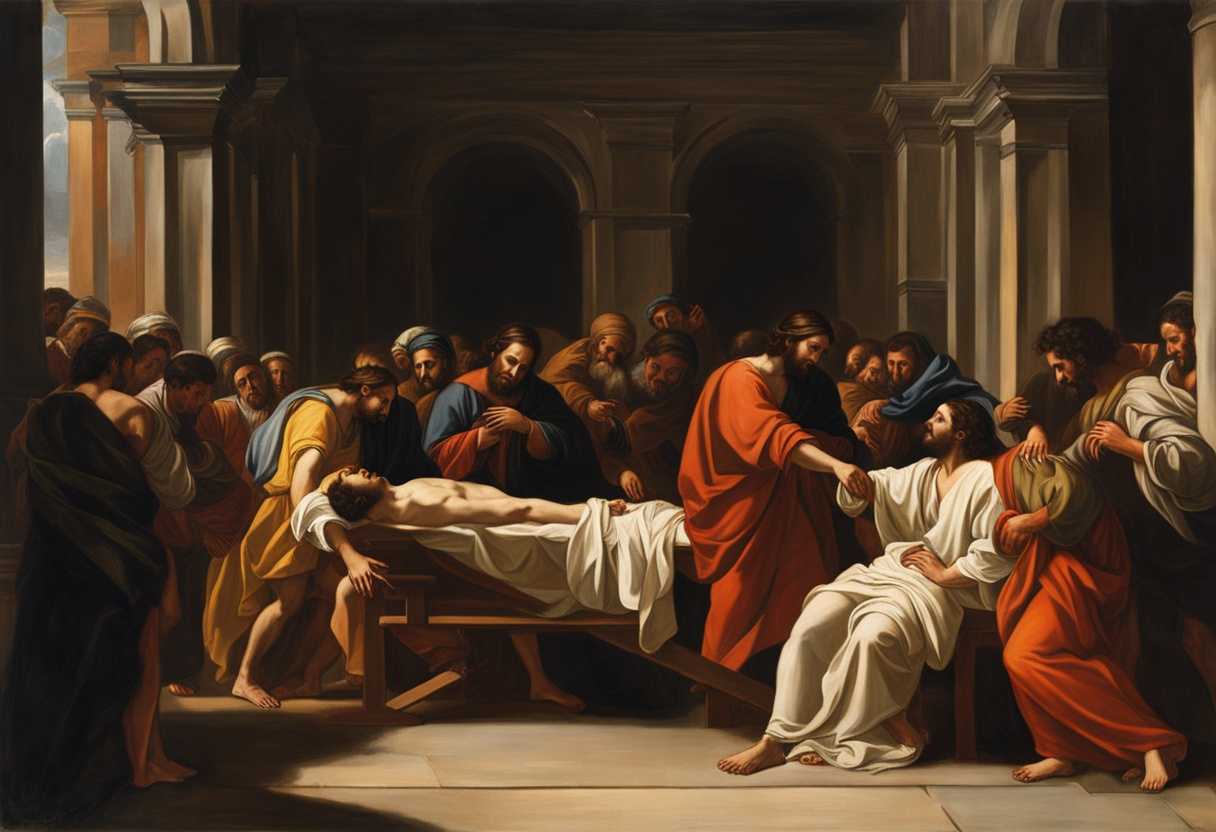
Setting the Scene for Luke 5:23-24
In Luke chapter 5, we find Jesus teaching in a crowded house in Capernaum by the Sea of Galilee. The scene is bustling with people eager to hear His words and witness His miracles. Among the crowd are Pharisees and teachers of the law who have come from every village of Galilee and Judea, as well as from Jerusalem. They have gathered to see this man who has been causing quite a stir with His teachings and healings.
As Jesus is speaking, a group of men arrives carrying a paralyzed man on a mat. Unable to get through the crowd to bring the man to Jesus, they climb up to the roof, remove some tiles, and lower the man down in front of Jesus. The faith and determination of these men are evident as they go to great lengths to bring their friend to Jesus for healing. Jesus, seeing their faith, not only heals the paralyzed man but also forgives his sins, causing amazement and astonishment among the onlookers.
The setting is filled with anticipation and awe as Jesus demonstrates His authority and compassion. The faith of the paralyzed man’s friends is a powerful example of the lengths to which we can go to bring others to Jesus for healing and restoration. The scene in Capernaum serves as a reminder of the importance of faith, community, and the transformative power of encountering Jesus.
What is Luke 5:23-24 about?
Jesus demonstrates his divine authority by forgiving the sins of a paralyzed man in this verse. This act is significant because, in the Jewish faith of that time, forgiveness of sins was believed to be within the power of God alone. Jesus is asserting his identity as the Son of Man and, therefore, his authority to absolve sins on earth by forgiving the man’s sins. This action challenges the religious leaders of the time who questioned Jesus’ authority and serves as a teaching moment for Jesus to display his divine power and compassion.
Imagine witnessing this scene unfold before your eyes. How would you react to seeing Jesus forgive sins with such authority? This act of forgiveness not only highlights Jesus’ compassion for the man but also emphasizes his power over sin and his ability to bring spiritual healing. It is a reminder of the limitless mercy and grace that Jesus offers to all who seek him. This verse teaches us that Jesus is not only a healer of physical ailments but also a restorer of our spiritual well-being. His forgiveness is a powerful testament to his identity as the Son of Man and the Savior of the world.
Understanding what Luke 5:23-24 really means
In Luke 5:23-24, we witness a pivotal moment in Jesus’ ministry where He not only performs a physical miracle but also asserts His divine authority to forgive sins. The context of these verses is crucial, as they follow the account of Jesus healing a paralyzed man brought to Him by his friends. The paralyzed man’s physical condition serves as a backdrop for the deeper spiritual truth that Jesus is about to reveal.
Jesus begins by addressing the paralyzed man’s spiritual state, declaring that his sins are forgiven. This statement immediately stirs controversy among the religious leaders present, who question Jesus’ authority to forgive sins. In response, Jesus poses a thought-provoking question: “Which is easier: to say, ‘Your sins are forgiven,’ or to say, ‘Get up and walk’?” This question challenges the onlookers to consider the power and authority behind Jesus’ words.
Through His actions, Jesus not only heals the paralyzed man but also demonstrates His authority to forgive sins. By commanding the man to get up, take his mat, and go home, Jesus provides a visible manifestation of His power. This act serves as a tangible proof of His divine authority and mission on earth. Jesus’ use of the title “Son of Man” further emphasizes His Messianic role and the authority He holds to bring about forgiveness and healing.
These verses in Luke 5:23-24 are echoed in parallel accounts in Matthew and Mark, emphasizing the consistency of Jesus’ message about His authority to forgive sins and heal. The Old Testament prophecy in Isaiah 53:5 foretells the Messiah’s role in bearing our sins and bringing healing, a prophecy that Jesus fulfills through His ministry. Furthermore, in John 20:23, Jesus extends the authority to forgive sins to His disciples, highlighting the continuation of this divine authority through His followers.
The relevance of this passage to people today is profound. It underscores the authority of Jesus to forgive sins, offering assurance of forgiveness and salvation to believers. The story also encourages faith in Jesus’ power to bring about both physical and spiritual healing. It teaches us that while visible miracles are awe-inspiring, the invisible work of forgiveness is equally powerful and transformative in our lives.
Imagine someone burdened by guilt and shame, feeling paralyzed by their past mistakes. Through encountering the message of Jesus’ forgiveness, they experience a profound sense of liberation and renewal, much like the paralyzed man who was healed. This anecdote illustrates the life-changing impact of understanding and accepting Jesus’ authority to forgive sins.
In conclusion, Luke 5:23-24 reveals the multifaceted nature of Jesus’ ministry, encompassing both physical healing and spiritual restoration. For contemporary readers, this passage serves as a poignant reminder of the all-encompassing salvation that Jesus offers, addressing our deepest needs and bringing about profound transformation in our lives.
Are we willing to forgive as Jesus does?
Jesus demonstrates his power to forgive sins by healing a paralyzed man in Luke 5:23-24. This passage teaches us about the depth of Jesus’s love and compassion for all people, regardless of their sins or shortcomings. We are called to forgive others and extend grace to those who have wronged us, just as Jesus was willing to forgive and show mercy to the paralyzed man.
Forgiveness is not always easy, but it is essential for maintaining healthy relationships and spiritual growth. We are encouraged to forgive others unconditionally and without hesitation, just as Jesus forgave the paralyzed man. We reflect the love and mercy of God in our own lives by letting go of resentment and choosing to forgive. Jesus provides the ultimate example of forgiveness, and we are called to follow his example in our interactions with others.
Application
Embrace the incredible power of forgiveness that Luke 5:23-24 reveals. Trust in Jesus to wipe away your past mistakes and give you a clean slate. Let go of doubts and fears, and allow Christ to revitalize your spirit. Will you take the leap and let Him free you from the weight of guilt and shame?

Reverend Michael Johnson is an experienced Church Minister with a profound expertise in spirituality and guidance. With a serene presence and a compassionate heart, he has faithfully served his congregation for over 20 years, leading them on a spiritual journey towards inner peace and enlightenment. Reverend Johnson’s extensive knowledge of religious philosophies and profound understanding of human nature have made him a trusted confidant and mentor to many, as he seamlessly weaves his profound wisdom into life teachings. Reverend Johnson’s calming demeanor and empathetic nature continue to uplift and heal souls, nurturing a sense of unity and tranquility within his community.