
Luke 7:1-30 is about the power of faith and humility, showcasing how even a small amount of faith can lead to great miracles, and how those who are humble and have faith in Jesus will be rewarded.
10 And when those who had been sent returned to the house, they found the servant well.
2 A centurion had a servant who was sick and at the point of death, who was highly valued by him.
3 When the centurion heard about Jesus, he sent to him elders of the Jews, asking him to come and heal his servant.
4 And when they came to Jesus, they pleaded with him earnestly, saying, “He is worthy to have you do this for him,
5 for he loves our nation, and he is the one who built us our synagogue.
6 And Jesus went with them. When he was not far from the house, the centurion sent friends, saying to him, “Lord, do not trouble yourself, for I am not worthy to have you come under my roof.
7 Therefore I did not presume to come to you. But say the word, and let my servant be healed.
8 For I too am a man set under authority, with soldiers under me: and I say to one, ‘Go,’ and he goes; and to another, ‘Come,’ and he comes; and to my servant, ‘Do this,’ and he does it.”
9 When Jesus heard these things, he marveled at him, and turning to the crowd that followed him, said, “I tell you, not even in Israel have I found such faith.”
10 And when those who had been sent returned to the house, they found the servant well.
11 Soon afterward he went to a town called Nain, and his disciples and a great crowd went with him.
12 As he drew near to the gate of the town, behold, a man who had died was being carried out, the only son of his mother, and she was a widow, and a considerable crowd from the town was with her.
13 And when the Lord saw her, he had compassion on her and said to her, “Do not weep.”
14 Then he came up and touched the bier, and the bearers stood still. And he said, “Young man, I say to you, arise.”
15 And the dead man sat up and began to speak, and Jesus gave him to his mother.
16 Fear seized them all, and they glorified God, saying, “A great prophet has arisen among us!” and “God has visited his people!”
17 And this report about him spread through the whole of Judea and all the surrounding country.
18 The disciples of John reported all these things to him. And John,
19 And John, calling two of his disciples to him, sent them to the Lord, saying, “Are you the one who is to come, or shall we look for another?”
20 And when the men had come to him, they said, “John the Baptist has sent us to you, saying, ‘Are you the one who is to come, or shall we look for another?’”
21 In that hour he healed many people of diseases and plagues and evil spirits, and on many who were blind he bestowed sight.
22 And he answered them, “Go and tell John what you have seen and heard: the blind receive their sight, the lame walk, lepers are cleansed, and the deaf hear, the dead are raised up, the poor have good news preached to them.
23 And blessed is the one who is not offended by me.”
24 When John’s messengers had gone, Jesus began to speak to the crowds concerning John: “What did you go out into the wilderness to see? A reed shaken by the wind?
25 What then did you go out to see? A man dressed in soft clothing? Behold, those who are dressed in splendid clothing and live in luxury are in kings’ courts.
26 What then did you go out to see? A prophet? Yes, I tell you, and more than a prophet.
27 This is he of whom it is written, “‘Behold, I send my messenger before your face, who will prepare your way before you.’
28 I tell you, among those born of women none is greater than John. Yet the one who is least in the kingdom of God is greater than he.”
29 (When all the people heard this, and the tax collectors too, they declared God just, having been baptized with the baptism of John,).
30 but the Pharisees and the lawyers rejected the purpose of God for themselves, not having been baptized by him.
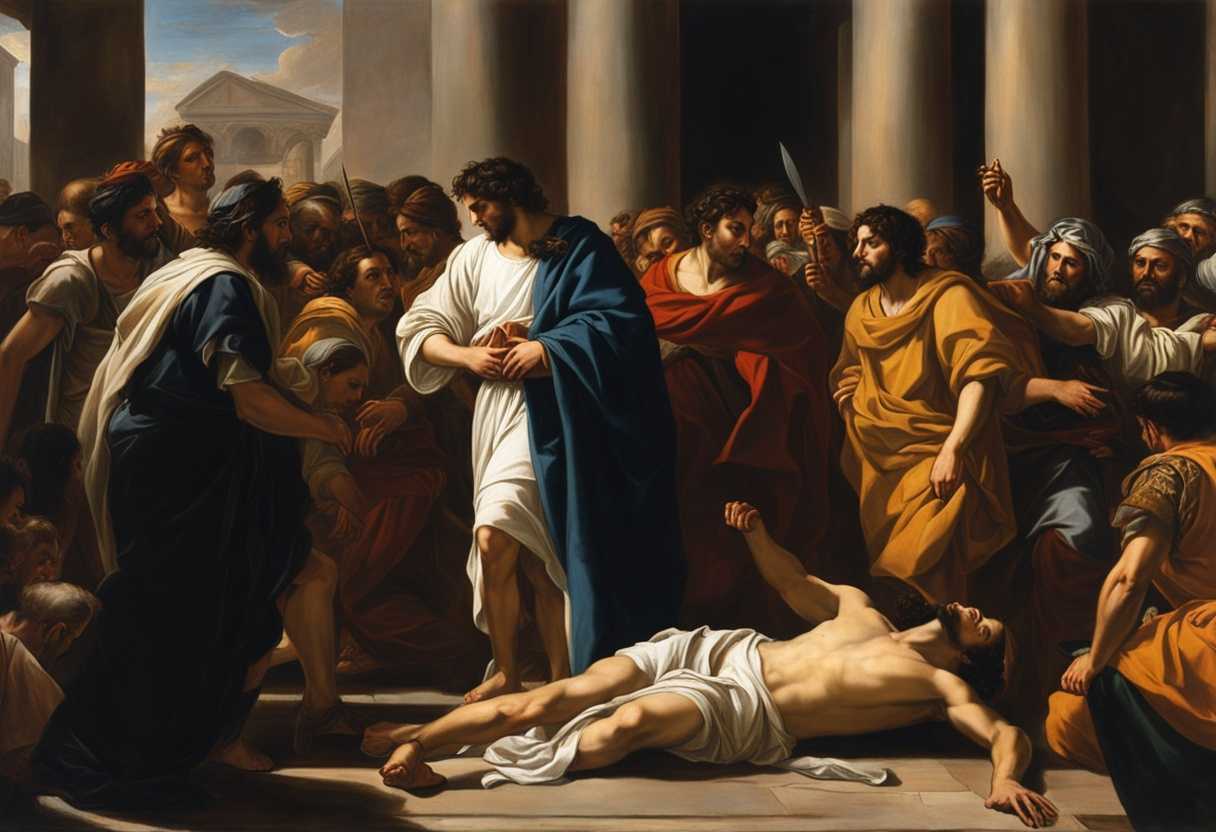
Setting the Scene for Luke 7:1-30
In Luke chapter 7, we find Jesus in the town of Capernaum, a bustling fishing village on the northern shore of the Sea of Galilee. The scene is set in the house of a Roman centurion, a high-ranking officer in the Roman army. The centurion had a servant who was dear to him, and when the servant fell ill and was close to death, the centurion sought out Jesus for help.
As Jesus approached the centurion’s house, a group of Jewish elders came to him on behalf of the centurion, praising his character and explaining that he was a friend to the Jewish people. The centurion, showing great faith, sent word to Jesus saying, “Lord, do not trouble yourself, for I am not worthy to have you come under my roof. Therefore I did not presume to come to you. But say the word, and let my servant be healed.”
Jesus was amazed at the centurion’s faith and spoke the word, healing the servant from a distance. This event not only demonstrated Jesus’ authority over sickness but also highlighted the faith of a Gentile, which was a significant moment in the ministry of Jesus. The scene in the centurion’s house serves as a powerful example of faith and humility, showing that God’s healing power transcends cultural and religious boundaries.
What is Luke 7:1-30 about?
This verse carries a powerful message about faith and humility. The centurion, a Roman soldier, displayed profound faith by recognizing Jesus’s authority and power to heal his servant. Despite not being a part of the Jewish community or religious elite, the centurion’s faith surpasses that of those who were considered to be the keepers of religious knowledge and tradition. Jesus praises this foreigner’s faith, showing that faith transcends boundaries and backgrounds.
Reflect on the contrast between the centurion’s humble acknowledgment of Jesus’s authority and the self-righteousness of the religious leaders. How often do we let our own beliefs or status blind us to the truth that stands before us? This verse challenges us to examine our own faith and humility. Are we willing to set aside our assumptions and prejudices to recognize the power and authority of Jesus in our lives? Let’s strive to embody the centurion’s humility and faith, valuing the truth and presence of Jesus above all else.
Understanding what Luke 7:1-30 really means
In Luke 7:1-30, we delve into a narrative rich with profound encounters and teachings. This passage encapsulates the healing of the centurion’s servant, the raising of the widow’s son, and John the Baptist’s inquiry about Jesus. The diversity of these events showcases Jesus’ compassion, power, and the significance of faith in various contexts.
The account of the centurion’s servant highlights the remarkable faith displayed by a Roman centurion, a man of authority, who believed in Jesus’ ability to heal without needing a physical presence. Jesus acknowledges this exceptional faith, marveling at its depth and expressing that such faith is rare even among the people of Israel. This emphasizes the universal nature of faith, transcending cultural and religious boundaries.
In the subsequent event of raising the widow’s son, Jesus encounters a grieving mother who has lost her only son. Moved by compassion, Jesus performs a miraculous act by bringing the young man back to life. This powerful demonstration not only reveals Jesus’ authority over death but also symbolizes hope and restoration in the midst of despair. It serves as a poignant reminder that Jesus brings new life even in the darkest of circumstances.
John the Baptist’s inquiry from prison about Jesus’ identity as the Messiah adds another layer of depth to this passage. Jesus responds by pointing to His miracles and teachings as evidence of His messianic role. By instructing John’s disciples to witness His works and teachings, Jesus underscores the importance of recognizing and reflecting on the evidence of God’s presence and activity in our lives.
Key phrases such as “I have not found such great faith even in Israel,” “Young man, I say to you, get up!” and “Go back and report to John what you have seen and heard” carry profound meanings that resonate with believers today. These phrases highlight the themes of extraordinary faith, Jesus’ authority over death, and the importance of recognizing the evidence of God’s work in our lives.
The relevance of these events to contemporary audiences is striking. They challenge us to embrace faith that knows no boundaries, find hope in the midst of despair, and seek evidence of God’s presence in our lives. Just as the centurion, the widow, and John the Baptist’s disciples encountered Jesus in transformative ways, we are called to reflect on our own encounters with Him and deepen our relationship with the Savior.
As we ponder the lessons from Luke 7:1-30, let us consider the profound impact of faith, hope, and witnessing Jesus’ works in our lives. May we be inspired by the examples in this passage to cultivate a deeper understanding of Jesus’ teachings, His power to bring life out of death, and the transformative nature of encountering Him. Let us walk in faith, hope, and the assurance that Jesus continues to work miracles in our lives today.
Do we recognize Jesus’ authority and respond in faith?
Various reactions to Jesus’ authority are seen in this passage. The centurion recognized Jesus’ authority and exhibited great faith by trusting that Jesus could heal his servant from a distance. Similarly, the woman who anointed Jesus’ feet with perfume displayed her recognition of Jesus’ authority by showing great love and humility. On the other hand, the Pharisees and experts in the law questioned Jesus’ authority and were skeptical of His actions, ultimately rejecting Him.
This passage prompts us to reflect on our own response to Jesus’ authority in our lives. Do we demonstrate faith and humility like the centurion and the woman, trusting in Jesus’ power to heal and save us? Or do we find ourselves skeptical and questioning, like the Pharisees, hesitant to fully surrender to His authority? Jesus’ authority is real and all-encompassing, and our response to it shapes our relationship with Him. Let us strive to recognize His authority and respond in faith, allowing His power to work in and through us. The key theme in this passage ultimately recognizes Jesus’ authority and elicits different responses. Those who recognize His authority with faith and humility are blessed and receive His grace, while those who doubt or reject His authority miss out on the blessings He offers. Let us respond to Jesus with faith and trust in His authority over all aspects of our lives, heeding the example of the centurion and the woman. We open ourselves up to the transformative power of His love and grace.
Application
Reflect on the faith of the centurion and the humility of John the Baptist in Luke 7:1-30. Let their examples inspire you to examine your own faith and obedience to God. Are you ready to trust Him unconditionally and serve Him with humility? Don’t just listen to the Word, act upon it. Will you rise to the challenge of deepening your faith and embodying the teachings of Jesus in your everyday life?

Reverend Michael Johnson is an experienced Church Minister with a profound expertise in spirituality and guidance. With a serene presence and a compassionate heart, he has faithfully served his congregation for over 20 years, leading them on a spiritual journey towards inner peace and enlightenment. Reverend Johnson’s extensive knowledge of religious philosophies and profound understanding of human nature have made him a trusted confidant and mentor to many, as he seamlessly weaves his profound wisdom into life teachings. Reverend Johnson’s calming demeanor and empathetic nature continue to uplift and heal souls, nurturing a sense of unity and tranquility within his community.